
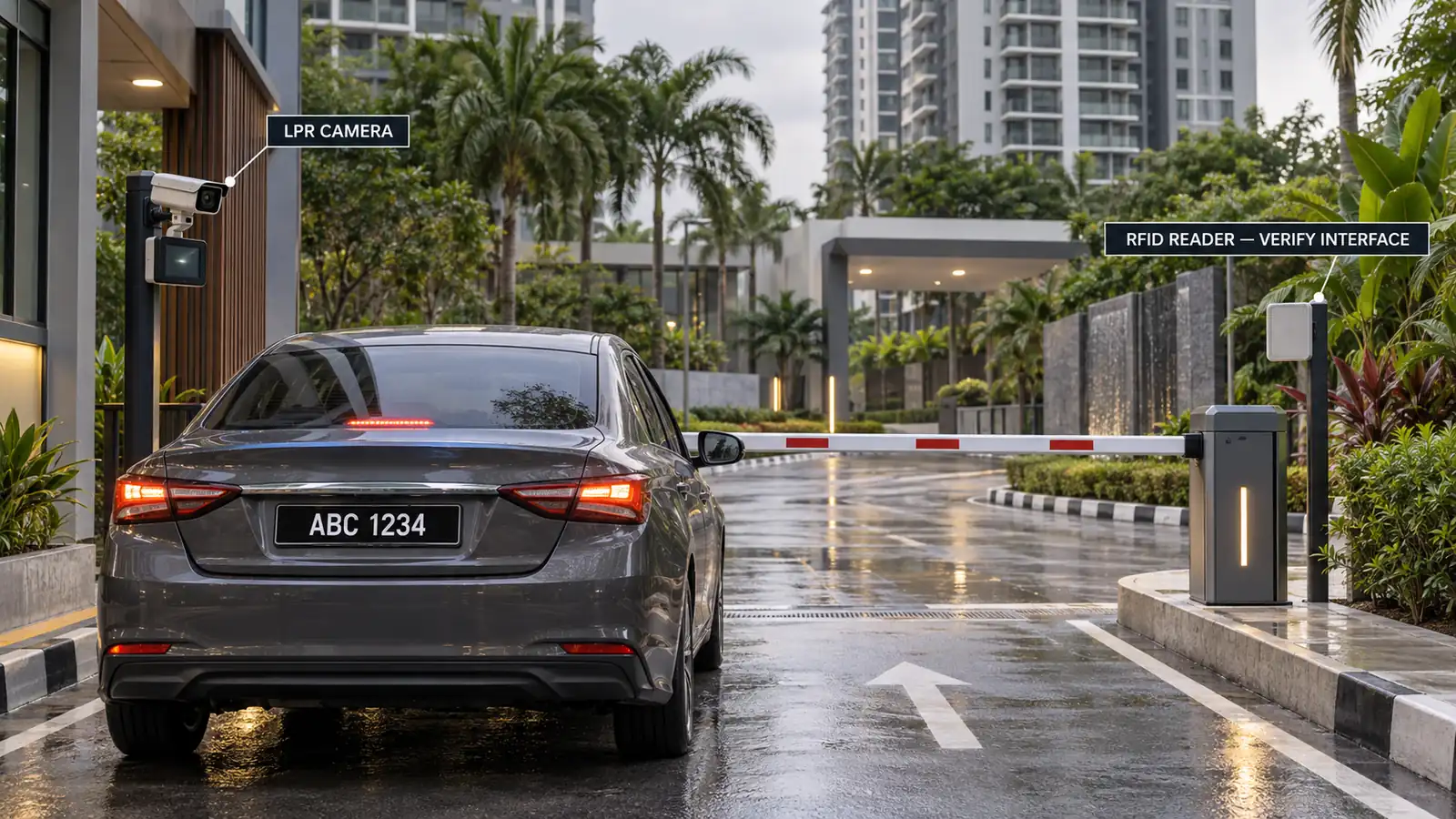
LPR can be the stronger primary credential when a condominium has reliable camera views and wants hands-free access, plate-linked records and software-based vehicle updates. RFID may suit a functioning tag estate or poor camera sightlines. Some properties benefit from a defined hybrid in which one credential is primary and another provides controlled fallback.
The right choice depends less on the label on the equipment and more on how the whole entrance will handle residents, tenants, visitors, motorcycles, unreadable plates, tailgating, network interruptions and database changes.
The Core Difference: The Plate or a Separate Credential
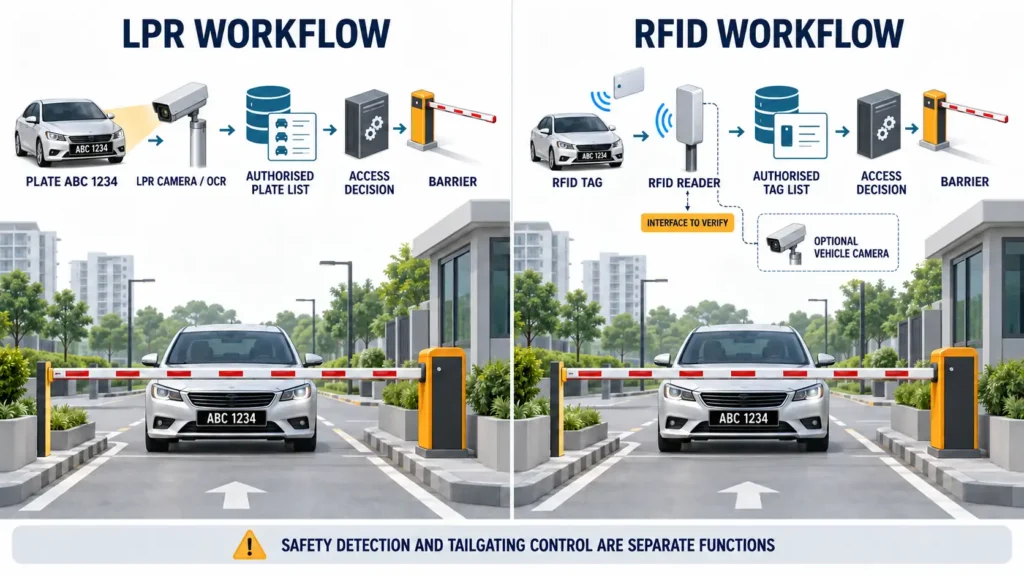
An LPR system—also called licence plate recognition, number plate recognition or ANPR—uses a camera and recognition software to read a vehicle’s registration plate. The parking system compares the result with an authorised list or visitor record and then instructs the barrier to open when the access rule is satisfied.
An RFID system reads a radio-frequency tag, sticker or card assigned to a resident or vehicle. The system decides whether the identifier is valid; it does not inherently confirm that the physical vehicle carrying the credential is the one registered in the management database.
That difference shapes daily administration. With LPR, changing a resident’s vehicle is principally a database task. With RFID, management may also have to issue, activate, recover, replace or deactivate a physical credential.
LPR vs RFID at a Glance
| Decision factor | LPR parking access | RFID parking access | What it means for a condominium |
|---|---|---|---|
| Credential | Vehicle number plate | Tag, sticker or card | LPR can avoid issuing a separate resident credential; RFID depends on credential control |
| Driver action | Normally none after registration | Usually none with a correctly placed long-range tag; cards may require tapping | Confirm the actual read method, not just the word “RFID” |
| Vehicle evidence | Can retain a plate read and associated lane image if configured | Records a tag read; a separate camera is needed for vehicle imagery | Decide what evidence guards need for disputes and exceptions |
| Visitor handling | Plate can be pre-registered for a defined period | Visitor needs a temporary credential or another process | LPR often makes pre-authorised visits easier, but walk-ins still need a workflow |
| Administration | Update plate and access rules in software | Issue, replace and deactivate tags as well as update records | Staff workload matters over the full system life |
| Main failure risks | Dirty, damaged, non-standard or obscured plate; glare, rain, angle or poor capture settings | Missing, damaged, misplaced, transferred or unreadable tag; reader-zone and interference issues | Test with the site’s real vehicles and lane geometry |
| Motorcycles | Requires a planned capture position and database workflow | Requires a suitable tag position and reliable reader geometry | Do not assume a car-lane design will work for motorcycles |
| Best fit | Plate-based access, visitor pre-registration and visual audit needs | Stable resident population, existing RFID estate or difficult camera geometry | A hybrid can preserve current investment while improving control |
Neither technology is automatically secure or reliable in isolation. Barrier detectors, anti-tailgating logic, guard procedures, database permissions, event logs and a safe failure mode are all part of the access-control design.
When LPR Is the Better Primary System
Management wants to avoid a separate resident tag
LPR uses the vehicle’s existing plate as the credential. A resident does not have to collect a sticker, remember a card or move a tag between vehicles. That can reduce physical-credential administration, particularly in larger developments with frequent tenant and vehicle changes.
It does not remove administration entirely. Management still needs an approval process for adding a plate, an expiry process for tenants, rules for multiple vehicles attached to one unit and a way to prevent an old plate from remaining active after a resident moves out.
Guards need plate-linked evidence
A properly configured LPR workflow can give authorised staff a time, lane, recognised plate and associated vehicle image for an access event. That can make it easier to investigate a complaint or compare the vehicle at the barrier with the record on screen. Retention and access should be limited to the property’s operational and legal needs.
Visitor access is frequently pre-arranged
For a scheduled visitor, a resident or management team can register a plate for a defined date, time window or number of entries. The visitor then uses the normal vehicle lane without receiving a physical tag. However, the system still needs explicit paths for ride-hailing vehicles, deliveries, contractors, replacement cars and visitors who enter the wrong plate.
Credential sharing is a recurring problem
An RFID credential can be handed to someone else or moved if its form permits. LPR ties the access decision to the plate presented at the lane, although it should not be described as identity proof or a complete anti-fraud solution. A higher-security property may compare the LPR result with a second credential or use a guard-assisted exception process.
When RFID May Be the More Practical Choice
The existing installation already works
If a condominium has dependable readers, compatible tags, clean resident records and established operating procedures, replacing everything may not create enough value. Management can retain RFID and add cameras or LPR selectively where visual evidence, visitor automation or additional verification is useful.
The camera cannot get a consistent plate view
Sharp turns, short ramps, columns, mixed vehicle paths and insufficient stopping distance can prevent a stable plate capture. Civil work or lane redesign may solve the problem, but RFID may be more practical when a suitable camera position cannot be created, particularly if it avoids lane reconstruction. A site survey should measure the approach path and capture zone rather than relying on a catalogue distance.
Plates and vehicle types are unusually difficult to capture
Malaysia’s Road Transport Department (JPJ) publishes vehicle number-plate specifications and also describes the newer JPJePlate design introduced for the first phase of new zero-emission vehicle registrations. A condominium test set should therefore include the plate formats and vehicle mix that will actually use the site—not only clean, standard passenger-car plates in daylight.
JPJ states that JPJePlate contains embedded RFID for digital identification and enforcement. That does not establish compatibility with a condominium reader or make it a substitute for a separately specified resident-access credential.
RFID can provide a fallback for vehicles whose plates are damaged, obscured or consistently outside the planned camera view. It introduces its own exception cases, so the installer should test tag placement and reads across the same real approach path.
When a Hybrid LPR and RFID Design Helps
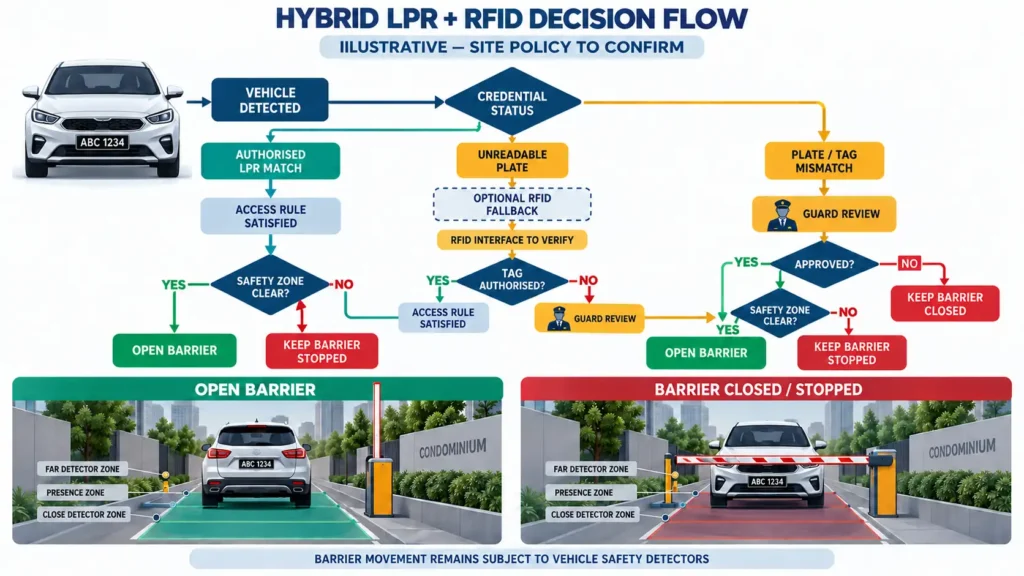
A hybrid system does not mean opening the barrier whenever either reader sees something. It means defining which credential is primary, when the second credential is required and how conflicting results are resolved.
Common policies include:
- LPR primary, RFID fallback: the barrier opens on an authorised plate; a registered tag can be used when the plate cannot be read.
- Two-factor matching: both the plate and tag must belong to the same active record before access is granted. This adds control but may increase false rejections and queue time.
- Different credentials by user type: residents use LPR or RFID, pre-registered visitors use LPR, and unscheduled visitors use QR, intercom or guard approval.
- Phased migration: RFID remains active while LPR is tested, resident records are cleaned and recognition exceptions are measured.
The access controller must also define what happens when the two identifiers disagree. A mismatch should create a clear event for authorised staff; it should not silently become an “open” decision.
Design the Daily Workflows Before Choosing Hardware
A useful proposal should show how each of these journeys works from registration to exit:
- Owner-occupier: who approves the plate, how many vehicles a unit may register and what happens when the vehicle changes.
- Tenant: how access is linked to tenancy dates and revoked at the end of the tenancy.
- Pre-registered visitor: who creates the visit, how long access remains valid and whether re-entry is permitted.
- Unscheduled visitor: where the vehicle waits, how the resident is contacted and who records the approval.
- Delivery and ride-hailing driver: whether drop-off uses a separate lane or time-limited access rule.
- Contractor: which zones and hours are permitted and how repeat visits are audited.
- Motorcycle: where the readable plate or RFID tag passes, how the barrier detects the motorcycle and whether a separate lane is needed.
- Emergency and service vehicle: how authorised staff can open the route without weakening normal access control.
- Failed recognition or lost tag: how the driver receives help without reversing into a queue.
If a vendor cannot demonstrate these workflows, a high recognition percentage or long RFID read range does not resolve the operational gap.
Test Both Options in the Actual Lane
Test LPR with representative Malaysian plates, motorcycles, relevant lighting and weather, and realistic following distances. Test the approved RFID tag and mounting position across vehicle types, approach angles and adjacent lanes. For either method, verify safety detectors, tailgating, manual override, outages, synchronisation and logs. Use the detailed Malaysia LPR site-acceptance checklist for the full protocol.
Include Data Governance in the Project Scope
Both systems can create access records linked to residents; LPR may additionally process plate text, timestamps and vehicle images. Malaysia’s Personal Data Protection Commissioner states that the Personal Data Protection Act 2010 applies to people who process, control or authorise the processing of personal data in connection with commercial transactions, subject to the Act’s scope and exceptions. Project owners should obtain appropriate Malaysian legal or data-protection advice for their circumstances rather than relying on an equipment supplier to make the compliance decision.
Before go-live, document:
- the operational purpose for collecting each data field;
- the notice provided to drivers where required;
- which organisation is the data controller and which suppliers process data on its behalf;
- user roles and access approval;
- retention and secure deletion rules;
- whether data or support access crosses national borders;
- incident response, backup and audit-log procedures; and
- what data residents or visitors can view or correct through the approved process.
These questions belong in the contract and system design, not only in a privacy policy drafted after installation.
A Practical Recommendation by Site Type
Choose LPR as the primary credential when the property has a workable camera view, wants hands-free resident access, regularly changes authorised vehicles, pre-registers visitors and benefits from plate-linked event evidence.
Choose RFID as the primary credential when the current system is reliable, the resident population and credentials are stable, visual capture is structurally difficult or the project deliberately needs a simple credential-based workflow.
Choose a hybrid system when uninterrupted access and exception handling matter more than technological purity, or when management wants to migrate from an existing RFID system in controlled stages. Specify the decision rules so that “hybrid” does not become an uncontrolled collection of readers.
Shunjie’s verified public product range includes ANPR cameras, ALPR display terminals and rapid barrier gates. Shunjie is a manufacturer based in Huizhou, China, not a Malaysia-based parking operator. Compatibility with a separate RFID access reader or controller must be verified against the proposed models, protocols and interface documents. A Malaysian deployment should also define who will conduct the site survey, civil and electrical work, local integration, commissioning, user training and on-site support.
For a useful technical proposal, provide the lane drawing, number of resident vehicles, peak vehicle flow, visitor process, motorcycle volume, existing or proposed RFID equipment, required integrations and the Malaysian plate samples to be tested. Then send the project details to Shunjie for an LPR equipment configuration and an interface-requirements review. The local integrator should confirm the complete RFID and site workflow.