Choose an outdoor barrier gate by matching the complete assembly to the site’s heat, water and corrosion exposures. Check the required operating pattern during hot periods, the actual routes by which water can reach the equipment, and the material and finish system for the local exposure. An IP label or a salt-spray-hour figure answers only part of that assessment.
This checklist helps buyers, distributors and integrators prepare a useful environmental brief before ordering. Use it with the general parking barrier selection guide when the arm type, lane layout and access-control arrangement also need review.
Describe the exposure at the barrier position
A country name or the word “outdoor” is not a complete specification. Two entrances at the same property can have different shade, runoff, shelter and salt exposure. Record conditions at the proposed cabinet, boom and accessory locations, and distinguish observations from design assumptions.
| Site input | What to send | What the supplier should address |
|---|---|---|
| Heat and direct sun | Expected ambient conditions during use, data source, sun/shade photographs and operating hours | Applicable temperature definition and operating limits for the proposed configuration |
| Rain, spray and cleaning | Exposure directions, nearby sprinklers or splash sources and intended cleaning method | Relevant enclosure protection and installation conditions |
| Runoff and accumulated water | Ground levels, water routes, high-water history and drainage arrangements | Approved cabinet location, foundation and cable-entry details |
| Coastal or corrosive exposure | Sea-spray exposure, prevailing conditions, shelter and relevant local pollution | Material/finish schedule, supporting evidence and care requirements |
| Wind and boom load | Site exposure, arm type and length, skirts, signs and other attachments | Approved assembly, operating restrictions and any storm procedure |
| Service access | Who can inspect, clean and repair the installation, and how the lane remains controlled | Practical maintenance and fault-response responsibilities |
Check the hot-period workload, not only the temperature range
A stated operating-temperature range does not, by itself, establish the highest operating frequency throughout that range. Ask whether a quoted limit refers to ambient air, the enclosure interior or another measurement point, and what load and settings apply.
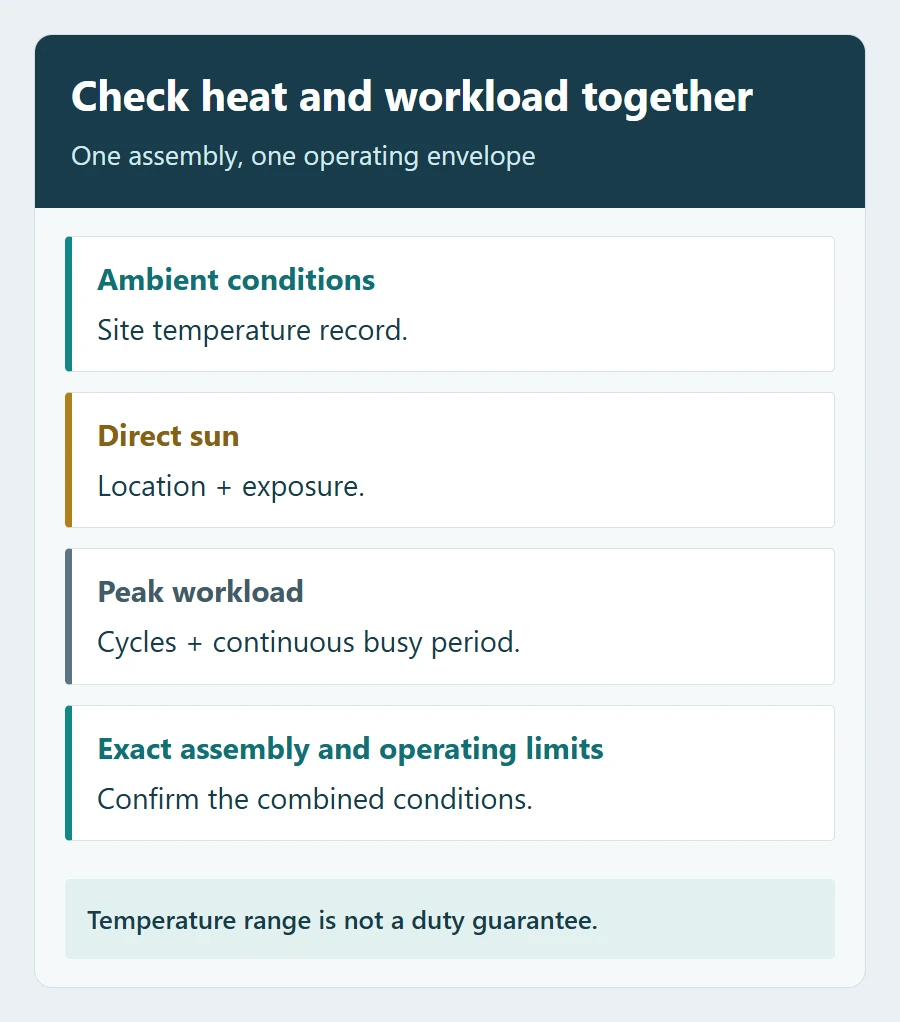
Give the supplier the intended arm, accessories, opening and closing settings, and the busiest sustained operating period. Ask for confirmation that this combination suits the expected hot-period conditions, including direct sun. A short demonstration on a mild day does not answer that question.
If shading, ventilation, a different drive or another environmental option is proposed, obtain the manufacturer’s approved arrangement. It must preserve access for service, the required movement space and the relevant protection claims. Do not assume that adding a cover, opening a door or drilling ventilation holes is an acceptable way to increase capacity.
The useful purchasing response is a documented operating envelope: the proposed configuration, applicable conditions, any reduced frequency or required pauses, and the response to a protective stop. Keep thermal protection active and follow the equipment instructions if abnormal operation occurs.
Separate rain exposure, cleaning jets and standing water
Request the full IP code and the evidence relevant to the actual enclosure and installed configuration. IP describes enclosure ingress protection. The code’s solid-object/dust and water elements should not be treated as a general guarantee of weather life, corrosion resistance or flood suitability.
Intertek’s explanation of IP testing distinguishes splashing, water jets and immersion as different water categories. Use those distinctions to describe the site, rather than choosing a single IP number for every outdoor lane. Ask which declared tests cover the intended exposure; do not turn an immersion statement into permission for an unapproved pressure-washing method.
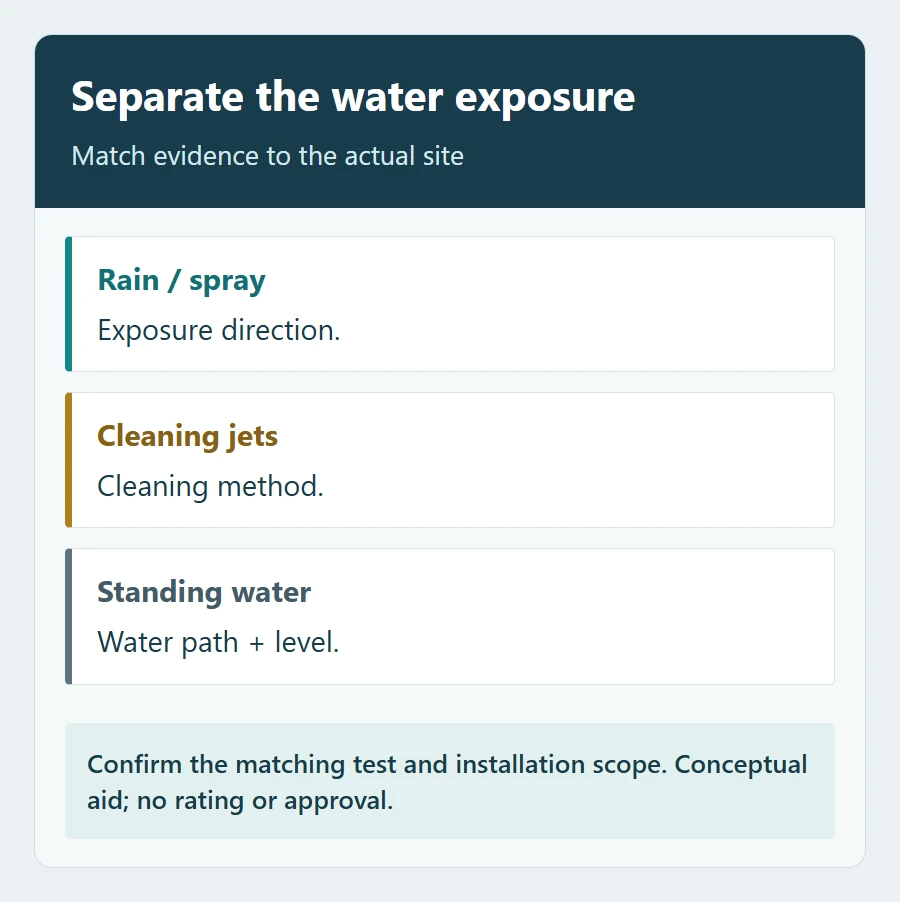
Check the scope of the evidence. A cabinet claim does not automatically cover a separately mounted camera, display, junction box, connector or other accessory. Keep the enclosure and accessory evidence identifiable in the quotation and handover record. Ask whether the report or declaration applies to the offered assembly, its openings and fitted components, and the installation conditions that must be maintained.
Follow the water route through the installed site
Heavy rain can create splash at one location and accumulated water at another. Review the slope and runoff around the cabinet, nearby drains, the cabinet door and base, and the routes used by cables and conduits. Include known high-water marks or photographs if the entrance has flooded before.
Ask the installer and supplier to agree the location, foundation, entry seals and drainage details using the selected equipment drawings. The article does not prescribe a universal raised-base height or a new drain hole. Site changes to openings, glands, vents or seals need approval against the equipment instructions and the protection being claimed.
If standing water or inundation remains credible at the proposed position, resolve that exposure before order release. An “outdoor” description should not be used to close an unanswered flooding question.
For a coastal site, specify the corrosion-protection system
Look beyond the cabinet colour and a broad “anti-rust” or “stainless” label. Request the actual substrate or material grade, surface preparation and coating system, plus the specified finish details where applicable. Include exposed hinges, locks, anchors, fasteners, arm attachments, edges and cutouts in the discussion.
Ask how the offered material combination, finish damage and any field modifications are handled. A cabinet panel’s evidence does not automatically establish the condition of every exposed component. Keep the approved cleaning and repair methods with the installation documents.
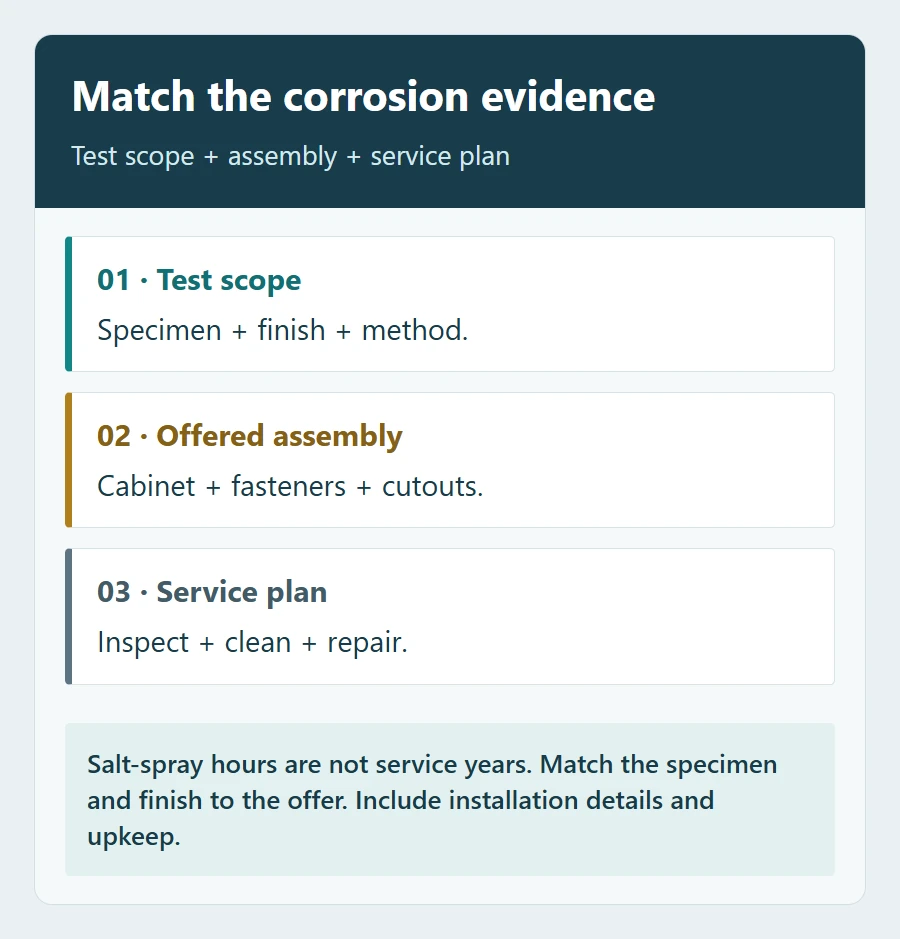
Read salt-spray hours with the report
A useful report identifies the test method, specimen, material and finish, exposure duration and evaluation criteria. ISO 9227’s published scope makes clear that product-specific exposure periods and interpretation need their own specifications, and that its salt-spray methods are not a means of predicting long-term corrosion resistance.
Do not convert a quoted number of test hours into guaranteed years outdoors. Likewise, distance from the sea alone is not a sufficient pass/fail rule for a coastal installation. Describe the actual salt exposure, shelter, wetting and relevant pollution, then ask for a suitable configuration and supporting evidence against that brief.
Where the project specifies a corrosivity category, coating standard or particular test requirement, pass the exact document and revision to the supplier. Have the responsible project team resolve applicability and acceptance criteria; do not infer compliance from a similar-looking product.
Review wind with the exact boom and attachments
Give the supplier the actual arm length and type, together with any skirt, advertising panel, lighting or other attachments. Ask which wind conditions and operating restrictions apply to that combination. A limit for a plain straight arm should not be transferred to a different arm assembly without confirmation.
Agree who decides when operation must stop, how the lane will be managed and what the manufacturer requires after severe weather. Do not invent a universal wind-speed threshold or an automatic storm position. Those decisions belong to the selected equipment and the site’s risk assessment.
Keep installation and maintenance inside the agreed scope
Record who preserves the specified protection when foundations, conduits, glands and accessories are installed. If a contractor changes an opening, coating, fastener or accessory after approval, review the affected environmental evidence before accepting the change.
Arrange practical access for inspection, cleaning and finish-damage repair using the selected model’s instructions and the site’s exposure. Do not impose one calendar schedule on every climate. The service handover should identify responsible people, approved methods, wear or damage requiring attention, and how the entrance is controlled during work.
At commissioning, check the documented configuration, installation details, operating response and service records. Follow manufacturer-approved checks; do not improvise a hose, pressure-wash, immersion or accelerated-corrosion test on an installed electrical barrier. If a season or exposure cannot be represented at handover, record the supporting evidence and the remaining review instead of claiming it was tested.
Send one environmental brief with the quotation request
Submit the site table with the required arm and operating pattern. Ask the supplier to return the proposed drive/arm/finish configuration, the applicable environmental evidence, the installation conditions and the maintenance responsibilities. Each exception should have an owner and a resolution before order release.
SHUNJIE’s barrier gate range is a starting point for that configuration discussion. Provide the site location, sun and water exposure, coastal conditions, arm details and busiest operating period so the recommendation can address the complete assembly.
The purchasing decision should leave three clear answers: can the proposed barrier operate under the expected hot-period load, is its installed water protection appropriate, and is the corrosion-protection and service plan suitable for the exposure? Keep any unanswered item open until the relevant evidence or design change resolves it.
Featured image: AI-generated planning illustration. This generic coastal scene is not a SHUNJIE project photograph, an installation design or evidence of weather resistance.
Featured image: AI-generated planning illustration. This generic coastal scene is not a SHUNJIE project photograph, an installation design or evidence of weather resistance.