
A fast boom arm can open in time and still leave drivers waiting. A car may spend much longer waiting for its plate to be read, its entry to be approved, the driver ahead to move, or space to open up beyond the gate. A queue grows whenever vehicles arrive faster than the entrance can move them through, even if that happens for only a few minutes.
Start with two counts during the rush: how many vehicles reach the back of the approach, and how many make it past the barrier. Then watch where the next vehicle stops. Those observations tell you whether to spread arrivals, change the way drivers are processed, or change the layout.
What happens between arrival and clearance?
- Arrival and approach. Count the vehicle when it joins the entrance approach. A driver may already be waiting well before reaching a camera or ticket machine.
- Recognition. Record when the system obtains a usable plate, card, ticket or QR code. ANPR, or automatic number plate recognition, may read a plate before the car stops. Watch for repeated reads, drivers stopping in the wrong place or a delay while they find a credential.
- Permission. Check when the system or staff confirm that the vehicle can enter and when an open command is issued. A plate can be read correctly while the driver waits for a booking, permission list or entry payment to be checked.
- Arm movement and driver response. Record when the arm starts and reaches the position that permits passage, then when the driver begins to move. If the driver stays stopped, check what signal they can see and whether the path ahead is clear.
- Passage and readiness. Mark when the rear of the vehicle passes a fixed point beyond the controlled area. Observe when the lane is ready for the next vehicle. The detection and closing sequence can matter even with a fast opening stroke.
Compare video and event logs using the same clock when possible. Some events overlap. For example, the next plate may be read while the preceding vehicle is clearing the lane. Use the actual sequence to locate the wait and measure the time between completed passages directly.
How to measure the lane during a real rush
Pick a busy period and use short intervals, such as five minutes. Agree on two count points and use them for every interval. Count arrivals upstream of the gate, far enough back to see new arrivals. Count completed passages at the point beyond the control area. If the queue extends past the arrival point, observe farther upstream as well and note that the queue reached the street, crossing or junction. A count taken at a blocked approach can miss demand that was held back or turned away.
When a line of cars is present and the road beyond the gate is clear, time the gap from one vehicle’s rear passing the same point to the next vehicle’s rear passing it. This gap is called headway. For example, 21 clearance timestamps give 20 gaps. Keep the ordinary slow transactions and assisted entries in your main record. Label retries, help requests and any downstream blockage so you can see what drove the longer gaps. Gaps during quiet periods include time with nobody waiting.
Record the longest line you can see, when it starts to shrink, and where it reaches. Count vehicles that turn away or are redirected separately. Repeat on a comparable peak after a change, using the same count points and noting changes in vehicle mix, staffing and weather. A busier or quieter day can otherwise make a fix appear better or worse than it was.
Example: a queue that forms in the first five minutes
Suppose a single entry starts clear and 48 vehicles arrive over 15 minutes. The lane completes 12 passages in each five-minute block, or 36 altogether. That is consistent with about 25 seconds between completed passages while the lane is continuously busy. Assume all arrivals are counted and nobody leaves the approach except through the gate.
In this example, 24 cars arrive in the first five minutes and 12 arrive in each of the next two intervals. After five minutes, 12 vehicles are still between the count points. With arrivals and passages then running at the same rate, 12 are still there at minute 10 and minute 15. These are counts at the five-minute marks and can include the car being processed. The line may be longer between those marks.
Now suppose quicker approvals and faster handling of exceptions let the same lane complete 16 passages per five minutes under the same arrival pattern. Eight vehicles still remain after five minutes, four after ten, and none after 15. The first surge still needs room. If there is room for only a few waiting vehicles before the driveway meets the street, staggering arrivals or providing more usable queue space may still be needed.

For a quick comparison, 3,600 seconds divided by a measured mean headway of 25 seconds is about 144 vehicles per hour if those conditions hold for a full hour. Use the actual short-interval counts and available space to plan the entrance. The calculation assumes continuous demand and comparable processing and clearance conditions.
Match the first fix to where vehicles wait
Watch several ordinary vehicles and several delayed vehicles before choosing a fix.
| What you see | Where to check | What to try |
|---|---|---|
| A long line forms at shift change or before an event, although cars move through steadily | Count arrivals in short blocks upstream and compare with completed passages. | Stagger groups or appointment slots and recheck the busiest block. |
| Cars stop twice, creep forward or reverse to get a read | Compare the capture position with the driver’s actual stopping point, including after dark. | Check alignment and lighting with the integrator. Make the correct stopping position clear. |
| A good read is followed by a long wait for approval | Compare the read, approval and open-command times. Check unregistered guests, help calls or entry payments. | Pre-register known visitors. Give exceptions a safe staffed pull-off where one fits. Move any payment still made at entry to prepayment or a separate location if the system and site support it. |
| The arm is up and the path is clear, but drivers wait | Observe what the driver sees from the seat, including display and lane signals. | Make the approved, wait and call-for-help instructions clear before the driver has to decide. |
| The next car is ready, but the lane is still completing the last passage | Compare rear clearance, safe closing or reset, and the next permitted opening. Check for a real vehicle or obstruction in the detection area. | Have the installer check detection, controller settings and the arm configuration against the equipment guidance. Keep protective detection in service. |
| Cars have permission but cannot move through the open gate | Look beyond the boom for a ramp, pedestrian crossing, merge, occupied drop-off or traffic searching for spaces. | Clear the downstream bottleneck or redirect traffic before adding gate capacity. |
When should you add a lane?
Spread demand when the existing lane keeps moving but arrivals bunch up. Try staggered visitor bookings, delivery slots or shift arrivals where you control them. For unscheduled public traffic, use early directions to other available entrances or parking areas. Confirm that the alternate entrance can accept those drivers.
Separate slow transactions when a few cases hold up the rest. A signed pull-off can let staff resolve an unregistered plate or lost credential while the main entrance keeps moving. Give drivers a choice before they reach the queue. Check that the pull-off has room and a safe route back. A dedicated fast lane helps only while its users can reach it and the other lane can handle its assigned traffic.
Add usable capacity when adjusted demand still exceeds observed throughput for long enough to create an unacceptable queue, or when even a short burst reaches a public road or crosses another movement. Check that drivers can reach both lane mouths, authorisations can be processed in parallel, and the ramp, crossing or merge after the gates can take the combined flow. Measure how much space vehicles can actually wait in on site and allow for the vehicle mix. If a shared entry road or downstream pinch point sets the limit, address that section first. Before making permanent lane changes, review storage, turning movements and pedestrian routes with the site’s designer.
When equipment is the limiting step, compare the proposed arm and its operating time in the barrier gate range and check the exact configuration’s permitted workload in the barrier duty-cycle guide. For driver prompts, see the plate recognition and display terminals. If repeated reads dominate, check the options for unreadable, missing or temporary plates.
For a layout or equipment review, share a peak-period count by interval, a plan showing the two count points and available queue space, a few timed passages and a tally of why drivers needed help. Those records let SHUNJIE and your integrator discuss the part of the entrance that needs to change.
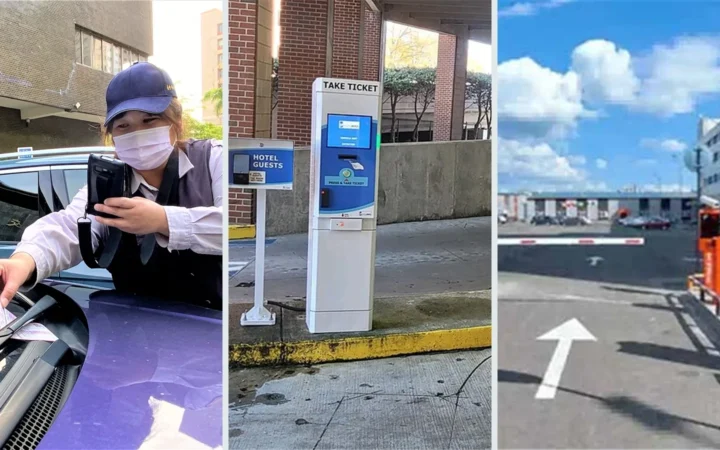
Featured image: A raised arm is one part of admission. Vehicles still need permission, time to move and space beyond the gate.