
A useful parking access control RFQ tells suppliers which lanes must work, how vehicles should be admitted, what equipment will be retained, and who will connect the remaining parts. It also asks every supplier to return the same information: an exact configuration, clear scope boundaries, interface evidence and a test plan.
Use the template below when requesting equipment or an integrated proposal. It is designed for distributors, system integrators and project buyers. Copy the tables into your procurement document, complete the answer fields, and send the same revision to each bidder. The blank answer lines are intentional fields for your project; they are not recommended specifications.
Define the purchase before filling in the equipment list
Write one sentence describing the required operating result. For example: “Provide controlled entry for approved employees and a staffed exception process for visitors at two existing vehicle lanes.” This is an illustrative brief, not a SHUNJIE package or a completed project.
Then identify whether the request covers equipment supply, equipment with software integration, or an installed and commissioned system. Name the buyer, operator, local installer and existing software provider where known. A factory quotation does not, by itself, establish who will complete local works or support the finished installation.
Keep the first issue manageable. A supplier can review a preliminary brief with unknowns clearly marked. A firm order should resolve the unknowns that affect equipment suitability, interfaces, safety or the included price.
Copy the project brief
Complete this once per project. Use document names and revision dates when referring to attachments. If an item does not apply, write “Not applicable” and explain briefly; do not leave a supplier to infer your intended scope.
| Field | Information to provide | Your answer |
|---|---|---|
| Project and destination | Site type, country, city, delivery destination, project contact and RFQ revision. | ___ |
| Purchase boundary | Equipment supply, integration or complete installation; identify work already awarded to others. | ___ |
| Users and access rules | Employees, residents, visitors or contractors; operating hours, temporary access and exception approval. | ___ |
| Vehicle identification | ANPR/LPR, RFID, ticket, QR or combinations; countries and plate types if recognition is required. | ___ |
| Payment, if required | Where payment occurs, currency, named provider if selected, tariff examples, refunds and report requirements. | ___ |
| Existing systems | Software name/version, device models/firmware, responsible providers and available interface documentation. | ___ |
| IT and data | Hosting preference, network owner, account roles, retention/export needs and approved remote-support method. | ___ |
| Delivery and support | Required opening date, installation windows, training language, local attendance, spares and support hours. | ___ |
| Commercial response | Response deadline and time zone; quotation currency, delivery basis, tax treatment, validity, payment milestones and recurring-charge period. | ___ |
For payment projects, describe the outcome rather than listing card or wallet logos. Identify who will arrange the merchant account, connect the provider, confirm successful payment to the parking system and investigate a disputed transaction. Ask the relevant parties to confirm the proposed country, provider and configuration in writing.
Add one sheet for each physical lane
Give every lane a stable identifier, such as ENTRY-01 or EXIT-01, and use it on the drawing, equipment schedule, quotation and test record. Do not combine dissimilar lanes into a single average.
| Lane field | Record with units or evidence | Your answer |
|---|---|---|
| Identity and direction | Lane ID; entry, exit or controlled two-way use; driver approach and stopping position. | ___ |
| Available space | Clear lane width and overhead clearance in m or mm; queue space; cabinet/service access. Mark measured versus estimated. | ___ |
| Vehicles and traffic | Cars, motorcycles, vans, trucks or trailers; observed peak vehicles/hour and observation period; daily operating hours. | ___ |
| Recognition conditions | Approach speed in km/h or mph, front/rear plate view, lighting, glare, weather exposure and representative permitted samples. | ___ |
| Equipment to retain | Model labels, firmware, condition, known faults, controller connections and the person who will approve reuse. | ___ |
| Power and communications | Available supply in V/Hz, network connection and location, estimated cable route lengths in m, and survey owner. | ___ |
| Physical constraints | Existing bases/ducts, drainage, mounting space, pedestrian routes, nearby doors and permitted work hours. | ___ |
| Attachments | Plan revision, approach/side photographs, dimension sketch and equipment labels, all linked to this lane ID. | ___ |
Request foundation and clearance drawings for the exact proposed model and arm arrangement. Magnetic’s planning library, for example, separates model configurations, left/right arrangements and foundation documents. Its drawings illustrate the need for configuration-specific information; they are not installation dimensions for SHUNJIE equipment.
Handle unknowns as actions. Record the missing fact, who will confirm it, the due date and the quotation assumption. For example: “ENTRY-01 overhead clearance unknown; local installer to measure before design approval; quoted arm arrangement remains provisional.” Never turn a missing measurement into an invented specification.
Describe the journeys the equipment must support
Attach a short sequence for each important user group: arrival, identification, authorization or payment, release, passage and the final record. Include the failure path. What happens when a visitor is not recognized, an account has expired or payment cannot be confirmed? Name the operator who can approve an exception and the record that must remain.
Keep requirements testable. Replace “fast, reliable access” with the operating conditions and measurements the supplier must propose for approval. Separate plate capture, full-character reading, access decisions and completed passage. An accuracy headline cannot stand in for all four.
Where performance targets are not yet agreed, request a proposed test method, representative sample and pass criteria with the quotation. State which vehicle and plate groups must be included, and require failures and manual interventions to remain in the results. Do not manufacture a percentage to make the RFQ look complete.
Assign an owner and proof to every interface
“Supports integration” is too broad to close a procurement question. Axis’s License Plate Verifier documentation describes separate event-push and relay or internal-I/O arrangements. This is one product example of distinct functions, not evidence that another camera offers the same interfaces.
Ask bidders to complete the following matrix for the proposed models and versions. One company may fill several roles, but every row still needs a named owner and a demonstration of the required result.
| Connection or function | Responsibility to name | Evidence to request |
|---|---|---|
| Recognition event to software | Event producer and receiving application owner. | Versioned message example; lane identity, timestamps and handling of repeated or corrected events. |
| Access decision and lists | System that owns permissions and the team maintaining them. | Allowed, expired and unknown-credential results; update and revocation test. |
| Release command and status | Command source, barrier-controller installer and feedback recipient. | Supported interface description and test separating a sent command from observed barrier state. |
| Payment to exit permission | Payment provider, parking software owner and integration lead. | One payment linked to the correct stay; failed/repeated notification handling and reconciliation record. |
| Failure and recovery | Owner of each affected device, network and service. | Declared behavior for internet, local network, server and power loss, tested separately. |
Request the relevant interface document revision, licensing conditions and integration charges alongside the hardware model. Share access credentials through an approved secure process, not in the general RFQ. A video stream, a connector label or an open-command acknowledgment alone does not prove the full workflow.
Make suppliers answer against the same scope
Assign a requirement ID to each deliverable. Ask every supplier to preserve those IDs and add its quotation line reference. Use these four statuses consistently:
| Status | Meaning in the response | What must accompany it |
|---|---|---|
| Included | Covered by the stated base quotation. | Exact configuration, quantity, deliverable and accountable party. |
| Priced option | Separately offered; not assumed in the base total. | Additional price, dependencies and effect on delivery or operation. |
| By others | Required work allocated outside this supplier’s scope. | Named provider, approval owner and required completion date. |
| Excluded | Not offered in this quotation. | Reason and impact; required work needs another agreed owner before order. |
For each row, collect the proposed model/version, quantity, status, responsible organization, evidence reference, one-time charge and recurring-charge basis. Require an explicit “none” where no recurring charge applies. An unanswered field is unresolved, not free.
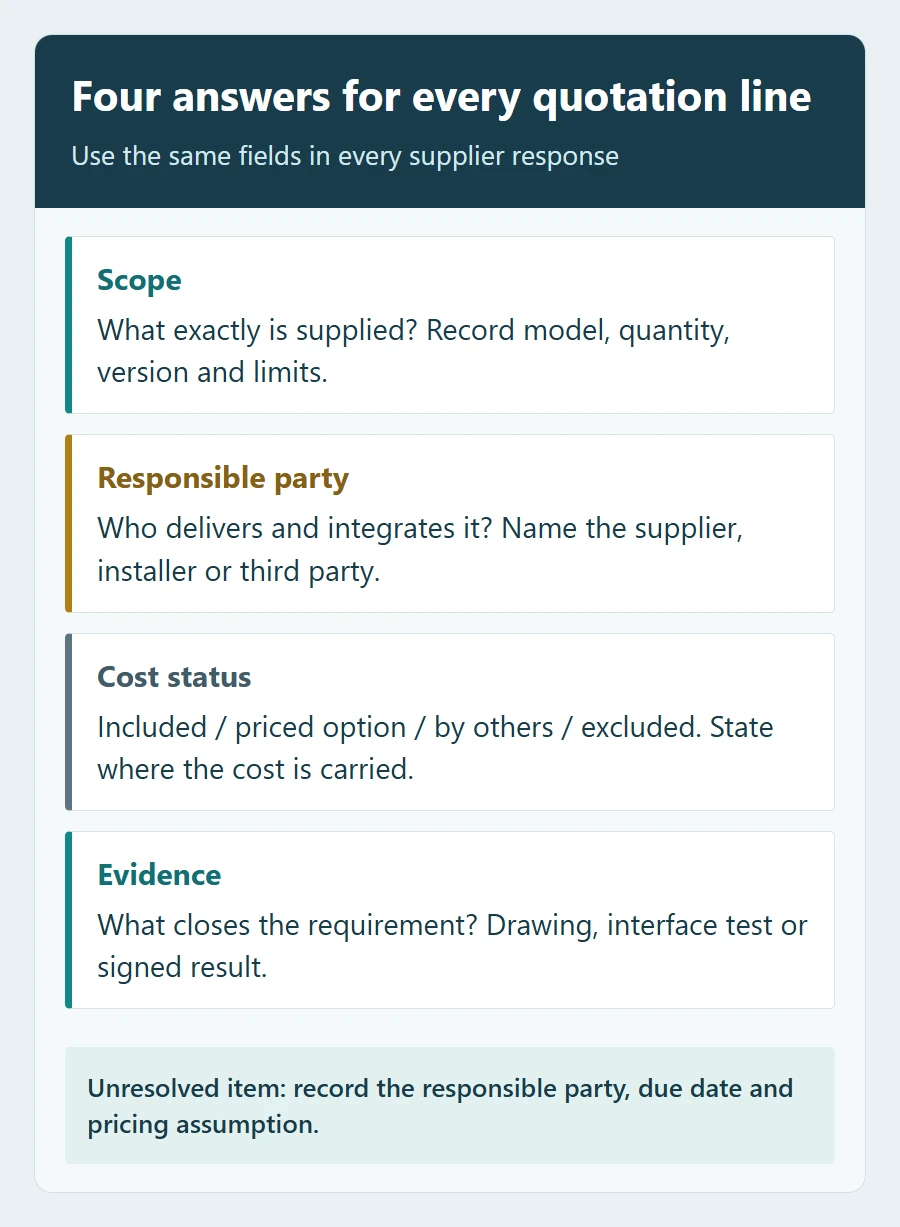
Include equipment and accessories, software/configuration, interfaces, local civil/electrical/network work, delivery, commissioning, documents, training and support. Keep warranty coverage separate from preventive maintenance and on-site response. Do not assume remote assistance includes a local visit.
When proposals arrive, first check that they answer the same RFQ revision and lane schedule. Resolve a missing interface owner or an incompatible retained device before comparing totals. For a separate budget worksheet and ownership-cost discussion, see our LPR quotation and TCO guide for Malaysia; its local cost treatment must be adapted for other destinations.
Agree what will be proved before shipment and on site
A factory acceptance test (FAT) can check the agreed equipment and configuration in a representative setup. It cannot establish the final site’s lighting, measurements, wiring or operational conditions. Loudoun County’s PARCS specification, section 3.5, separates a pre-installation mockup from installed-lane testing.
Site acceptance should also examine the connected operation. The Reading Parking Authority’s RFP, pages 54–55, distinguishes facility-level SAT from individual lane tests. These are project examples; their durations and contractual thresholds are not universal requirements.
| Proposed test | Before shipment | At the actual site |
|---|---|---|
| Approved and denied access | Demonstrate agreed permissions and event records using identified equipment/software versions. | Repeat for the installed lanes, user groups and representative vehicles. |
| Recognition to completed passage | Check message mapping and control sequence; identify simulated dependencies. | Check real approach, day/night conditions, physical passage and resulting records. |
| Paid exit, if included | Demonstrate available payment test integration and declared limitations. | Verify the approved local payment workflow, release decision and reporting. |
| Interruption and recovery | Check supported failure behavior under an agreed controlled test. | Repeat approved outage scenarios and verify recovery without unexplained missing or duplicate records. |
For each test, agree the setup, action, expected result, sample or duration, witness and evidence to retain. Log defects with an owner and retest date. Keep simulated or unavailable dependencies open rather than treating them as passed. Safety design and validation require the selected equipment instructions and competent local personnel; this procurement table does not replace them.
Include configuration backups, as-built drawings, interface documentation, operator training and support contacts in the handover list. Decide who approves each item before the equipment is ordered.
Send a brief that the supplier can answer
Use this message with your completed project and lane sheets:
Please review the attached parking access project brief, lane sheets and attachment index. Quote against the stated RFQ revision and retain our requirement IDs in your response.
For each deliverable, identify the exact equipment/software configuration, quantity, scope status, responsible party and supporting document. Separate one-time charges, recurring charges and priced options. List assumptions and questions explicitly, including any site survey or third-party approval needed before order.
Please propose the pre-shipment and site tests needed to demonstrate the requested operation, and identify anything that cannot yet be verified. Include delivery conditions, documentation, training, spares and support scope in your response.
For a SHUNJIE equipment enquiry, use the ANPR camera page’s quotation form to share the project summary, lane count, destination, existing equipment and integration requirements. Reference your drawings and test requirements in the message. Ask for confirmation of the proposed configuration and the factory’s scope, with local installation and third-party responsibilities identified separately.
Featured image: AI-generated illustration with generic equipment and a simulated UK-format plate. Not an actual SHUNJIE installation or a recognition test.
Featured image: AI-generated illustration with generic equipment and a simulated UK-format plate. Not an actual SHUNJIE installation or a recognition test.