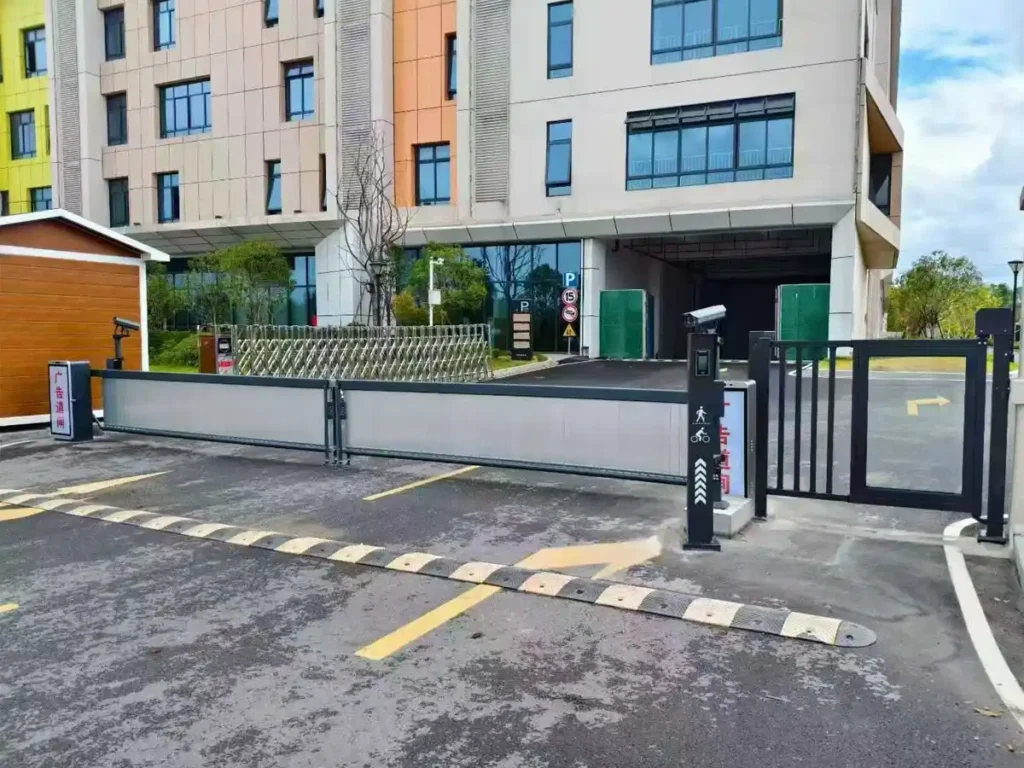
A residential or commercial entrance needs more than an opening gate. Its vehicle lane, pedestrian route, cameras, readers and operating rules must work together. The pictured entrance shows barriers, recognition equipment, lane markings and a separate pedestrian gate; it does not establish the capabilities of the software behind them.
For property managers, the task is to coordinate vehicle access and people access without treating the two as identical. Start with who uses each route, what permissions are required and how exceptions will be handled.
1. Automatic vehicle entry and exit management
Guards, cards, remote controls and manual registration remain useful in some situations. Repeated manual checks, lost credentials and peak-hour queues are reasons to consider LPR/ANPR, but automation must fit the site’s operating rules.
- When a vehicle reaches the reading position, the camera captures the plate and the recognition software returns its text.
- The access system checks the result against configured permission lists or a vehicle database.
- If permission and the controller’s operating conditions allow it, an opening request is issued and the entry event is recorded.
- At exit, a corresponding event can support session matching, fee calculation and reporting where the selected software includes those functions.
Possible benefits include fewer routine stops, fewer manual checks and more traceable access decisions. These are not automatic guarantees of shorter queues or prevention of every unauthorised entry. Record unreadable plates, denied access and manual overrides so that staff can resolve exceptions.
2. People access with a separate route
A shared approach can expose pedestrians to moving vehicles or barriers. A separate pedestrian gate can help organise movement, but the whole route—including waiting space, crossing points and emergency escape—still needs a site-specific review.
Pedestrian access can be specified with:
- A suitable pedestrian gate, swing gate or turnstile chosen for the required passage width and users.
- Card, QR, PIN or face access where supported by the chosen reader, controller and project requirements.
- Visitor permissions and time-based rules in the access software.
- Entry and exit records with appropriate operator access and retention arrangements.
The intended result is clearer movement for residents, staff and visitors, better peak-hour order and clearer management responsibilities. A vehicle detector is not, by itself, a complete protection system for people. Confirm the pedestrian gate’s release and protection arrangements with the installer.
3. Coordinated management and system connections
Vehicle and pedestrian access can share management rules when their products and software support the required integration. A common screen or similar connector does not prove that credentials, events and opening commands are interchangeable.
- Define which residents and staff may use each entrance.
- Set the visitor registration process, time limits and the response when a permission expires.
- Define deny-list decisions and a manual review path; do not assume every unwanted person or vehicle is detected and blocked instantly.
- Give authorised operators access to the records needed for incidents or disputes, with agreed permissions and retention.
Residential sites, offices, campuses, hotels, industrial parks and mixed-use properties can have different access and evacuation needs. Confirm controller versions, event fields, licence requirements, network failure behaviour and responsibility for each connection before procurement.
4. Factory-direct supply and project cooperation
Shunjie manufactures parking and entrance-control equipment and works with parking solution companies, system integrators and distributors. A project discussion can cover:
- The selected cameras, barriers, pedestrian gates and identity devices.
- OEM or branding requirements and the agreed customisation scope.
- Technical support for product selection, installation connections and troubleshooting.
- Changes needed to suit the actual project rather than an assumed standard configuration.
Send the entrance layout, vehicle and pedestrian requirements, existing equipment and quantity. Agree the supplied components, integration responsibilities and acceptance checks in the quotation before placing an order.