
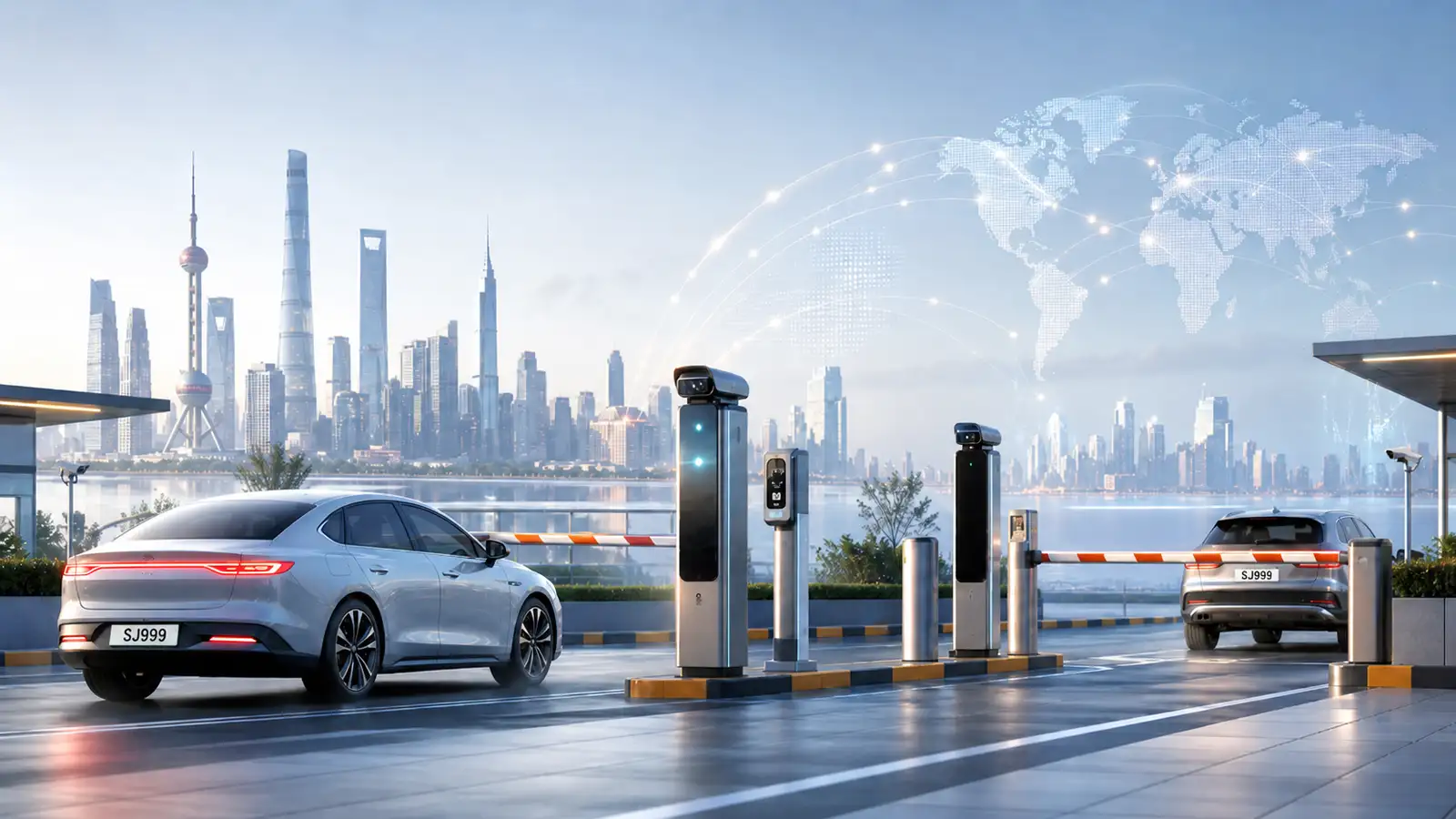
China’s smart parking industry has developed from simple barrier gate control into a mature ecosystem that combines license plate recognition, digital payment, cloud platforms, parking guidance, access control, and centralized operation. Jieshun is one of the best-known examples of this development in China. For international buyers, the more important lesson is clear: a modern parking project is not just about buying a camera or a barrier gate; it is about building a reliable, localized, and scalable parking management system.
Shunjie serves this global demand from a different position. While Jieshun is widely recognized for its influence in China, Huizhou Shunjie Technology Co., Ltd. focuses on international LPR/ANPR parking solutions, helping overseas distributors, parking operators, system integrators, and project contractors deploy smart parking systems adapted to local markets.
Important note: Jieshun and Shunjie are different companies. This article introduces Jieshun as an example of China’s mature smart parking market, then explains how Shunjie supports global parking projects.
Who Is Jieshun and Why Is It Influential in China?
Jieshun, officially Shenzhen Jieshun Science and Technology Industry Co., Ltd., was established in 1992 and is known as a major smart parking and access control solution provider in China. Its official English website states that it has deployed more than 100,000 parking management systems worldwide, serves more than 100 million people, has more than 1,000 R&D staff, and positions itself as the No.1 parking solution provider in China.
This scale makes Jieshun an important reference point for understanding China’s parking market. In many Chinese residential communities, shopping malls, office buildings, industrial parks, schools, hospitals, and public parking areas, parking management has already moved beyond manual ticketing. The market now expects automated recognition, fast entry and exit, electronic payment, cloud reporting, and centralized multi-site management.
Jieshun’s influence also shows that smart parking in China is not a single-device business. Mature projects usually combine several layers: vehicle recognition, barrier control, payment, user management, parking guidance, cloud services, access control, and maintenance support.
What Global Buyers Can Learn from Jieshun’s Role in China
The biggest lesson from China’s parking market is that parking operators do not simply need “hardware.” They need complete systems that solve real operational problems.
A parking lot may start with one simple need: reduce manual guard work at the entrance. But after deployment, the operator often needs more functions, such as monthly card management, visitor registration, online payment, revenue reports, blacklist control, remote troubleshooting, and multi-lane data synchronization.
This is why international buyers should not evaluate an LPR parking system only by camera price. They should ask whether the whole system can work reliably in their country, their language, their payment environment, and their actual parking scenario.
How Shunjie Brings LPR Parking Solutions to Global Markets
Huizhou Shunjie Technology Co., Ltd. was established in 2008 and specializes in LPR parking solutions. According to Shunjie’s official website, the company has 17 years of professional manufacturing experience, supports plate recognition in more than 150 countries, reaches up to 99% license plate recognition accuracy, and is trusted by agents and clients across 123+ countries.
Shunjie’s value for global buyers is its export-focused approach. International parking projects often face conditions that are different from the Chinese domestic market. License plate formats vary by country. Payment habits differ by region. Some markets need QR code payment, while others require cash, card, mobile wallet, prepaid accounts, or integration with a local payment provider. Software language, tax receipt format, lane layout, climate, power standards, and after-sales support also matter.
Shunjie focuses on helping overseas partners build practical systems around these needs, including LPR/ANPR cameras, barrier gates, LED display terminals, payment stations, parking management software, cloud management, and OEM customization.
Jieshun vs. Shunjie: Different Roles in the Smart Parking Industry
| Comparison Point | Jieshun | Shunjie |
|---|---|---|
| Main market image | Major smart parking brand in China | Export-focused LPR parking solution manufacturer |
| Typical audience | Domestic smart parking projects, smart communities, commercial complexes, access control projects | Overseas distributors, parking operators, system integrators, OEM partners, project contractors |
| Core value | Demonstrates the maturity of China’s smart parking ecosystem | Helps international buyers deploy localized LPR/ANPR parking systems |
| Product direction | Smart parking, parking guidance, access control, cloud platform, entrance and exit control | LPR cameras, parking barriers, payment systems, management software, OEM customization |
| Key lesson for buyers | Smart parking requires a complete ecosystem | Global projects require flexible localization and technical support |
This comparison does not mean one company replaces the other. Instead, it helps overseas buyers understand two different perspectives: Jieshun represents the scale and maturity of China’s smart parking industry, while Shunjie focuses on making LPR parking technology easier to deploy in international markets.
How to Choose an LPR Parking System for an International Project
1. Confirm license plate recognition compatibility
The first question should be simple: can the system recognize license plates in your country accurately?
Different countries use different plate sizes, fonts, colors, symbols, reflective materials, and numbering structures. A suitable LPR/ANPR system should be tested for local plate formats, day and night operation, vehicle speed, entry angle, rain, glare, dust, and low-light conditions.
Shunjie’s LPR/ANPR systems are designed to support multiple countries and regions, which is important for distributors and integrators serving different markets. Shunjie also lists supported regions across Asia, North America, Europe, Oceania, the Middle East, and Africa on its official contact page.
2. Check software and payment requirements
Parking software should match the business model of the site. A residential community may need whitelist management and visitor records. A shopping mall may need fast payment and detailed revenue reports. A public parking lot may need unmanned operation and remote monitoring.
Before buying, confirm whether the system supports:
| Requirement | Why It Matters |
|---|---|
| Monthly user management | Suitable for residential communities, offices, and staff parking |
| Temporary vehicle billing | Needed for malls, hotels, public lots, and visitor parking |
| QR code or mobile payment | Reduces manual cashier work and improves exit speed |
| Cash/card payment option | Important in markets where digital payment is not universal |
| Multi-language software | Helps local operators use the system easily |
| Revenue reports | Supports financial control and owner reporting |
| Cloud or remote access | Useful for operators managing multiple parking sites |
3. Evaluate hardware reliability
A parking system works outdoors every day. The barrier gate, camera, display, loop detector, radar, and controller must handle frequent use, temperature changes, rain, dust, sunlight, and unstable power conditions.
Buyers should check barrier opening speed, motor durability, cabinet protection, camera resolution, night recognition ability, LED display visibility, spare parts availability, and emergency operation during network failure.
4. Ask about OEM and local market support
For distributors, OEM support is often as important as the product itself. Local partners may need their own logo, cabinet color, interface language, user manual, packaging, software name, or special function settings.
Shunjie supports OEM customization and welcomes partners to visit its factory, which is especially useful for long-term distributors who want stable supply, product differentiation, and market-specific branding.
Typical Global Application Scenarios for Shunjie LPR Parking Systems
| Application Scenario | Main Parking Challenge | Recommended Solution Focus |
|---|---|---|
| Residential community | Managing residents, visitors, and unauthorized vehicles | LPR camera + barrier gate + whitelist/blacklist management |
| Shopping mall | High traffic flow and fast payment | LPR entry/exit + self-service payment + revenue reports |
| Office building | Staff parking and visitor control | LPR recognition + user groups + backend management |
| Hotel | Temporary guests, VIP vehicles, and front desk coordination | LPR system + flexible billing + manual override function |
| Industrial park | Trucks, staff vehicles, logistics flow, and security records | Durable barrier + long-range recognition + vehicle records |
| Public parking lot | Revenue control and reduced labor cost | LPR + payment station + cloud reporting |
| School or hospital | Peak-hour congestion and safety control | Fast recognition + access rules + clear entry/exit records |
The right solution depends on the site layout and operation model. For example, a small apartment entrance may only need one LPR camera, one barrier, and basic whitelist management. A large public parking lot may require multiple lanes, payment stations, cloud monitoring, financial reports, and remote technical support.
Why International Partners Work with Shunjie
International parking projects need more than a standard product catalog. They need a supplier that understands localization.
Shunjie’s advantage is its focus on LPR parking systems for global markets. Its systems are designed for different license plate environments, and its product range supports common parking functions such as automatic recognition, barrier control, payment, vehicle records, and parking lot management.
For distributors and project contractors, Shunjie can also support OEM needs. This helps partners build their own local brand, adapt the system to customer requirements, and compete with a more flexible solution.
For parking operators, the key benefit is practical deployment. A well-designed LPR parking system can reduce manual checking, improve vehicle entry and exit efficiency, strengthen revenue control, and provide clearer parking data.
Conclusion: From China’s Smart Parking Experience to Global Deployment
Jieshun’s influence in China shows how advanced and integrated the smart parking industry has become. Its scale reflects a market where parking is no longer managed only by guards, tickets, and barrier gates, but by connected systems that combine recognition, payment, software, cloud data, and access control.
Shunjie brings this smart parking direction to international markets from an export-focused position. With LPR/ANPR parking solutions, OEM customization, and support for different country requirements, Shunjie helps global partners build parking systems that are practical, localized, and ready for real-world operation.
FAQ
1. Is Jieshun the same company as Shunjie?
No. Jieshun and Shunjie are different companies. Jieshun is widely known in China’s smart parking industry, while Shunjie is Huizhou Shunjie Technology Co., Ltd., an international-focused manufacturer specializing in LPR/ANPR parking solutions.
2. Why is Jieshun influential in China’s smart parking industry?
Jieshun has a long history in the parking industry and has built large-scale experience in smart parking, access control, parking guidance, and cloud-based management. Its official website states that it has deployed more than 100,000 parking management systems worldwide and positions itself as No.1 in China.
3. What can overseas buyers learn from China’s smart parking market?
They can learn that smart parking is not just a camera or a barrier gate. A complete project should include recognition, access control, payment, software, reporting, remote management, and after-sales support.
4. What does Shunjie specialize in?
Shunjie specializes in LPR/ANPR parking solutions, including license plate recognition cameras, parking barrier gates, management software, payment-related systems, and OEM customization for international markets.
5. Can Shunjie LPR systems recognize license plates from different countries?
Yes. Shunjie states that its systems support plate recognition in more than 150 countries and regions, with up to 99% recognition accuracy.
6. What should I check before buying an LPR parking system?
You should check local license plate compatibility, recognition accuracy, night performance, barrier reliability, software language, payment method support, reporting functions, installation requirements, and after-sales support.
7. Can Shunjie provide OEM parking system customization?
Yes. Shunjie supports OEM customization, which can include branding, cabinet appearance, software interface, language, documentation, and function adaptation for local markets.
8. Which parking scenarios are suitable for Shunjie LPR solutions?
Shunjie LPR systems can be used in residential communities, shopping malls, office buildings, hotels, industrial parks, public parking lots, schools, hospitals, and other controlled vehicle entry and exit scenarios.
9. How does LPR parking reduce manual management?
LPR parking automatically reads vehicle license plates at entry and exit. This reduces manual ticket checking, improves traffic flow, records vehicle data, supports automatic billing, and helps operators manage vehicles more efficiently.
10. What information should I provide before requesting a parking system quote?
You should provide the country, license plate sample, number of lanes, site layout, expected traffic volume, payment method, software language, parking rules, installation environment, and whether OEM customization is required.