
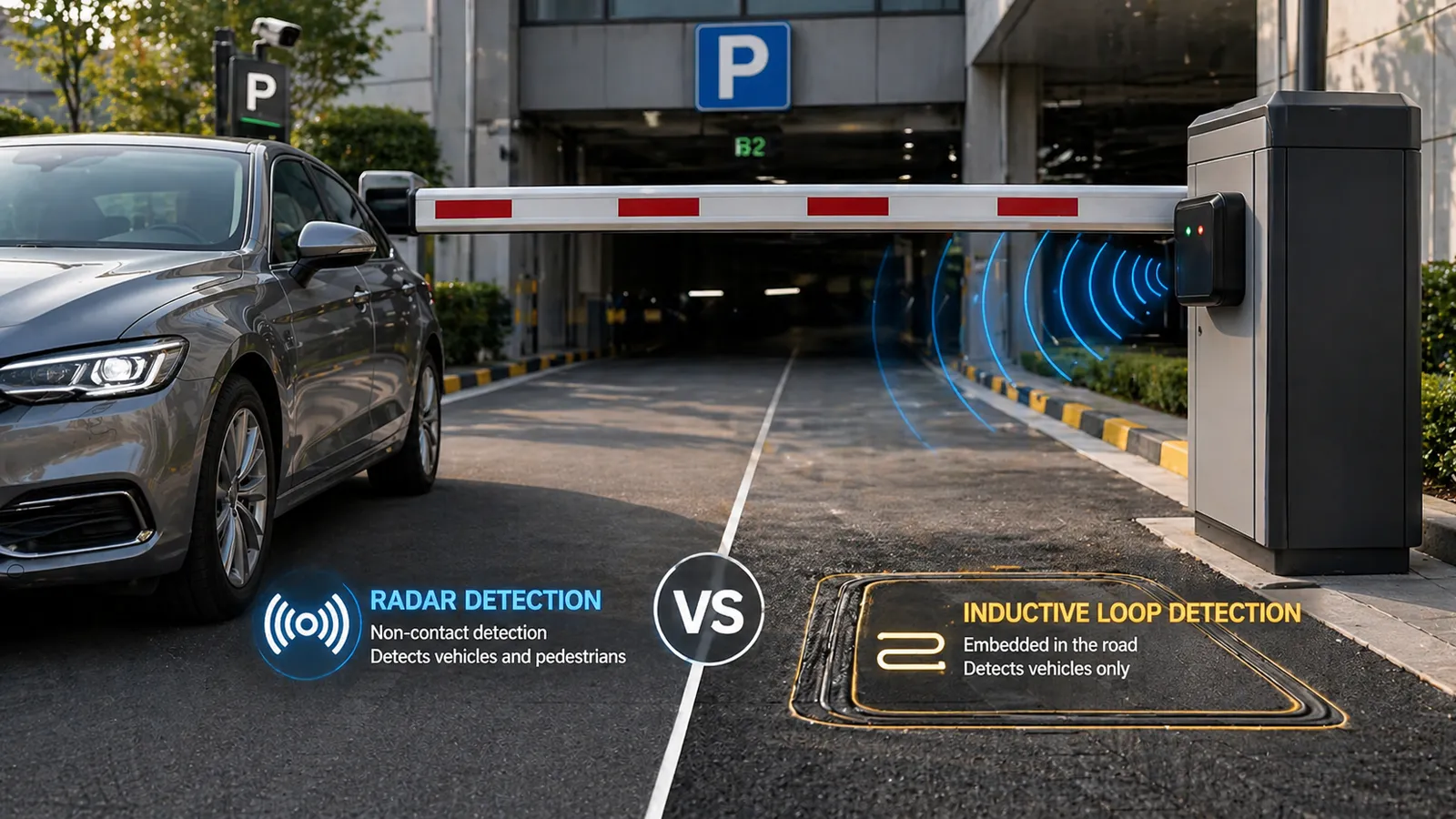
For most modern parking lots, underground garages, and LPR parking entrances, barrier gate radar is usually the better anti-collision choice because it is easier to install, does not require road cutting, and can detect more than just metal vehicles. However, inductive loop detectors are still a proven and stable vehicle-detection method, especially when the site only needs vehicle presence detection and the road surface is suitable for cutting.
The best choice is not simply “radar is better” or “loop detectors are better.” It depends on the lane environment, safety requirements, installation conditions, maintenance expectations, and budget. In high-traffic or high-risk entrances, radar and loop detectors can also be used together for stronger protection.
What Is Barrier Gate Radar?
Barrier gate radar is a vehicle and obstacle detection sensor used around parking barrier gates, underground garage entrances, residential communities, office buildings, industrial parks, and LPR parking systems.
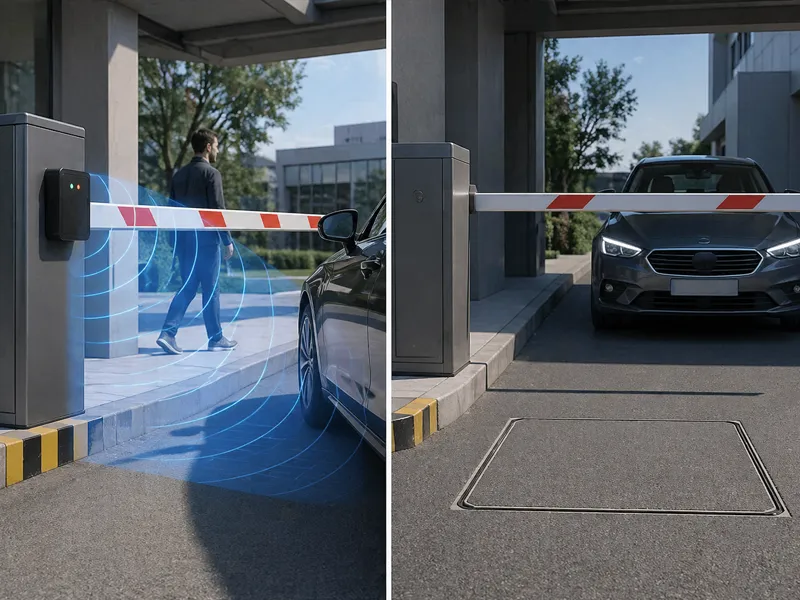
It commonly uses microwave or millimeter-wave detection to monitor the area near the barrier arm. When a vehicle, pedestrian, or other target enters the detection zone, the radar sends a signal to the barrier controller. The controller can then keep the boom arm raised, delay closing, or trigger another action depending on the system design. Some anti-collision radar products are designed to detect both vehicles and pedestrians near the gate arm area.
Barrier gate radar is mainly divided into two types:
| Radar Type | Main Function | Typical Use |
|---|---|---|
| Trigger radar | Detects an approaching vehicle and sends a trigger signal | Triggering LPR camera capture or opening logic |
| Anti-collision radar | Detects vehicles, pedestrians, or obstacles near the boom arm | Preventing the barrier arm from hitting vehicles or people |
For LPR parking systems, this distinction is important. The LPR camera identifies the license plate, while the radar or loop detector helps confirm whether something is physically in the gate’s movement area.
What Is an Inductive Loop Detector?
An inductive loop detector is a traditional vehicle detection device. It uses a wire loop buried under the road surface. When a vehicle with enough metal mass passes over or stops above the loop, it changes the electromagnetic field. The detector senses this change and sends a signal to the gate controller.
In parking barrier systems, loop detectors are commonly used for two purposes:
| Loop Type | Main Purpose | Typical Position |
|---|---|---|
| Trigger loop | Detects an arriving vehicle and supports opening, ticketing, or LPR capture | Before the barrier gate or near the camera area |
| Anti-smashing / safety loop | Confirms that a vehicle is still under or near the boom arm | Under or just beyond the barrier arm |
Loop-based anti-smashing remains common because it gives the controller a direct vehicle-presence signal. In an LPR system, the camera can identify the plate, but it does not by itself confirm that the vehicle has fully cleared the barrier arm area.
Barrier Gate Radar vs Inductive Loop Detector: Quick Comparison
| Comparison Point | Barrier Gate Radar | Inductive Loop Detector |
|---|---|---|
| Installation | Mounted on the barrier gate body or nearby post | Requires cutting the road and burying a loop coil |
| Road surface impact | No road cutting; cleaner appearance | Road surface must be cut and sealed |
| Detection target | Vehicles; some models can detect pedestrians or obstacles | Mainly vehicles or metal objects |
| Anti-collision safety | Better for mixed vehicle and pedestrian environments | Good for vehicle protection, not pedestrian protection |
| Maintenance | Easier to access and replace | Coil repair may require road work |
| Weather and lighting | Not dependent on visible light; suitable for dark garages and outdoor entrances | Stable when correctly installed, but road damage or water ingress may affect performance |
| False detection risk | Possible if angle, height, sensitivity, or detection zone is not set correctly | Possible if loop size, sensitivity, wiring, or road condition is poor |
| Best use case | Modern parking entrances, LPR systems, retrofit projects, pedestrian-risk areas | Vehicle-only detection, stable road conditions, traditional barrier systems |
Which Is Safer for Anti-Collision Gates?
For anti-collision gates, radar usually provides broader protection because it can monitor the area around the boom arm without relying on a buried coil. This is especially useful in entrances where pedestrians, motorcycles, bicycles, carts, or irregular vehicle movement may appear near the barrier arm.
A loop detector is effective for detecting a vehicle over the loop, but it is not designed as a pedestrian detector. If a person walks under the barrier arm, a standard inductive loop may not detect them because it responds mainly to metal mass. This is why loop detectors should not be the only safety measure in areas where people may walk near the gate.
However, radar is not automatically safe just because it is radar. The final performance depends on correct mounting height, angle, detection range, sensitivity, wiring, and controller logic. A poorly installed radar can still misjudge targets or create false triggers. The best anti-collision design always includes proper installation, testing, and regular inspection.
Which Is Easier to Install and Maintain?
Barrier gate radar is usually easier to install because it does not require cutting the road. In many projects, it can be mounted directly on the barrier gate housing or on a nearby column. This reduces construction time, avoids damage to the road surface, and keeps the entrance cleaner. Some barrier radar suppliers highlight “no ground damage” as a key advantage of radar-based detection.
Inductive loop installation is more labor-intensive. Installers need to cut the road surface, lay the loop wire, seal the slot, connect the detector, and test the sensitivity. If the loop fails later because of road cracking, water ingress, resurfacing, or cable damage, maintenance may require reopening the road.
For new construction, this may be acceptable. For existing parking lots, shopping centers, residential communities, and underground garages, radar is often more convenient because it avoids civil work.
Which Performs Better in Real Parking Environments?
Radar performs well in many parking environments because it is not dependent on visible light. It can work in dark underground garages, outdoor entrances, dusty areas, and low-visibility conditions. Radar-based obstacle detection is also commonly promoted for environments with rain, fog, or poor visibility.
Loop detectors can also be very stable when installed correctly. Their main advantage is that they are mature, familiar to installers, and reliable for vehicle-only detection. In simple vehicle lanes with stable pavement, they can work for many years.
The main difference is the failure mode. Radar problems are often related to settings, angle, interference, or target filtering. Loop detector problems are often related to ground condition, coil damage, cable faults, or installation quality.
In practice:
| Site Condition | Better Choice | Reason |
|---|---|---|
| Existing site where road cutting is difficult | Radar | Faster retrofit and less construction work |
| Underground garage with LPR system | Radar | Good for compact lanes and low-light conditions |
| Vehicle-only industrial entrance | Loop detector or radar | Both can work; choose based on installation conditions |
| Entrance with pedestrian crossing risk | Radar | Can provide broader obstacle detection |
| High-end commercial building | Radar + loop detector | More redundancy and stronger safety logic |
| Traditional barrier gate with stable road surface | Loop detector | Proven and cost-effective for vehicle presence |
When Should You Choose Barrier Gate Radar?
Choose barrier gate radar when the project needs easier installation, better appearance, and broader anti-collision protection.
Radar is especially suitable when:
- The customer does not want to cut the road surface.
- The parking entrance is already in operation and needs a fast retrofit.
- Pedestrians, motorcycles, bicycles, or carts may appear near the barrier.
- The site is an underground garage, office building, residential community, or commercial parking lot.
- The system uses LPR/ANPR and needs reliable lane detection near the camera and barrier.
- Maintenance access needs to be simple.
- The project requires a cleaner, modern installation.
For modern LPR parking systems, radar can be a strong match because the camera handles license plate recognition while the radar helps monitor the physical safety zone around the gate.
When Should You Choose an Inductive Loop Detector?
Choose an inductive loop detector when the site mainly needs stable vehicle detection and road cutting is acceptable.
Loop detectors are still useful when:
- The lane only needs to detect cars or trucks.
- There is little or no pedestrian movement near the barrier arm.
- The pavement is stable and suitable for cutting.
- The project already has loop detector wiring and installer experience.
- The budget is sensitive and the installation environment is simple.
- The customer wants a traditional, familiar solution for vehicle presence detection.
Loop detectors are not outdated. They are still widely used because they are mature and effective for vehicle detection. The key limitation is that they are not a complete solution for detecting people or non-metal obstacles.
Can Radar Replace an Inductive Loop Detector Completely?
In many modern parking gate projects, yes, radar can replace a loop detector, especially when the main goal is anti-collision protection and easy installation. But it should not be treated as a universal replacement in every situation.
Radar replacement is more suitable when the site needs:
- no road cutting;
- pedestrian or obstacle detection;
- faster installation;
- easier maintenance;
- integration with modern LPR parking systems.
Loop detectors may still be preferred when the site needs a very stable vehicle-only presence signal and the pavement is already prepared for loop installation.
For high-traffic lanes, premium commercial buildings, or sites with stricter safety requirements, using both radar and a loop detector can be a better design. The loop confirms vehicle presence, while radar monitors a wider safety area around the boom arm.
Common Mistakes When Choosing Anti-Collision Detectors
Mistake 1: Thinking LPR cameras can replace safety sensors
An LPR camera identifies a plate. It does not automatically confirm that the vehicle has cleared the barrier arm area. A complete barrier gate system still needs a physical detection method such as radar, loop detector, infrared sensor, or a combined safety design.
Mistake 2: Using loop detectors where pedestrians may pass
Loop detectors mainly detect vehicles. If pedestrians often walk near the barrier, relying only on a loop detector can leave a safety gap.
Mistake 3: Installing radar without proper testing
Radar is easier to install than a loop detector, but it still needs correct setup. The detection area should be tested with cars, motorcycles, pedestrians, and typical site conditions before handover.
Mistake 4: Ignoring the lane layout
The best detector depends on the real lane environment. Lane width, vehicle speed, boom arm length, pedestrian flow, slope, curb position, and camera location can all affect the final design.
Mistake 5: Choosing only by product price
A cheaper detector may cost more later if it causes false triggers, gate damage, maintenance work, or customer complaints. For parking operators, reliability and safety usually matter more than the lowest component price.
Final Recommendation: Which Is Better?
For most modern parking lots and underground garage entrances, barrier gate radar is the better anti-collision choice. It is easier to install, does not damage the road surface, supports cleaner retrofit projects, and can detect a wider range of targets depending on the model.
However, inductive loop detectors remain a reliable choice for vehicle-only detection, especially in traditional barrier gate systems with stable pavement and low pedestrian risk.
A practical recommendation is:
| Project Type | Recommended Solution |
|---|---|
| Modern LPR parking entrance | Barrier gate radar |
| Old parking lot retrofit | Barrier gate radar |
| Underground garage | Barrier gate radar |
| Vehicle-only lane with stable pavement | Inductive loop detector or radar |
| High-traffic commercial entrance | Radar + loop detector |
| Site with pedestrian safety risk | Barrier gate radar, plus additional safety devices if needed |
In short: choose radar for flexibility, easier installation, and broader safety coverage. Choose loop detectors for stable vehicle-only detection. Use both when the project needs higher redundancy.
FAQ
1. Is barrier gate radar better than an inductive loop detector?
For modern anti-collision gates, barrier gate radar is often better because it does not require road cutting and can detect a wider range of targets. But loop detectors are still reliable for vehicle-only detection.
2. Can barrier gate radar detect people?
Some anti-collision radar models can detect both vehicles and pedestrians. Always check the radar model, detection range, installation requirements, and controller compatibility before using it as a pedestrian safety device.
3. Can an inductive loop detector detect pedestrians?
A standard inductive loop detector is not designed to detect pedestrians. It mainly detects vehicles or metal objects that change the loop’s electromagnetic field.
4. Does radar need road cutting?
No. Barrier gate radar is usually mounted on the barrier gate body or a nearby post, so it does not require cutting and burying a loop coil in the road.
5. Is radar affected by rain, snow, dust, or darkness?
Radar is not dependent on visible light, so it can work in dark or low-visibility environments. However, product quality, installation angle, and settings still affect performance.
6. Why do some parking gates still use loop detectors?
Loop detectors are mature, familiar, and stable for vehicle detection. They are still a good choice when the site only needs to detect vehicles and road cutting is acceptable.
7. Can radar fully replace loop detectors?
In many parking barrier projects, yes. Radar can replace loop detectors when the site needs easier installation and broader anti-collision detection. But in some high-reliability vehicle-only applications, loop detectors may still be preferred or used together with radar.
8. What causes radar false detection?
Common causes include incorrect installation height, wrong angle, excessive sensitivity, poor detection zone settings, vibration of the barrier housing, nearby moving objects, or low-quality radar hardware.
9. Which detector is better for underground garages?
Radar is usually more convenient for underground garages because it avoids road cutting and works without relying on visible light. It is also easier to retrofit in existing garage entrances.
10. Should I use both radar and loop detector?
For high-traffic, high-end, or high-risk entrances, using both can provide stronger redundancy. Radar can monitor the barrier arm area, while the loop detector can provide stable vehicle presence confirmation.