
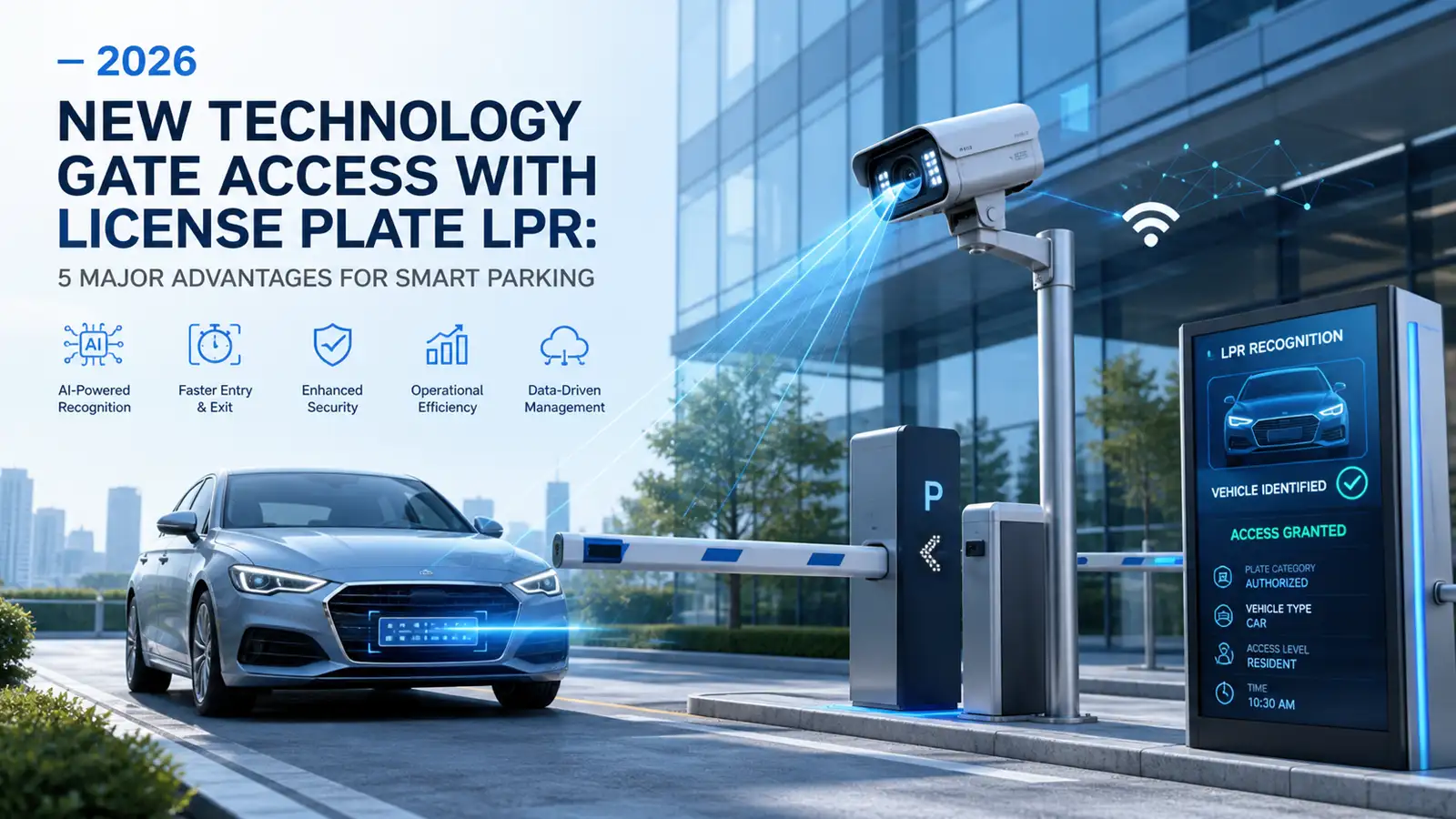
License Plate Recognition, also called LPR, is becoming one of the most practical technologies for smart parking in 2026. Instead of using paper tickets, RFID cards, remote controls, or manual guards, an LPR gate access system uses a camera and recognition software to identify the vehicle’s license plate and automatically control the barrier gate.
For parking operators, property managers, factories, office parks, residential communities, and commercial parking lots, the five biggest advantages are clear: faster vehicle entry, stronger security, lower labor cost, better driver experience, and smarter parking data management. Modern LPR systems are widely used to automate vehicle access, reduce manual checking, and connect parking equipment such as barrier gates, payment systems, LED displays, and cloud platforms.
What Is License Plate LPR Gate Access Technology?
License Plate LPR gate access is a vehicle access control system that uses a camera to capture a license plate, converts the plate image into readable text, checks the result against an authorization database, and then decides whether the gate should open.
A typical LPR gate access process works like this:
- A vehicle approaches the parking entrance or exit.
- The LPR camera captures the license plate image.
- The software recognizes the plate number.
- The system checks whether the vehicle is authorized, unpaid, blacklisted, temporary, or registered.
- The barrier gate opens automatically if access is approved.
- The system saves the plate number, image, time, lane, and access result.
This makes the vehicle’s license plate act like a digital access credential. In many smart parking projects, the plate number replaces the physical card or ticket.
Why Is LPR Gate Access More Important in 2026?
Parking lots are under pressure to become faster, safer, and easier to manage. Drivers do not want to wait in long queues. Property managers want better control over who enters the site. Parking operators want to reduce manual work and improve payment accuracy.
LPR gate access helps solve these problems because it combines vehicle identification, gate control, access records, and parking management in one system. Modern systems can also integrate with payment kiosks, online payment platforms, cloud software, visitor registration, and access-control platforms.
For international projects, plate format support is also important. Shunjie’s LPR system supports license plate recognition in more than 150 countries and regions and claims up to 99% recognition accuracy under suitable conditions.
5 Major Advantages of LPR Gate Access for Smart Parking
Advantage 1: Faster Vehicle Entry and Exit
The first major advantage of LPR gate access is speed.
In a traditional parking lot, drivers may need to stop, lower the window, scan a card, collect a ticket, press a button, or wait for a guard. Each action takes time. During peak hours, these small delays create long queues at the entrance and exit.
With LPR, the vehicle can be recognized automatically as it approaches the lane. If the plate is approved, the barrier gate opens without the driver needing to search for a card or ticket.
This is especially useful for:
- Residential communities
- Office buildings
- Factories and industrial parks
- Schools and hospitals
- Shopping malls
- Logistics parks
- Monthly parking lots
- VIP parking areas
For sites with repeated users, such as residents, employees, tenants, or registered members, LPR makes daily access much smoother.
Advantage 2: Higher Security with Real-Time Vehicle Identification
LPR gate access improves security because every vehicle is identified and recorded. Instead of only knowing that “someone opened the gate,” the operator can know which vehicle entered, when it entered, which lane it used, and whether the gate opened automatically or manually.
A smart LPR system can support:
- Whitelist access for authorized vehicles
- Blacklist alerts for restricted vehicles
- Temporary visitor approval
- Monthly parking registration
- Paid parking verification
- Entry and exit image records
- Abnormal access reports
This is valuable for residential communities, commercial properties, factories, campuses, government facilities, and other controlled-access locations.
For example, if a vehicle causes damage, violates parking rules, or enters without permission, the manager can search the record by plate number or time period. This creates better traceability than a simple remote-control gate or manual paper log.
Advantage 3: Lower Labor and Operating Costs
Traditional parking access often depends on guards or attendants to check cards, issue tickets, collect fees, record vehicle information, or open the gate manually. This increases labor cost and can also create mistakes during busy periods.
LPR gate access reduces the need for repetitive manual checking. The system can automatically identify vehicles, open the gate, record access data, and support payment or subscription rules.
This does not mean every site can remove all staff. Some parking lots still need personnel for customer service, emergency handling, cash payment, or security patrols. However, LPR can reduce the amount of manual work required at the gate.
Table 1: Traditional Gate Access vs LPR Gate Access
| Item | Traditional Card/Ticket Access | LPR Gate Access |
|---|---|---|
| Entry method | Card, ticket, QR code, remote control, or guard | License plate recognition |
| Driver action | Stop, scan, tap, collect ticket, or call guard | Vehicle is recognized automatically |
| Labor demand | Higher | Lower for routine access |
| Lost credential problem | Cards and tickets can be lost or shared | Plate number is the credential |
| Access record | Limited or manual in many systems | Plate image, time, lane, and event record |
| User experience | Slower during peak hours | Faster and contactless |
| Best for | Small sites or simple gates | Smart parking, repeated users, and high-traffic entrances |
For parking operators, this can improve operating efficiency. For distributors and project contractors, LPR also makes the solution more attractive because it adds automation, data, and management value.
Advantage 4: Better Driver Experience
A good parking system should not make drivers feel that entry is complicated. LPR gate access improves the driver experience because it is contactless, fast, and easy to understand.
Drivers do not need to:
- Lower the window in rain or heat
- Search for a card
- Take a paper ticket
- Scan a QR code at the gate
- Wait for a guard to check the vehicle
- Worry about losing a parking credential
For residents and employees, the experience becomes simple: drive to the gate, let the system recognize the plate, and enter.
For visitors, the system can also support pre-registration. A property manager or host can add the visitor’s plate number in advance and set a valid time period. When the visitor arrives, the system recognizes the plate and opens the barrier automatically.
This makes LPR useful not only for permanent users, but also for visitor management and temporary parking.
Advantage 5: Smarter Parking Data and System Integration
LPR is not only a camera. In a complete smart parking solution, LPR becomes part of a larger management system.
A parking manager can use LPR data to understand:
- Vehicle entry and exit volume
- Peak traffic hours
- Monthly vehicle usage
- Parking duration
- Payment status
- Unauthorized access attempts
- Visitor traffic
- Lane performance
- Abnormal gate events
This data helps operators make better decisions. For example, if the exit lane is always crowded at 6:00 p.m., the property manager can adjust lane rules, add another exit, improve signage, or optimize payment before exit.
LPR systems can also connect with:
- Barrier gates
- LED displays
- Voice prompt devices
- Vehicle detectors or radar
- Parking payment software
- QR code payment
- Cloud parking platforms
- Access control systems
- Visitor management platforms
- Remote monitoring software
This is why LPR gate access is a key part of smart parking. It turns the entrance and exit from a simple gate into a digital management point.
Main Components of an LPR Gate Access System
A complete LPR gate access system usually includes both hardware and software.
Main Hardware
| Component | Function |
|---|---|
| LPR camera | Captures the vehicle image and license plate |
| Barrier gate | Opens or closes the vehicle lane |
| Vehicle detector/radar | Detects vehicle presence and helps trigger recognition |
| Fill light | Improves recognition at night or in low-light conditions |
| LED display | Shows plate number, fee, welcome message, or access result |
| Voice prompt device | Gives audio instructions to drivers |
| Access controller | Sends opening signal to the barrier gate |
| Server or cloud platform | Stores records and manages software data |
Main Software Functions
A professional LPR parking system should support:
- License plate recognition
- Whitelist and blacklist management
- Monthly user management
- Temporary visitor authorization
- Entry and exit records
- Image storage
- Payment rules
- Report export
- Multi-lane management
- User permission control
- Remote monitoring
- System logs
When choosing a system, buyers should not only check the camera. They should also check the software, database, integration ability, and after-sales support.
What Affects LPR Recognition Accuracy?
LPR accuracy depends on more than the recognition algorithm. Real-world installation quality is just as important.
Even a strong LPR camera may perform poorly if the installation angle is wrong, the lighting is too weak, the plate is too reflective, or the vehicle speed is too high. Industry systems commonly use illumination, infrared cameras, and image-processing software to improve plate capture and recognition.
Table 2: Key Factors That Improve LPR Performance
| Factor | Why It Matters | Practical Recommendation |
|---|---|---|
| Camera angle | Reduces image distortion | Keep the plate within the clear capture zone |
| Camera distance | Affects plate size in the image | Follow the supplier’s recommended distance |
| Lighting | Improves night and rainy-day recognition | Use fill light or low-light camera design |
| Vehicle speed | Fast movement may blur the plate | Use lane design, speed bumps, or signs |
| Plate condition | Dirty, damaged, or blocked plates are harder to read | Add manual review or backup access method |
| Country plate format | Different regions use different fonts, colors, and layouts | Choose a system with local plate support |
| Database quality | Wrong whitelist data causes wrong access results | Keep vehicle records updated |
| Barrier timing | Bad timing can cause delay or tailgating risk | Match gate opening with recognition trigger |
| Maintenance | Dust, vibration, and wiring problems reduce stability | Clean lens and inspect equipment regularly |
For international buyers, local testing is recommended before large-scale deployment. A good supplier should be able to help test plate formats, lane conditions, recognition distance, and integration requirements.
LPR Gate Access vs RFID, Ticket, and QR Code Systems
LPR is powerful, but it does not mean every other access method is useless. The best smart parking design often combines LPR as the main method with backup methods for special cases.
When LPR Is the Better Choice
LPR is usually better when the parking site has:
- Many repeated users
- Monthly parking members
- High traffic volume
- Need for contactless access
- Need for accurate vehicle records
- Need for unmanned or semi-unmanned operation
- Need for payment or subscription integration
When Other Methods Are Still Useful
RFID, QR code, intercom, or manual control may still be useful for:
- Temporary visitors without pre-registration
- Vehicles with damaged or blocked plates
- Emergency vehicles
- Special deliveries
- System maintenance periods
- Backup access during network or power problems
Best Practice
Use LPR as the main access method, but keep at least one backup method. This gives drivers a smoother experience while protecting the parking operator from unexpected access problems.
Privacy and Data Security Considerations
LPR systems collect vehicle-related data, so privacy and data security should not be ignored. Depending on system design, the data may include the license plate number, vehicle image, entry time, exit time, lane, payment record, and access result.
Automated license plate reader rules differ by country and region. In the United States, for example, the National Conference of State Legislatures tracks state statutes related to automated license plate readers, and some states have specific requirements for ALPR data use, sharing, or retention.
Parking operators should consider these basic protection measures:
- Set clear user permissions
- Limit who can view or export plate records
- Use strong passwords and administrator controls
- Define a reasonable data retention period
- Protect network transmission and storage
- Keep software updated
- Record system operation logs
- Train staff on data handling
- Follow local privacy and data-protection laws
LPR improves parking efficiency, but responsible data management is part of a professional smart parking project.
How to Choose a Reliable LPR Gate Access Supplier in 2026
A reliable LPR supplier should provide more than a camera. Buyers should evaluate the complete solution.
1. Check Recognition Accuracy and Local Plate Support
Ask whether the system supports the target country or region. License plates vary by font, color, size, layout, and language. For global projects, broad plate-format support is important.
Shunjie’s LPR solution supports recognition in more than 150 countries and regions and is used by agents and customers in 123+ countries and regions.
2. Check Barrier Gate and Software Integration
The LPR system should be able to connect with barrier gates, parking software, payment systems, LED displays, controllers, and third-party platforms when needed.
Before purchasing, confirm:
- Communication protocol
- API or SDK availability
- Barrier gate compatibility
- Payment integration options
- Cloud or local deployment
- Multi-lane management
- Offline operation ability
3. Check OEM and Project Customization
For distributors, contractors, and brand owners, OEM customization can be important. This may include logo, software interface, language, cabinet color, function configuration, and market-specific settings.
Shunjie supports OEM customization and provides LPR parking solutions for different application scenarios, making it suitable for partners who need factory-direct support and project flexibility.
4. Check Technical Support and Real Cases
A good supplier should provide installation guidance, wiring diagrams, software instructions, testing support, and after-sales service. For serious projects, ask for real installation photos, videos, product specifications, and sample testing where possible.
Common Installation Mistakes to Avoid
Even the best LPR system can fail if the installation is poor. Before deployment, avoid these mistakes:
Installing the Camera at the Wrong Angle
If the camera is too high, too low, too far, or too tilted, the plate image may be distorted. This reduces recognition accuracy.
Ignoring Night Lighting
Night recognition needs stable lighting. Too little light creates dark images, while too much direct light can cause glare or overexposure.
Allowing Vehicles to Move Too Fast
If vehicles enter too quickly, the plate image may blur. Speed bumps, warning signs, and proper lane design can help.
Not Keeping the Plate Database Updated
If a resident changes vehicles or an employee leaves the company, the access database must be updated. Old data can create security risks.
No Backup Access Method
Every parking site should prepare backup access, such as manual gate control, intercom, QR code, or remote approval.
Weak Data Permission Management
Only authorized staff should view, edit, export, or delete vehicle records. Poor permission control can create privacy and management risks.
Conclusion: Is LPR Gate Access Worth Upgrading in 2026?
Yes. For many smart parking projects, LPR gate access is one of the most practical upgrades in 2026.
Its five major advantages are:
- Faster entry and exit — reduces waiting time and improves traffic flow.
- Higher security — identifies vehicles and stores access records.
- Lower operating cost — reduces repetitive manual gate work.
- Better driver experience — provides contactless and convenient access.
- Smarter parking management — connects gate access with data, payment, and software systems.
For residential communities, office parks, factories, commercial plazas, hospitals, schools, logistics parks, and paid parking lots, LPR is no longer only a camera technology. It is a core part of smart parking automation.
As a professional LPR parking solution manufacturer established in 2008, Huizhou Shunjie Technology Co., Ltd. provides license plate recognition parking systems, barrier gate integration, OEM customization, and project support for global partners. For distributors, contractors, and parking operators looking for a high-performance and cost-effective solution, LPR gate access is a strong direction for 2026 smart parking upgrades.
FAQs About 2026 LPR Gate Access Technology
1. What is LPR gate access?
LPR gate access is a smart vehicle access system that uses a license plate recognition camera to identify a vehicle and control the barrier gate automatically.
2. Can LPR open a barrier gate automatically?
Yes. When the LPR camera and software are connected with the barrier gate controller, the system can open the gate automatically for authorized vehicles.
3. Is LPR better than RFID card access?
For vehicle parking access, LPR is often more convenient because drivers do not need to carry or scan a card. However, RFID can still be useful as a backup or for special management scenarios.
4. Does LPR work at night?
Yes, if the system uses proper camera hardware, lighting, installation angle, and lane design. Fill lights or infrared support can help improve night recognition.
5. What happens if the license plate cannot be recognized?
The parking operator can use backup methods such as manual review, intercom, QR code, remote opening, or guard approval.
6. Can LPR be used for paid parking lots?
Yes. LPR can connect with parking payment software to calculate parking duration, verify payment status, and support automatic entry or exit rules.
7. Is LPR suitable for visitor management?
Yes. Visitors can be pre-registered by plate number and given temporary access for a specific date or time period.
8. What should I check before buying an LPR gate access system?
Check recognition accuracy, local license plate support, barrier gate compatibility, software functions, payment integration, installation guidance, OEM support, and after-sales service.
9. Is LPR data private?
LPR data can include plate numbers, vehicle images, entry times, and exit times. Parking operators should protect this data with permission controls, secure storage, clear retention rules, and compliance with local privacy laws.
10. Which places are suitable for LPR smart parking?
LPR is suitable for residential communities, office buildings, factories, shopping malls, hospitals, schools, logistics parks, government facilities, commercial parking lots, and mixed-use properties.