
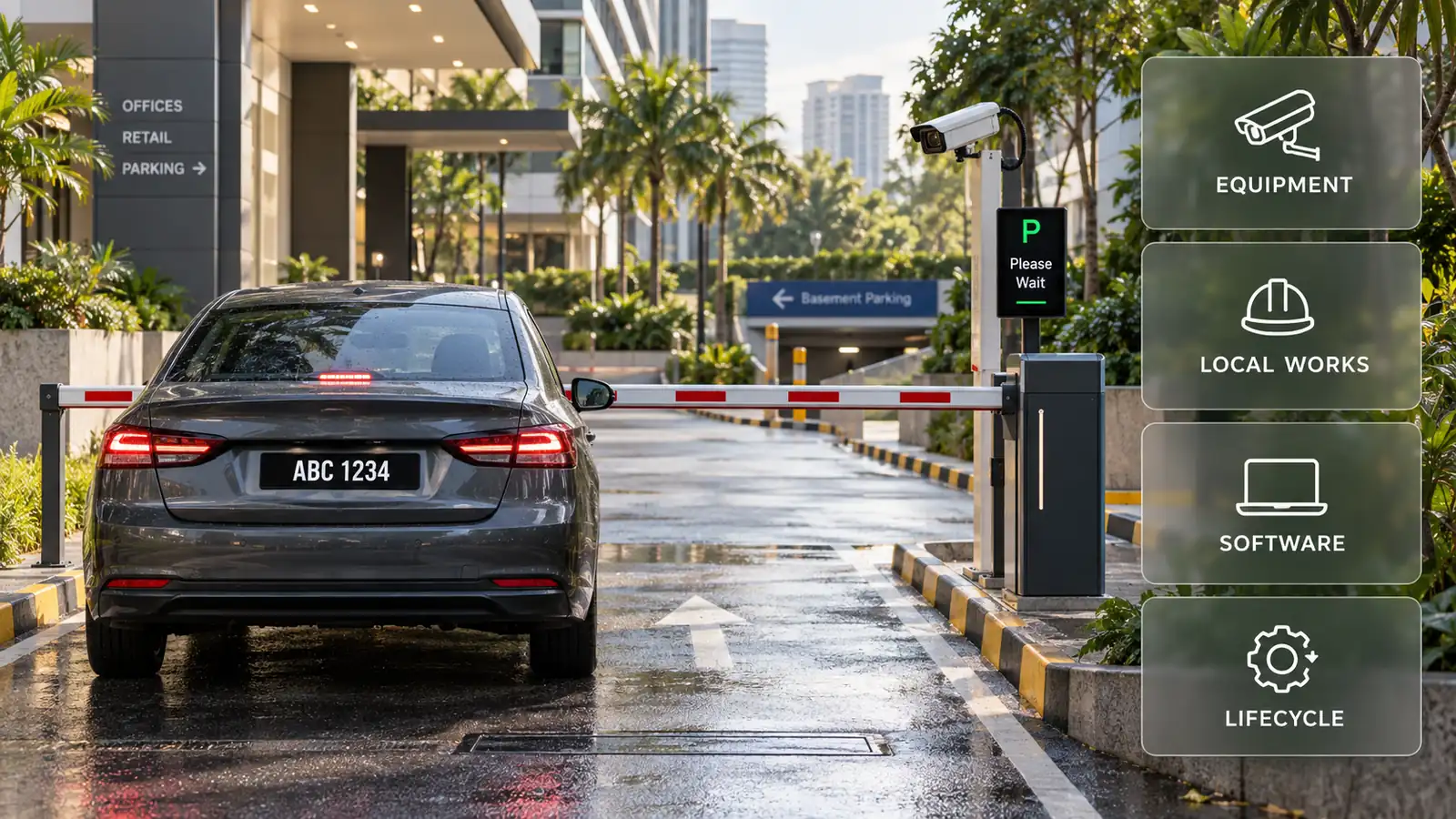
There is no responsible one-price answer for an LPR parking system in Malaysia. The total depends on the number of lanes, access or payment workflow, recognition conditions, barrier and safety equipment, software integrations, site works and support level. A useful quotation must also separate factory-supplied hardware from freight, import charges and work performed by a Malaysia-based installer or integrator. Compare proposals using the same scope and a chosen ownership period—not camera price alone.
The short answer: define the system before asking for a price
A basic access-control project and a paid, multi-lane car park are different systems even when both use licence plate recognition (LPR), also called automatic number plate recognition (ANPR).
An access-only installation might identify authorised number plates and trigger a barrier. A commercial car park may also need fee calculation, season-parking rules, payment terminals, intercoms, exception handling, reports and links to other systems. High-traffic sites may require faster barriers, extra safety devices, redundancy and stronger local support.
Before treating any figure as comparable, ask whether it covers a complete operational lane, only selected equipment, or an installed and commissioned system.
What should an LPR parking system quotation include?
The cost is easier to understand when it is divided into layers. The party responsible for each layer varies by project, so the quotation should name both the inclusion and the responsible organisation.
| Cost layer | Typical inclusions | Main variables | Responsibility to confirm |
|---|---|---|---|
| Recognition and lane hardware | LPR/ANPR camera, display, controller, barrier, vehicle detection, safety devices | Lane count, traffic speed, boom length, duty cycle, mounting and redundancy | Factory, distributor or integrator |
| Parking and access software | Plate lists, tariff logic, user roles, reports, database, API and integrations | Access-only versus paid parking, sites, users, interfaces and deployment model | Software vendor or integrator |
| Local site works | Survey, foundations, cabling, power, network, drainage protection, mounting and reinstatement | Existing infrastructure, cable routes, civil scope and working hours | Malaysia-based contractor or integrator |
| Logistics and import | Packing, freight, insurance, customs clearance, duties and delivery to site | Shipment size, destination, Incoterm and current import treatment | Supplier, importer or buyer |
| Commissioning and handover | Configuration, tuning, testing, training, documentation and acceptance | Number of lanes, integrations, test cases and on-site attendance | Integrator, with factory support where agreed |
| Ongoing operation | Licences, hosting, connectivity, payment fees, maintenance, spares and support | Contract term, transaction volume, response time and replacement policy | Operator, service provider and integrator |
Hardware is more than the camera
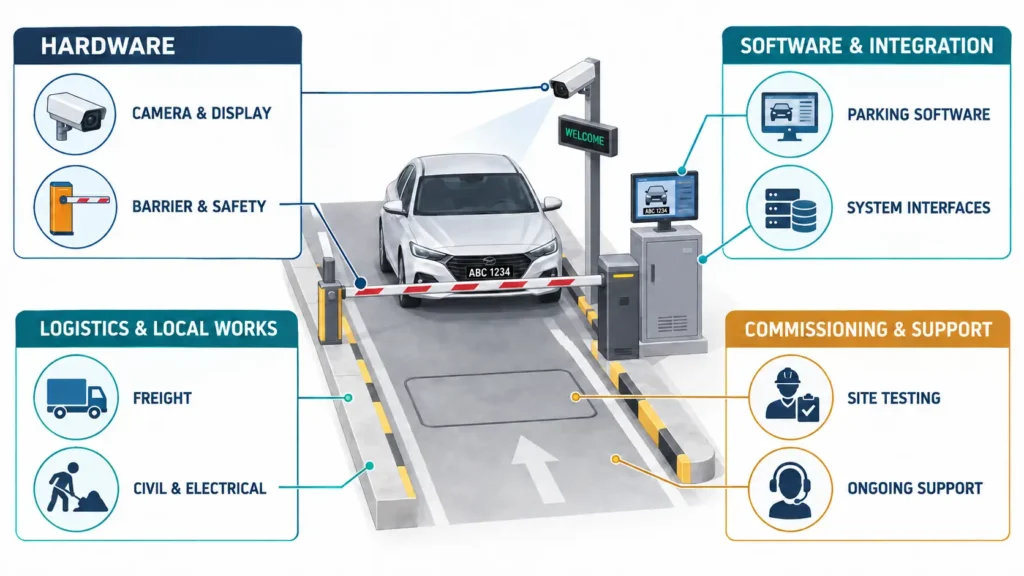
A complete bill of materials may combine an ANPR camera, an ALPR display terminal, a rapid gate arm barrier and appropriate vehicle-detection and safety devices. Paid parking may add a multi-channel payment station, receipt hardware, an intercom, signage, an uninterruptible power supply and network equipment.
These product pages describe equipment categories; they are not an installed Malaysia price or a promise of local services. Shunjie’s About page identifies the company as a manufacturer based in Huizhou, China. The final configuration should follow the site survey, operating workflow and interface requirements.
Factory supply and local delivery are separate scopes
A manufacturer’s proposal may cover equipment, factory configuration, packaging, documentation, spare parts and agreed remote technical support. A Malaysian integrator may be needed for the site survey, foundations, electrical and network work, installation, software integration, testing, training and on-site response.
Neither division should be assumed. Ask each bidder to mark every line as included, optional, by others or excluded, and identify who owns the result if a factory component and a local system do not communicate as expected.
Seven variables that change the project cost
- Number and direction of lanes. One entry and one exit can require different equipment from a reversible lane. Extra entrances, exits, staff lanes or service lanes increase hardware, network and commissioning scope.
- Vehicle flow and barrier duty. Peak vehicles per hour, acceptable queue time, boom length, opening speed and daily operating cycles affect barrier selection. Safety loops, radar or other detection should be designed around the lane rather than removed simply to reduce the initial quote.
- Recognition conditions. Camera position, vehicle speed, headlight glare, night lighting, rain exposure, plate angle and mixed vehicle types can change the mounting, illumination and testing required. Use the LPR camera placement guide to prepare for a survey, but require a project-specific design.
- Access and payment workflow. Resident access, visitors, season parking, validations, lost-ticket handling and paid casual parking each require different logic. Payment integration should name the supported methods, payment provider or acquirer, certification responsibility, transaction path and fallback process. Project-specific compatibility and fees need written confirmation from the relevant providers.
- Software and data architecture. Cloud, on-premise and hybrid designs have different server, licence, connectivity, backup and support implications. Ask about data ownership, retention, user permissions, audit logs, exports and deletion. Where the project processes personal data in commercial transactions, the operator should obtain appropriate advice on Malaysia’s Personal Data Protection Act 2010 and current amendments.
- Existing infrastructure. Reusable power, network, ducts, islands and foundations can reduce work, while long cable routes, poor connectivity, drainage constraints or restricted working hours can increase it. Only a local survey can establish this reliably.
- Support and resilience. The quote may need commissioning attendance, operator training, preventive maintenance, response-time commitments, remote diagnostics, spare units or local stock. A lower initial price can become expensive if a failed component causes queues, manual operation or extended downtime.
Calculate total cost of ownership, not just purchase price
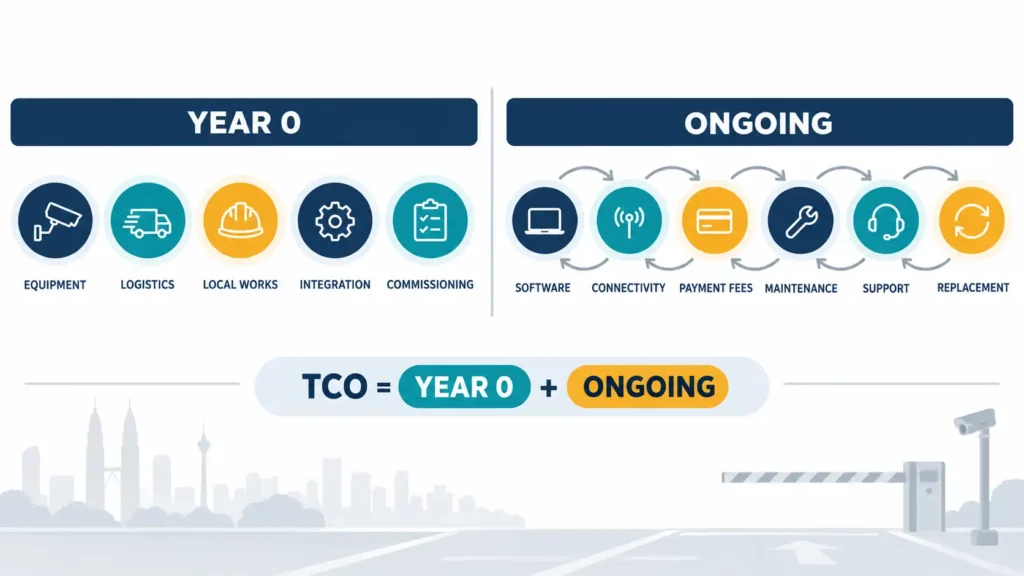
Choose a common evaluation period—such as the period used by your organisation for capital planning—and make every bidder use the same assumptions. A practical formula is:
TCO = equipment + logistics and import + local works + software and integration + operating and support costs + expected exception or downtime costs − residual value
Do not force a residual value or downtime estimate if there is no defensible basis. Record it as “not included” instead. The purpose is transparency, not false precision.
TCO worksheet
Enter all amounts in MYR, record whether tax is included, and state the source date and exchange-rate basis for imported items.
| Line item | One-time or recurring? | Quote input | Assumption or evidence required |
|---|---|---|---|
| Recognition and barrier equipment | One-time | MYR ___ | Final bill of materials per lane |
| Controller, server and network equipment | One-time | MYR ___ | Capacity and redundancy |
| Freight, insurance and clearance | One-time | MYR ___ | Incoterm and destination |
| Duties and applicable taxes | One-time/variable | MYR ___ | Confirm with importer or adviser |
| Civil, electrical and network works | One-time | MYR ___ | Site-survey scope |
| Installation, integration and commissioning | One-time | MYR ___ | Interfaces and acceptance tests |
| Software or cloud licence | Recurring | MYR ___ / period | Users, lanes, sites and renewal terms |
| Connectivity and hosting | Recurring | MYR ___ / period | Data volume and availability target |
| Payment-service charges | Recurring/usage | MYR ___ | Provider, fee basis and volume |
| Preventive maintenance and support | Recurring | MYR ___ / period | SLA, visits and exclusions |
| Spares and replacements | Planned/variable | MYR ___ | Recommended stock and warranty |
| Manual exceptions or downtime | Variable | MYR ___ | Use only documented assumptions |
| Residual value | End of period | Less MYR ___ | Use only if supportable |
| TCO for chosen period | MYR ___ | Same period for all vendors |
Vendor quote-comparison worksheet
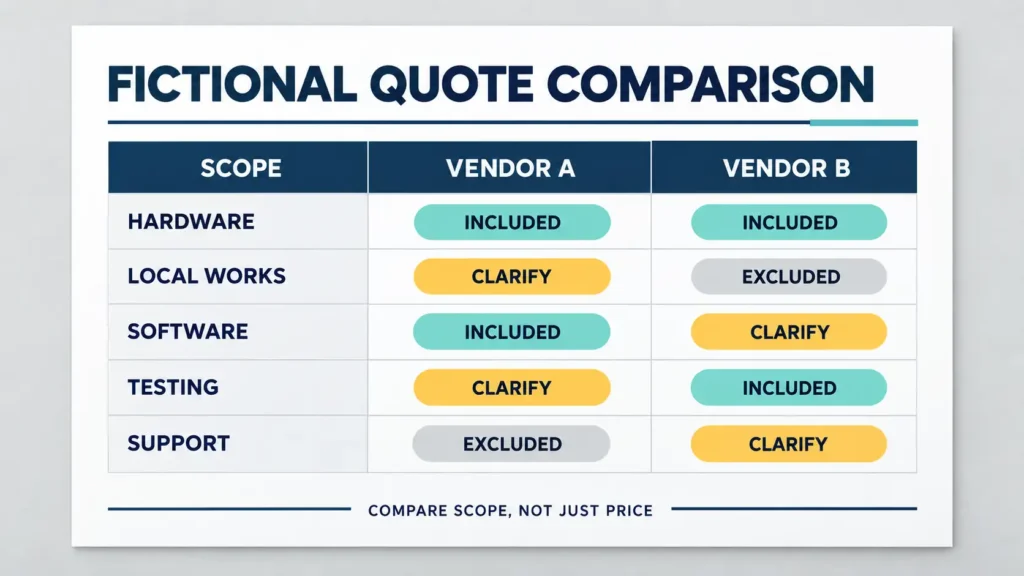
Send the same brief to every supplier. Complete this worksheet from written proposals and supporting documents, not sales-call impressions.
| Comparison item | Vendor A | Vendor B | Decision note |
|---|---|---|---|
| Lane design and complete bill of materials | ___ | ___ | Same lane scope? |
| Malaysian plate sample test and conditions | ___ | ___ | Evidence supplied? |
| Barrier speed, duty and safety design | ___ | ___ | Suitable for peak flow? |
| Software functions and integrations | ___ | ___ | Included, optional or by others? |
| Payment compatibility and provider scope | ___ | ___ | Live integration verified? |
| Factory configuration and documentation | ___ | ___ | Deliverables listed? |
| Freight, import and delivery basis | ___ | ___ | Same Incoterm and destination? |
| Malaysia-local works and commissioning | ___ | ___ | Named responsible party? |
| Acceptance test and remediation | ___ | ___ | Pass criteria agreed? |
| Warranty, SLA and spare-parts plan | ___ | ___ | On-site versus remote support? |
| Recurring fees and renewal conditions | ___ | ___ | Full evaluation period covered? |
| Exclusions and dependencies | ___ | ___ | Material gaps resolved? |
| TCO for the same period | MYR ___ | MYR ___ | Like-for-like result |
Common quotation mistakes to avoid
- Comparing one supplier’s equipment-only price with another supplier’s installed project price.
- Accepting a recognition-rate headline without the test conditions, sample, exclusions and pass criteria.
- Assuming “payment supported” means the required Malaysian provider is already integrated and commercially approved.
- Leaving civil work, network availability, surge protection, drainage or traffic management outside the survey.
- Treating remote factory assistance as equivalent to a Malaysia-local on-site SLA.
- Comparing upfront totals while ignoring licences, hosting, transaction-related charges, maintenance and replacement terms.
The lowest complete quote may be suitable; the lowest incomplete quote rarely tells you what the operating system will cost.
What to send suppliers for a useful quotation
Prepare one short project brief containing:
- site type and city or delivery destination;
- entry, exit and reversible lane counts;
- lane dimensions, boom length and site plan or photographs;
- peak traffic, operating hours and vehicle types;
- representative, lawfully shared plate samples for testing;
- resident, visitor, staff, season-parking and payment workflows;
- required payment methods and named providers, if known;
- existing barriers, software, databases, APIs and access-control systems;
- power, network, server or cloud preferences;
- data access, retention, reporting and backup requirements;
- required warranty, response time, training and spare-parts plan; and
- the work expected from the factory, importer and Malaysian integrator.
For equipment planning, review the complete guide to LPR parking system components. Then send Shunjie the project brief and ask for a line-by-line factory hardware proposal. Local installation, integration and support should be quoted separately or assigned to a verified Malaysian project partner.
Build the quote around the operating result
The most useful cost question is not “What is the cheapest LPR camera?” It is “What complete system will operate these lanes, under these conditions, with clearly assigned support, for the full evaluation period?” Define that result, obtain matching quotations and calculate TCO. The comparison will then expose missing scope and commercial risk without relying on an unsupported market-price figure.