
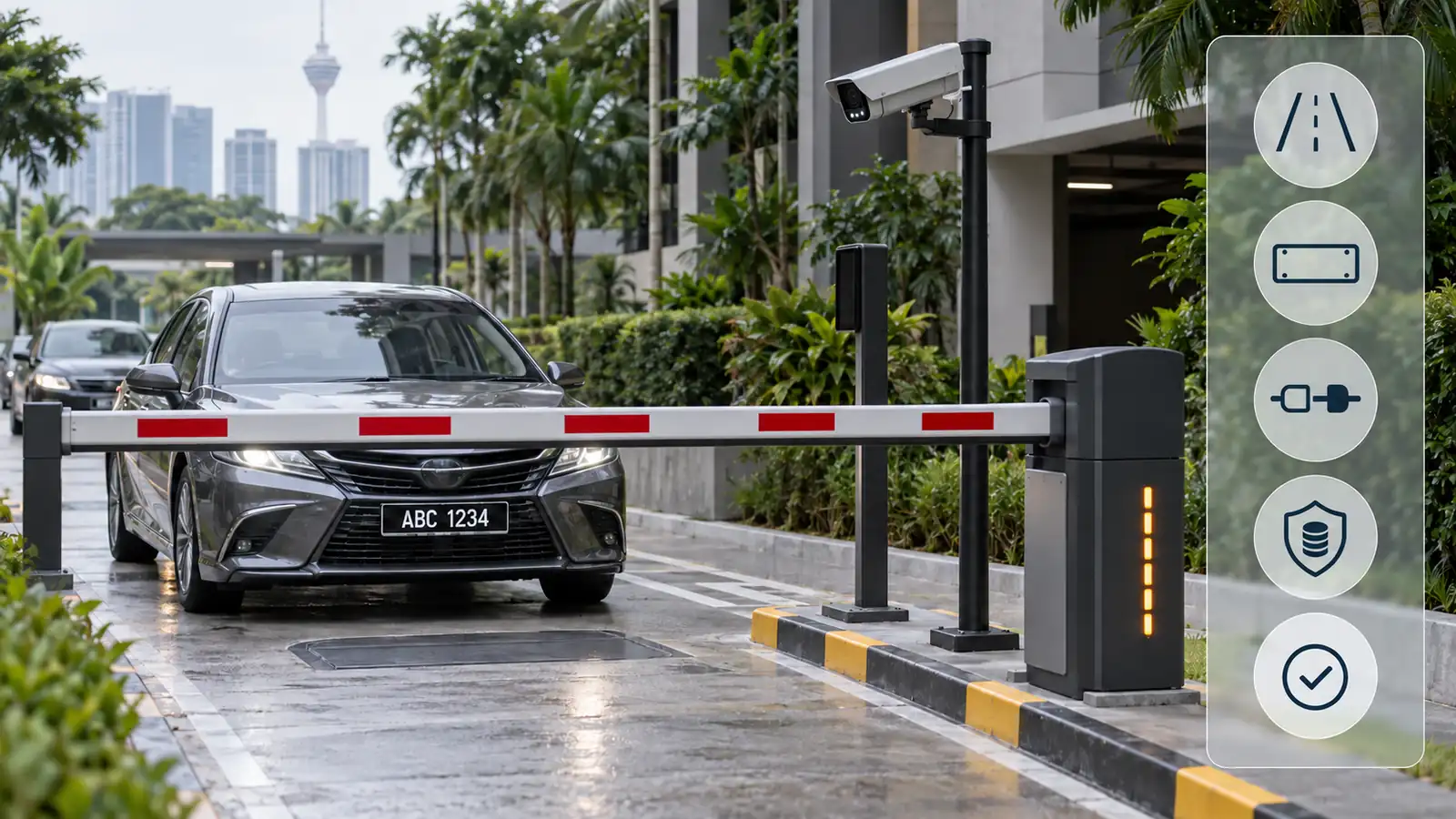
The right LPR parking system for a Malaysian site is a complete lane workflow—not simply a camera with an impressive accuracy claim. Before ordering, verify that it recognises the vehicles you receive, makes the correct access or payment decision, moves the barrier safely, protects data and recovers from failures. This checklist turns those outcomes into specifications, tests and clear supplier responsibilities.
1. Define the parking outcome before choosing hardware
Start with the operating model. A condominium admitting residents differs from a public fee-charging car park; a mixed-use property may need separate rules for tenants, visitors, deliveries and contractors.
Record at least the following for every entry and exit lane:
- access-only, paid parking or hybrid operation;
- user groups and the rule for each group;
- expected peak flow and likely queue conditions;
- required capture direction, approach speed and stopping behaviour;
- barrier arm length, headroom and equipment space;
- required payment, intercom, visitor, season-parking or building-system connections;
- the manual process for unread plates, denied access, network failure and power loss.
This schedule makes technically different quotations comparable. For background, see this guide to LPR cameras, barriers, loop detectors and software.
2. Make Malaysian plate performance testable
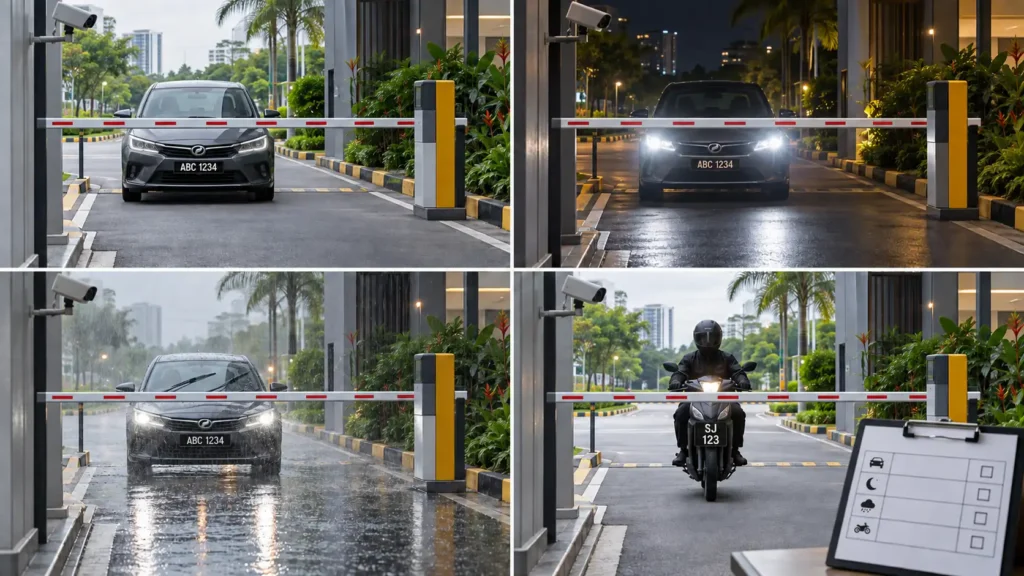
“Supports Malaysia” is not an acceptance criterion. Malaysia’s Road Transport Department (JPJ) publishes several plate colour arrangements and describes the newer white-background JPJePlate used initially for newly registered zero-emission vehicles. Test the formats, vehicle classes and conditions expected at the site, not only clean standard samples. See the official JPJ plate specifications.
Have each supplier run the same dataset or pilot. The procurement schedule should define the evidence before the supplier is selected:
| Procurement requirement | What the specification should state |
|---|---|
| Test population | Plate categories, vehicle types, lanes, lighting, weather and approach conditions |
| Counting method | Denominator, exclusions and separate reporting for detection, exact read, correct transaction, response time and false authorisation |
| Acceptance boundary | Project-approved pass criteria and the treatment of security-relevant failures |
| Evidence and change control | Raw result record, configuration version, correction owner and retest obligation after relevant changes |
Do not accept a percentage without its conditions and denominator. Use the detailed Malaysia LPR site-acceptance checklist to turn these procurement requirements into test scenarios, metrics and a signed defect record.
3. Survey the lane, not just the network cabinet
Measure lane width, camera-to-plate distance, mounting height and angles, stopping position, speed, sunlight, night lighting and obstructions. For basements, note ceiling height and ramp gradient; outdoors, address rain, drainage, heat, glare, surge protection and foundations.
Require a lane drawing showing the camera view and recognition zone, detectors, barrier and safety zone, cable routes, cabinet and network point. Select the camera and lens against that drawing; do not reuse it where lane geometry differs.
4. Freeze the integration boundary in writing
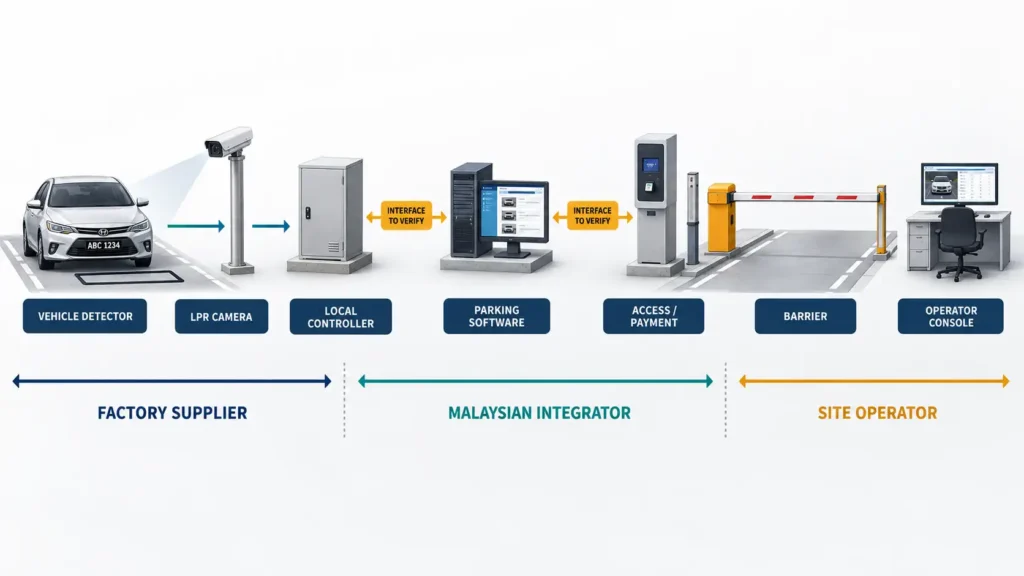
Map the complete path from detection through recognition, rules, access or fee decision, barrier command, payment confirmation and audit record. Name the party responsible for every interface.
For each connection, request its API or protocol, data fields, command sequence, timeouts, authentication, error codes, version policy and test environment. Confirm where processing runs and what works without internet or an upstream application. A listed port, API or payment method does not prove compatibility with a Malaysian third-party platform.
5. Treat the barrier lane as a safety system
Recognition and physical movement must be commissioned together. Specify the required arm type and length, opening and closing behaviour, duty cycle, manual release and recovery after power interruption. Define the role of loops, radar, photocells or other presence sensors in preventing the arm from descending onto a vehicle. Also test tailgating, reversing, a vehicle stopping under the arm and two vehicles entering the detection area closely together.
Conduct physical tests under the approved manufacturer and project method with trained personnel. Never use a person as the obstruction or place anyone beneath the boom.
The safest design is site-specific. Buyers should require the local installer to assess civil works, traffic flow, electrical work, emergency procedures and applicable local requirements. Product options such as rapid gate arm barriers can be shortlisted only after those lane constraints are known.
6. Put privacy and cybersecurity into the tender
Because a plate record may include an image, time, lane and payment or access event, treat it as potentially personal data when it can identify or link to a living person, and obtain Malaysian privacy advice.
For commercial processing, the Personal Data Protection Commissioner’s official introduction to Act 709 outlines controller responsibilities. Its Personal Data Protection Standard 2015 identifies security, retention and data integrity as minimum areas to address.
Document:
- the data controller, processors and authorised user roles;
- every storage and backup location, including any transfer outside Malaysia;
- the purpose for collecting plate images and event data;
- access control, password policy, encryption and audit logging;
- retention periods and secure deletion procedures;
- software patching, vulnerability handling and credential handover;
- incident escalation, backup restoration and data export procedures;
- what data the supplier can access remotely, for what purpose and with whose approval.
This checklist is not legal advice; review the final design and notices against the site’s actual processing.
7. Allocate local and overseas responsibilities explicitly
A factory supplier, local integrator and site operator solve different parts of the project. Shunjie is a China-based LPR and barrier-equipment manufacturer offering OEM/ODM supply; it is not presented here as a Malaysian local installer. For a Malaysian deployment, the contract should identify who performs the site survey, civil and electrical works, networking, local payment or access-control integration, installation, commissioning, user training, on-site response and statutory checks.
For distributors and integrators, factory-level options may be useful for hardware configuration, branding, enclosure design or software discussions. However, every requested change should be captured in a controlled specification with sample approval, version identifiers and responsibility for retesting. Review the relevant ANPR camera or integrated ALPR display terminal only as the beginning of that technical review—not as proof that the complete Malaysian project is already validated.
8. Compare total delivered scope, not unit price
Normalise quotations: one may include only cameras and barriers, while another includes software, detectors, freight, local work and spares. Compare:
- exact model, quantity, firmware and software version;
- licences, subscriptions and future upgrade charges;
- optional and excluded equipment;
- samples, customisation and approval stages;
- packaging, Incoterm, freight, insurance, import responsibilities and taxes;
- local labour, machinery, cabling and civil work;
- recommended commissioning and operational spare parts;
- warranty scope, start point, return process and exclusions;
- remote-support scope and named local first-line support;
- documentation, training and source/configuration backups.
Undefined integrations, spares and exception handling can outweigh a lower camera price.
9. Link payment to FAT, SAT and handover evidence
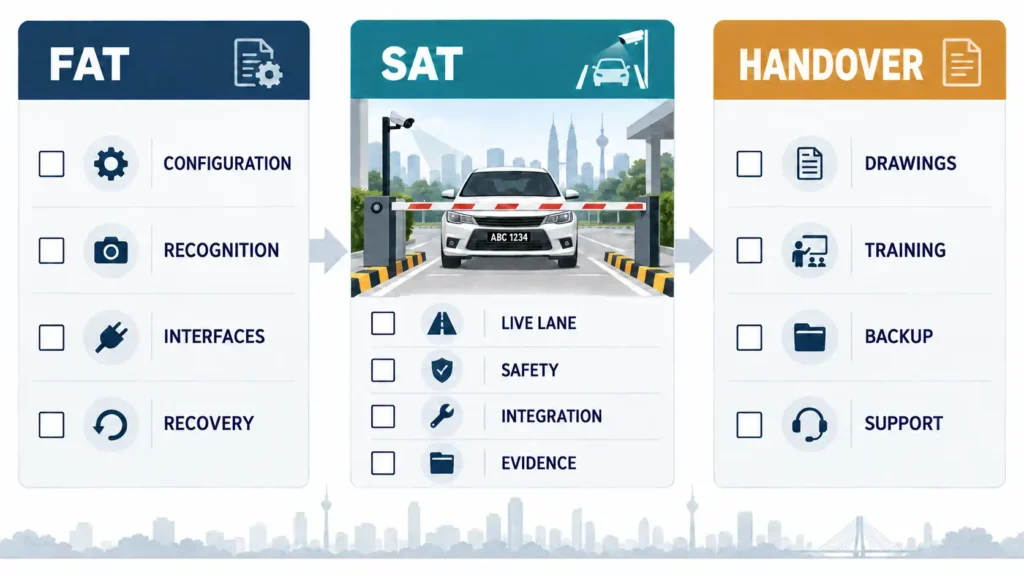
Tie commercial milestones to defined evidence. A factory acceptance test (FAT) before shipment can verify the configured equipment, agreed sample workflow and documented interfaces. A site acceptance test (SAT) should verify the contracted result under installed conditions. The detailed SAT guide owns the metrics, scenario matrix, defect log and retest method; this procurement guide’s role is to make those obligations clear before award.
Handover should include as-built drawings, inventory, configuration backup, credential procedure, manuals, API documents, test records, warranty contacts, spares and an exceptions register with owners and due dates.
A short go/no-go checklist
Before award, the buyer should be able to answer “yes” to all of these questions:
- Is every lane and user journey defined?
- Has a representative Malaysian plate test set been agreed?
- Are recognition, transaction, latency and false-authorisation measures separate?
- Is there a lane drawing with camera and safety zones?
- Does every integration have an owner and test method?
- Are offline, power-loss and manual-recovery behaviours documented?
- Are data location, access, retention, deletion and incident duties clear?
- Are factory, local integrator and operator responsibilities separated?
- Are quotation exclusions and total delivered costs visible?
- Are FAT, SAT and handover evidence tied to acceptance?
If any answer is “no”, close the gap before award. Malaysian distributors and integrators can send Shunjie the lane schedule, drawings, plate formats, interfaces and acceptance plan through the factory contact page. Shunjie can assess the OEM or equipment-supply scope; Malaysian project parties should define local installation, integrations and support.