
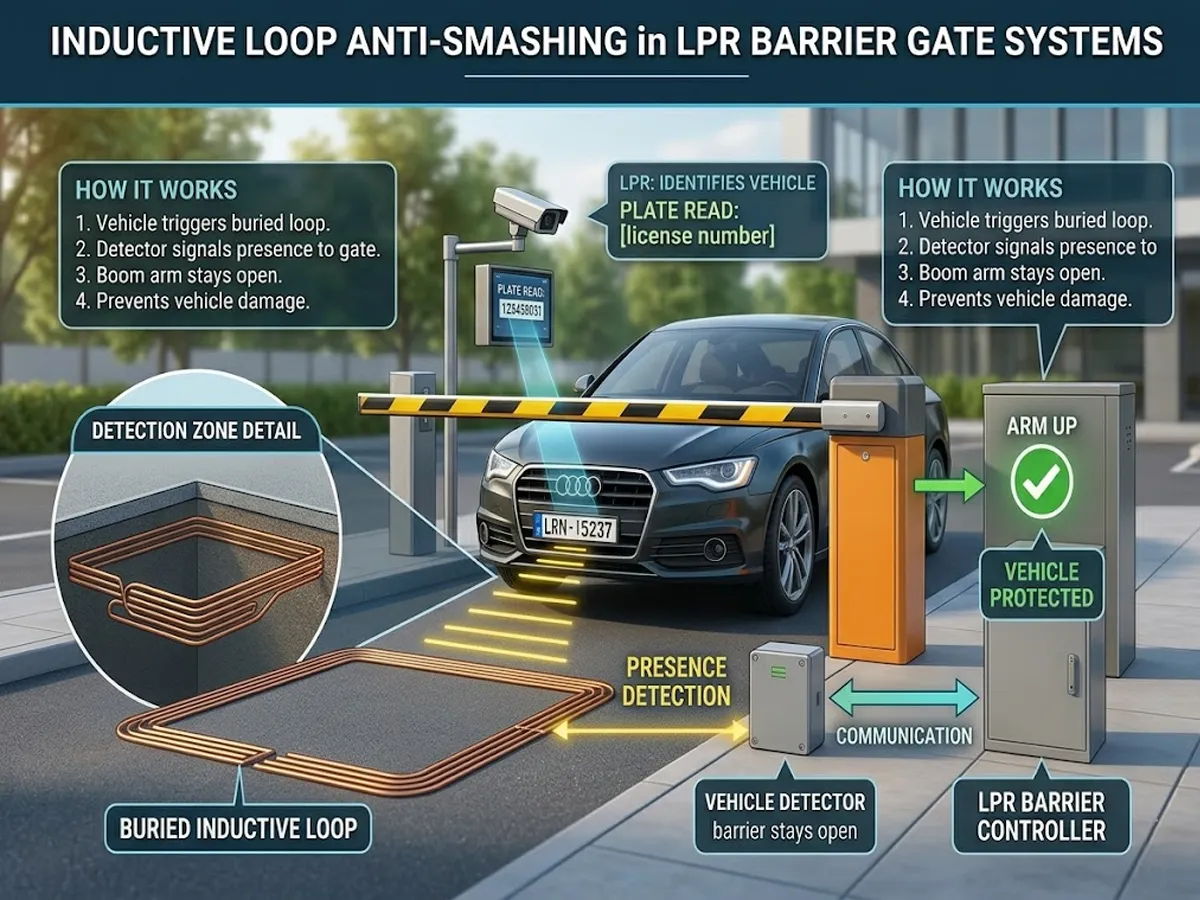
In an LPR barrier gate system, license plate recognition decides whether a vehicle is allowed to pass, but it does not by itself confirm that the vehicle has fully cleared the barrier arm area. That is why inductive loop anti-smashing remains a common design: it gives the barrier gate a real-time vehicle-presence signal so the arm does not drop onto a car that is still passing through. In practice, many parking barrier systems separate these jobs into an opening/trigger function and a safety or anti-smashing function.
What Is Inductive Loop Anti-Smashing in an LPR Barrier Gate System?
Inductive loop anti-smashing is a safety function that uses a buried loop and vehicle detector to tell the barrier gate that a vehicle is still present in the protected zone. When the detector sees a vehicle under or just beyond the boom arm area, the barrier stays open. Only after the vehicle leaves that zone does the closing signal become valid again. Manufacturers commonly describe this as an anti-fall, monitoring, or safety-loop function.
For users, the simplest way to understand it is this: LPR handles identification, while the loop handles presence protection. That combination is one reason LPR barrier systems can stay efficient without giving up basic vehicle safety.
Why LPR Systems Still Need Inductive Loops
An LPR camera can recognize a plate and send an authorization result to the parking system, helping registered or paid vehicles pass quickly through the lane. But camera recognition does not replace the need to know whether the vehicle is still physically under the barrier arm. That is why barrier systems often add a dedicated vehicle-detection input for anti-fall protection even when LPR is already handling access control.
This is especially important in real parking lanes because vehicle movement is not perfectly uniform. A car may slow down, stop briefly, follow another vehicle too closely, or occupy the lane longer than expected. A loop-based anti-smashing signal gives the controller a direct “vehicle still here” input, which is more reliable for closing logic than plate recognition alone. That is also why some barrier manufacturers describe separate opening, monitoring, and presence loops in parking applications.
How the Two Inductive Loops Work
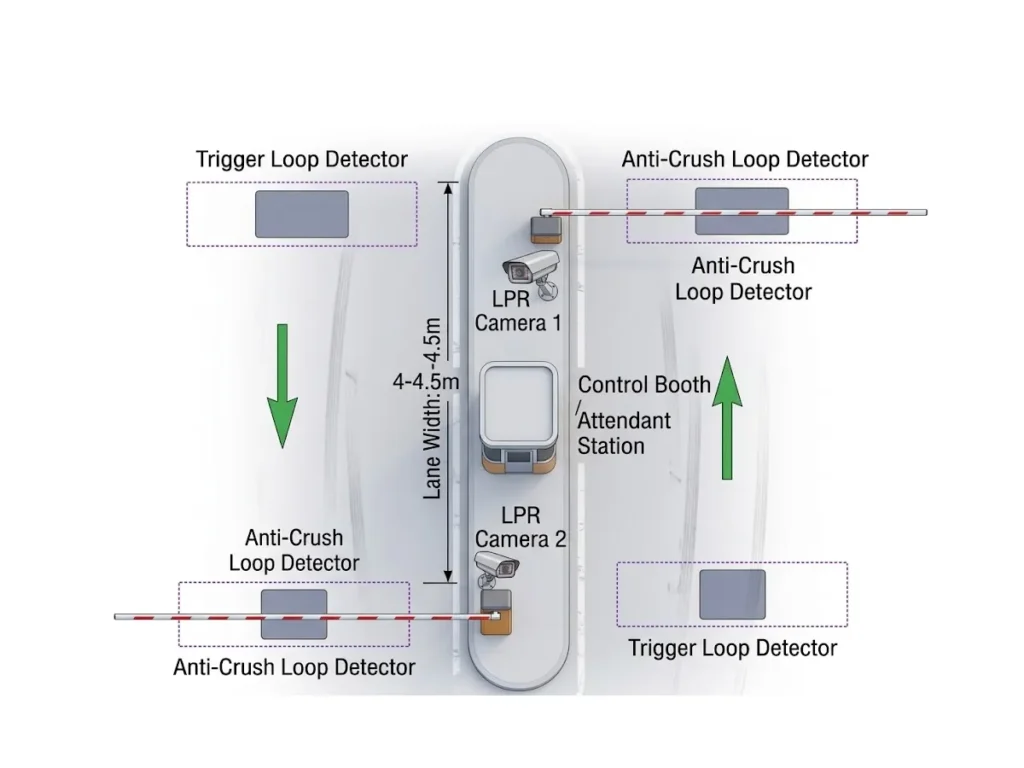
In many parking projects, the first loop is the trigger loop or opening loop. Its job is to detect that a vehicle has arrived in the approach area and send a signal for opening, capture, or lane logic. Depending on the project, that signal may help trigger the camera, confirm a vehicle is present for processing, or release the exit lane.
The second loop is the anti-smashing loop, also called the safety loop or anti-fall vehicle detector. It is installed in the barrier protection zone so the controller knows a vehicle is still under the arm or has not fully cleared the lane. If that signal remains active, the barrier arm should not close. Hikvision’s barrier documentation, for example, specifically instructs that the anti-fall detector be placed behind the barrier so the boom does not fall after the vehicle passes the first detection point and the signal disappears.
Step-by-Step Working Process in an LPR Barrier Gate System
A typical workflow looks like this. The vehicle enters the lane and is identified by the LPR camera. If the plate is authorized, paid, or otherwise approved by the system logic, the barrier receives an opening command. At the same time, loop-based detection helps confirm vehicle presence in the lane so the system is reacting to a real vehicle, not only to data from the camera.
After the barrier arm rises, the vehicle passes through the lane. While the vehicle is still in the protected zone, the anti-smashing loop continues sending an occupied signal. That signal tells the controller to hold the boom open or delay closing. When the vehicle fully leaves the zone and the signal disappears, the barrier can close according to the configured delay and controller logic.
Trigger Loop vs Anti-Smashing Loop: What Is the Difference?
The table below summarizes the two loop roles commonly described in barrier and loop-detector documentation.
| Item | Trigger Loop | Anti-Smashing Loop |
|---|---|---|
| Main purpose | Detect an arriving vehicle and support opening or capture logic | Prevent the boom arm from closing onto a vehicle |
| Typical position | In the approach area, often before the barrier or near the island/reader zone | In the protection zone under or just beyond the barrier arm |
| Signal timing | Active when a vehicle arrives | Active while a vehicle is still in the danger zone |
| Effect on gate movement | Helps start opening, capture, or lane processing | Holds the barrier open and blocks unsafe closing |
| Role in LPR system | Works with the camera to confirm lane activity | Adds physical safety after authorization and opening |
| Main value | Efficient vehicle handling | Vehicle and barrier protection |
Why Inductive Loop Anti-Smashing Is a Common Solution
Loop-based anti-smashing remains common because it is a mature, widely supported method for vehicle detection in parking and barrier control. Manufacturers such as Magnetic and FEIG describe opening, presence, monitoring, and direction-detection loop functions as standard building blocks in professional parking and access systems, which shows how established this approach is across the industry.
Another reason is integration. Loop detectors are already familiar to parking installers and can work alongside LPR, ticket dispensers, readers, and other lane devices. For many projects, they offer a practical balance of safety, reliability, and cost without forcing the entire site to adopt a more complex sensor stack.
Common Applications in Real Projects
This design is well suited to parking lots, office buildings, schools, construction sites, dealerships, and similar sites where vehicles need both fast authorization and safe barrier movement. Official solution pages for parking lots, office buildings, schools, construction sites, and dealership access all show the same basic requirement: efficient vehicle entry and exit, supported by ANPR and barrier control.
It is also a natural fit for mixed projects where some lanes are highly automated and some still involve readers, terminals, or temporary vehicle processing. In those environments, a loop-based safety layer helps keep the closing logic simple even when the authorization logic becomes more complex.
Common Problems and What Causes Them
Most anti-smashing issues are not caused by the idea of loop detection itself, but by placement, sensitivity, interference, or detector setup. Industry detector documentation highlights functions like multiplexing, auto-calibration, frequency management, and continuous readjustment specifically to avoid loop interaction, drift, and unstable detection. That is a good clue about the real-world problems installers need to watch for.
The table below gives a practical troubleshooting view for common parking-lane problems. It is based on typical barrier controller logic and on the loop-detector design issues manufacturers explicitly address in their documentation.
| Problem | Likely Cause | Recommended Solution |
|---|---|---|
| Barrier arm closes too early | Anti-smashing loop is too far from the protected zone, or the occupied signal disappears too soon | Re-check loop position and closing logic so the protected area stays covered until the vehicle fully clears |
| Gate stays open too long | Detector remains occupied because of incorrect sensitivity, damaged wiring, or loop fault | Inspect loop wiring, detector status, and sensitivity settings |
| False detection | Electrical crosstalk, poor shielding, frequency conflict, or unstable installation | Use proper wiring practices, correct detector frequency settings, and multiplex/synchronization where supported |
| Missed detection | Sensitivity too low or loop layout not matched to the lane and vehicle mix | Re-tune sensitivity and verify loop geometry for the actual lane conditions |
| Unstable performance over time | Environmental drift, aging cable, moisture ingress, or poor sealing | Use quality installation materials and detectors with auto-adjustment; inspect periodically |
Installation and Layout Recommendations
The most important installation principle is simple: the trigger loop should detect arrival, while the anti-smashing loop should cover the danger zone where a falling arm could hit the vehicle. Barrier manuals and loop-module documentation repeatedly separate these functions, which is why copying one loop position for both jobs usually leads to poor results.
In practice, installers should match the loop layout to lane width, vehicle mix, controller logic, and boom length. Hikvision’s manual, for example, notes a typical anti-fall detector width of about 1 meter and suggests widening it for larger vehicles, but the broader lesson is that layout should follow the actual traffic scenario rather than a one-size-fits-all drawing. Final testing should always be done with real vehicles, including slow-moving vehicles and larger vehicles, before the lane is handed over.
When Should You Add Other Safety Sensors Besides the Loop?
Inductive loops are very strong for vehicle presence detection, but they are still vehicle-focused sensors. When a project also needs reliable protection for pedestrians, mixed traffic, or unusual lane behavior, adding radar or infrared can make sense. Both Hikvision and FEIG describe radar-based barrier safety as an option that can detect vehicles and pedestrians and keep the barrier open when the passageway is not clear.
That does not make loops obsolete. It simply means the best sensor stack depends on the site. For many standard vehicle-only parking lanes, loop anti-smashing is still a practical solution. For lanes with pedestrians, cyclists, awkward geometry, or high safety expectations, combining loops with radar or infrared usually gives a more complete protection strategy.
FAQ
Is LPR alone enough to prevent barrier arm smashing?
No. LPR is excellent for identification and authorization, but anti-smashing requires a reliable presence signal in the protected zone. That is why barrier systems often keep a separate anti-fall or safety detector even when LPR is already installed.
What is the difference between a trigger loop and an anti-smashing loop?
A trigger loop helps the system react to an arriving vehicle, while an anti-smashing loop prevents unsafe closing when a vehicle is still under or beyond the boom arm area. They use the same detection principle but serve different control purposes.
Where should the anti-smashing loop be installed?
It should be installed in the barrier protection zone, not just in the approach area. One official barrier manual specifically says the anti-fall detector should be behind the barrier so the boom does not drop after the first signal disappears too early.
Can inductive loops work together with radar or infrared?
Yes. Many barrier systems support multiple safety methods, and manufacturers explicitly document anti-fall functions via inductive loop, infrared, or radar depending on the project requirement.
Why does the barrier arm stay open after the vehicle passes?
Usually because the controller still sees an occupied safety signal, or because the close-delay logic has not expired yet. The first things to check are loop status, wiring, sensitivity, and whether the protected zone is being cleared correctly.
Is inductive loop anti-smashing suitable for all parking projects?
It is suitable for many standard vehicle-access lanes, but not always sufficient by itself where pedestrians mix with vehicles or where the site demands broader object detection. In those cases, radar or other sensors may need to supplement the loop.