What ANPR/ALPR captures in a parking context
ANPR (Automatic Number Plate Recognition) and ALPR (Automatic License Plate Recognition) refer to the same class of systems—the naming varies by region. In parking, the goal is not “OCR for its own sake,” but making correct operational decisions: open/deny, start/stop a parking session, enforce rules, and produce audit evidence.
The canonical parking “data objects” you should design for
Regulatory guidance from Information Commissioner’s Office (UK) describes what ANPR systems generally capture:
- an overview image of the vehicle,
- a plate patch image of the number plate,
- the VRM (vehicle registration mark / plate text),
and often supplements this with date, time, and location.
From an integration and dispute-handling perspective, a practical event record often includes:
| Data element | What it looks like | Why you need it in parking |
|---|---|---|
| Overview image | Full vehicle context frame | Customer disputes, vehicle context, fraud review. |
| Plate patch image | Cropped plate region | Evidence of readability; helps manual reviewers correct OCR. |
| Plate text (VRM/LPN) | “ABC1234” / local format | Primary identifier for sessions, permits, enforcement matching. |
| Timestamp(s) | capture time + processing time | Pair entry/exit, calculate duration, reconcile payments; some systems carry both camera and processing timestamps. |
| Location / lane / zone ID | Lane 3 / Gate A | Critical when a site has multiple entry/exit points; enables troubleshooting by lane. |
| Confidence / score | 0–100 or 0–1 | Supports thresholding and “manual review” routing rather than hard failures. |
| Optional “alerts” | allowlist hit / blocklist hit | Enables permit enforcement and security workflows. |
One concrete integration example (parking management context) shows “Event ID, Lane ID, License Plate Data, Confidence Level, Alerts, Images” as part of the event payload passed from an ALPR system into parking/access software.
Why auditability matters more than OCR “accuracy claims”
Disputes typically arise from mismatched sessions (wrong plate, wrong lane pairing, tailgating, or OCR confusion). The UK regulator advises that where you cross-reference ANPR data with other databases, those databases should be up-to-date, accurate, and of sufficient quality to prevent mismatches, and that both cameras and algorithms must be of sufficient quality to prevent misidentification.
Operationally, this means “plate text alone” is insufficient. The images, timestamps, and lane identifiers are what allow you to (a) resolve customer complaints fairly, (b) explain why a decision was made, and (c) improve the system over time without guesswork.
Core parking use cases and deployment models
Parking LPR is most successful when the use case is explicitly defined and the workflow is designed around real conditions (lighting, lane geometry, plate variability, customer behavior).
Ticketless access in gated facilities
Ticketless parking commonly uses LPR cameras to scan the plate and link it with entry time, removing the need to carry a paper ticket. Some systems emphasize that the approach-to-barrier process can be “almost uninterrupted,” helping avoid congestion at peak occupancy.
Ticketless can also be hybrid (LPR + classic tickets). For example, SKIDATA explicitly describes modernizing a ticket-based setup into LPR-based access while still supporting combination modes, and highlights reduced friction and fewer “lost ticket” issues.
Barrierless / free-flow / “gateless” models
Many vendors position barrierless systems as a way to reduce mechanical points of failure and improve flow, but these models put even higher pressure on read reliability and enforcement logic. A common pattern is to treat the license plate as the “digital credential” that triggers a session and later a payment/enforcement outcome.
Mixed credential environments: plate + app/QR + RFID/NFC
In real deployments, LPR is frequently one identity factor among several. Amano McGann presents contactless parking as a portfolio of options that can include LPR, Bluetooth, NFC, and mobile payments—useful when different customer groups require different flows.
Contract parking, permits, allowlists/blocklists, and enforcement loops
A common high-confidence scenario is “known vehicles”: residents, employees, contractors. Some on-camera solutions explicitly verify plates against an allowlist or blocklist stored locally in the camera—useful for edge-first access control.
On the enforcement side, vendor documentation for ALPR platforms describes use in “municipal and commercial organizations” to enforce parking restrictions, with support for both fixed and mobile installations. Airports are a representative segment: one recent industry article argues airports often combine fixed (lane/garage) and mobile (patrol) LPR for coverage and compliance programs.

System architecture overview: cameras → reads → decisions
Parking ANPR/ALPR architecture typically decomposes into: capture, recognition, decisioning, business system integration, and evidence storage. Where each stage runs (edge vs on-prem vs cloud) has major implications for latency, bandwidth, and privacy.
Reference architectures
Edge-first (on-camera / on-edge device)
On-camera LPR can directly trigger gate/barrier I/O for allowlisted vehicles. One documented entry/exit scenario requires an LPR app embedded on a camera plus I/O support (or a relay module) to open and close the barrier. This architecture can reduce dependency on upstream network latency for basic access decisions.
On-prem / local server
Traditional ALPR deployments may send images/reads to a local server/VMS or an ALPR manager role; the local layer performs storage, matching, reporting, and integration to PARCS.
Cloud-assisted / cloud storage
Some ticketless implementations emphasize cloud data storage to avoid maintaining a local server and to reduce risk of data loss. The parking tradeoff is governance: you must understand where personal data is stored and who can access it.
Interoperability building blocks: IP video + metadata/event streaming
When you integrate LPR into broader parking platforms (VMS, access control, analytics), interoperability matters.
ONVIF Profile T is a widely used IP video profile and includes support for imaging, metadata streaming, and motion alarm events (and may support analytics, I/O, and relay outputs).
The ONVIF Streaming Specification distinguishes media vs control planes and defines interoperable streaming of audio/video/metadata; it also describes metadata streaming as a container for real-time analytics/status/notification data.
From an ALPR event-ingestion standpoint, a webhook approach is common: Plate Recognizer documents sending a POST payload with JSON plus image files (vehicle image, plate image, etc.), including timestamps for arrival time and (if available) camera capture time.
A practical event flow for ticketless parking
Below is a mermaid reference flow you can adapt to your system docs. (For production, ensure your actual implementation defines idempotency and retry behavior, and that the “open barrier” step has safe fallbacks.)
mermaid
flowchart LR
A[Vehicle approaches entry lane] –> B[Capture: overview + plate patch]
B –> C[ALPR/ANPR read + confidence score]
C –> D{Match rule}
D –>|Permit/allowlist match| E[Create or update parking session]
D –>|Unknown or low confidence| F[Fallback: ticket/app/QR or manual review]
E –> G[Payment: pay station/app/autopay]
G –> H[Exit capture + read]
H –> I{Exit verification}
I –>|Paid + session match| J[Open barrier / allow free-flow exit]
I –>|Mismatch / unpaid| K[Prompt payment or route to dispute workflow]
Suggested diagrams for this page (high indexing and usability value)
- System architecture diagram (edge vs on-prem vs cloud): show where images and plate text are processed and stored; include data flow arrows and trust boundaries.
- Data object model graphic: show the ALPR event fields (Event ID, Lane ID, plate text, confidence, images, timestamp) flowing into PARCS and analytics.
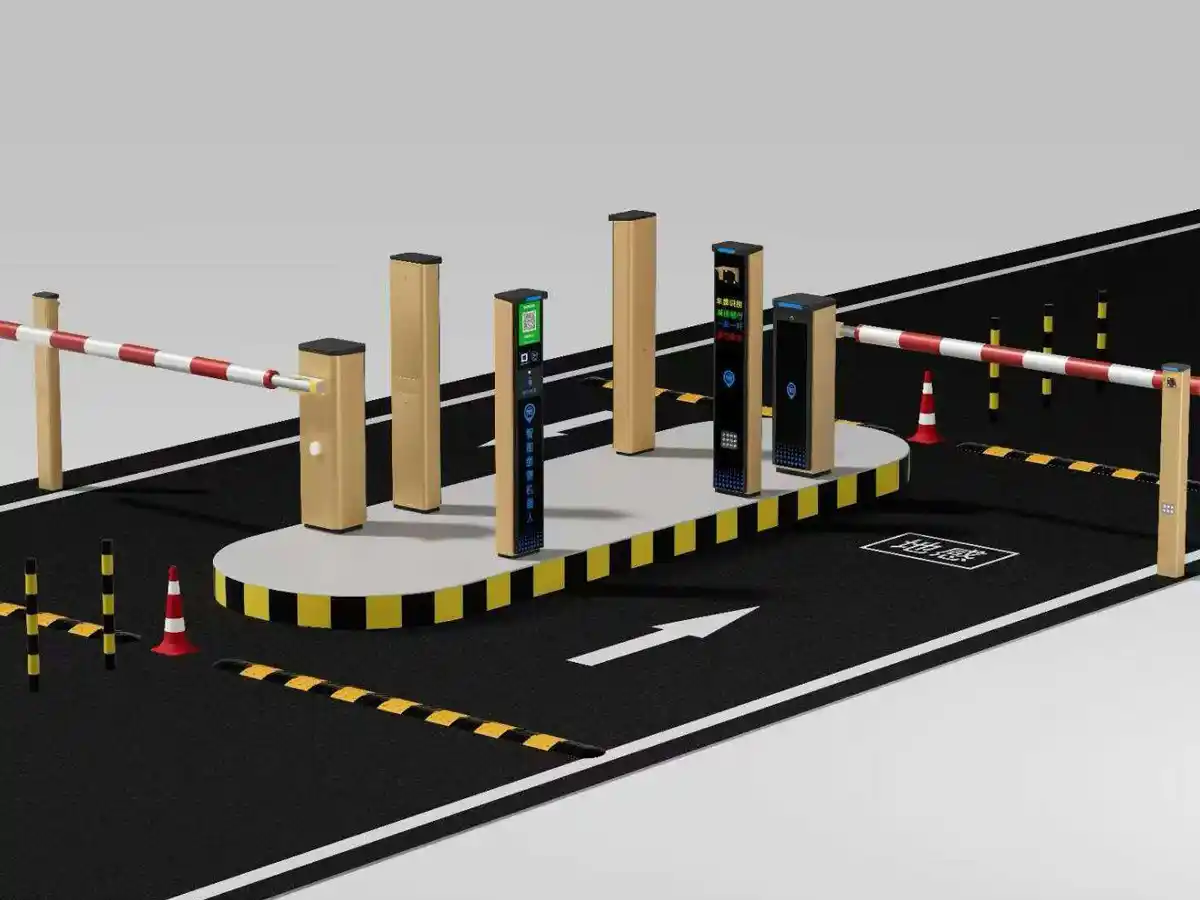
- Annotated lane photo: entrance camera + illuminator + barrier + pay station; label “capture zone,” “stop line,” and typical occlusion threats (SUV tailgate, tow hitch, dirt).
Benefits and measurable KPIs: flow, fraud, and operations
Parking LPR is often sold as “convenience,” but the operational case should be built on measurable KPIs tied to revenue assurance and cost-to-serve.
Flow and throughput
In ticketless implementations, vendors argue that near-continuous entry reduces congestion risk at high occupancy.
A published parking case study reports that after new equipment installation, throughput increased during busy periods and queues reduced.
A PARCS vendor frames the throughput problem simply: every manual step (swiping/scanning) adds time; identifying vehicles via LPR can yield smoother entry/exit for monthly and transient parkers.
KPIs to track (examples): average queue time by lane, vehicles processed per minute, % of “no-stop” entries, barrier open time, and “manual intervention rate.” (Tie these to customer satisfaction and peak-hour staffing.)
Fraud prevention and revenue assurance
One parking vendor describes the license plate as a “virtual ticket” and emphasizes entry/exit matching to reduce ticket swapping and fraud.
A dedicated LPR leaflet also describes “ticket and license plate have to match at entry and exit,” positioning this as a fraud-prevention mechanism.
KPIs to track: ticket swap incidents, unpaid exits, tailgating indicators, permit abuse rate, and recovered revenue from enforcement/dispute resolution.
Reduced ticket handling and operational overhead
A ticketless workflow eliminates the need for customers to keep a paper ticket safe (no loss/damage risk) because entry time and identity are linked digitally.
SKIDATA highlights fewer “lost ticket” issues and smoother entry/exit when LPR is used for access.
KPIs to track: lost ticket incidents, customer support contacts per 1,000 sessions, equipment downtime related to ticket dispensers/readers, and maintenance visits.
Analytics: occupancy, dwell times, and pricing inputs
Some operators position LPR as a data foundation for occupancy-driven pricing and automated enforcement. One operator-facing article claims LPR enables automated payment collection, violation detection, and dynamic pricing inputs, reporting revenue increases for participating properties (self-reported outcomes).
For airports and large mobility hubs, a sector-specific article describes fixed LPR as providing continuous identification and analytics (dwell time, turnaround, peak congestion), with integration into revenue systems and enforcement.
KPIs to track: occupancy accuracy vs ground truth, dwell-time distribution, peak utilization, conversion to prepaid/reserved sessions, and enforcement yield.
Cost factors to include in your ROI model
Your ROI conversation should explicitly separate:
Capital expenditure: cameras (LPR + context), lighting/IR, mounts, lane civil work, networking/PoE switches, edge compute (if used). Capture quality requirements are highly sensitive to lane geometry and camera settings.
Operating expenditure: software licensing, cloud storage/egress (if applicable), monitoring, cleaning (lenses/illuminators), periodic re-calibration and seasonal tuning. The ability to avoid maintaining a local server is cited as an operational advantage in cloud-storage ticketless designs—but must be weighed against governance and connectivity requirements.
Risks and governance: privacy, accuracy, and dispute handling
Parking LPR systems process vehicle identifiers at scale. That creates material governance obligations and technical risks—especially for barrierless deployments where automation has fewer “human checkpoints.”
Privacy and legality: treat plates as personal data unless proven otherwise
The UK regulator explicitly states that ANPR can collect and analyze large quantities of personal data in real time and that cameras process personal data when vehicles pass through their field of view; it notes ANPR is also used in privately owned car parks.
It also states: “In most circumstances, a VRM is personal data,” depending on the context and the system purpose (for example, identifying an individual to take action such as a parking fine).
Practical compliance controls recommended by the same guidance include: conduct a DPIA, minimize camera count, justify camera placement, provide clear signage, define retention/disposal policies, and maintain governance processes to retrieve data for access requests or disclosures.
Note that the ICO’s surveillance guidance (including ANPR) is flagged as under review due to a UK law change in June 2025.
For EU contexts, European Data Protection Board provides GDPR-oriented guidelines on processing personal data through video devices.
System-level privacy feature examples. One enterprise ALPR platform documents privacy settings that can obscure plate numbers and/or exclude plate/context/wheel images from being stored in the ALPR database, explicitly positioning this as supporting compliance with regional privacy laws.
Accuracy is an engineering outcome: angles, shutter, gain, and weather matter
Parking operators should not treat LPR as a “magic black box.” Multiple authoritative sources (vendor engineering guides + peer-reviewed studies) show accuracy depends heavily on capture quality and environmental robustness.
Angles and dwell time in frame. One installation guide notes that reducing camera angles increases time in field of view and improves chances of successful reads; it provides allowable deviation guidance (up to 30° vertical, 50° horizontal) while advising smaller angles for fast vehicles.
Motion blur and shutter-speed budgets. A license plate capture guide from Axis Communications explains that moving vehicles cause motion blur if shutter time is too long and provides a table of recommended maximum shutter times based on vehicle speed and camera angle.
Reflective plates and IR overexposure. The same guide explains that reflective plates can overexpose under intense IR, making them impossible to read, and recommends limiting maximum gain; it also warns that WDR can cause motion artifacts and recommends turning WDR off for license plate capture unless specified otherwise.
Retro-reflectivity and illuminator alignment. Guidance from Metrici explains that because plates have retro-reflective properties, the camera and IR illuminator (if separate) should be mounted close together so their optical axes are as close/parallel as possible; it also provides practical limits on angles and notes occlusions/objects to avoid.
Weather distortions can collapse performance. A peer-reviewed 2024 evaluation study reports that weather distortions (rain/brightness/fog/frost/snow) significantly impacted ALPR systems, with snow and frost often reducing accuracy to near zero; even minimal camera read noise caused noticeable drops in recognition.
Datasets and training: international plate diversity and “generalization gaps”
If you operate across countries (plate layouts, fonts, scripts), model generalization is a strategic risk.
A cross-dataset study argues that evaluation “within each dataset” may not indicate real generalization ability; it reports significant performance drops when using “leave-one-dataset-out” evaluation across multiple datasets.
A widely cited “robust ALPR” paper discusses how many datasets have constraints (static camera, simple backgrounds, limited variation), and motivates more realistic datasets and augmentation to handle varied capture conditions.
Parking-specific implication: your acceptance test should reflect your real plate mix (countries, states/provinces, motorcycles, commercial vehicles), not only a vendor’s “best-case demo lane.”
False positives/negatives mitigation: confidence thresholds + multi-factor fallbacks
Most production systems operationalize confidence rather than trying to eliminate uncertainty.
An on-camera LPR application explicitly describes a “confidence threshold,” noting that detections below the selected level won’t appear in the event list; it also suggests lowering the confidence threshold in low lighting to allow more detections (which can increase recall but may increase false positives).
An enterprise ALPR platform defines a “Confidence Score” (0–100) for each read and demonstrates using it in rule conditions (e.g., trigger actions only if confidence > 80).
Multi-factor verification is not a defeat—it’s good design. One access-control scenario explicitly recommends using a door controller and card reader as backup for vehicle access control. This is the same principle in parking: if a lane is high-occlusion or high-glare, use hybrid identity methods (plate + QR/app/RFID) to keep customer experience high without sacrificing revenue assurance.
Maintenance and monitoring: treat LPR as a living system
Parking LPR “drifts” because environments drift: seasons, sun angle, construction cones, newly installed signage reflecting IR, dirty lenses, and firmware changes.
A practical engineering configuration guide from Rekor Systems recommends focusing/zooming procedures and suggests shutter limits (e.g., 1/500–1/1000 depending on lane distance) and turning WDR off for better plate capture consistency.
Operationally, you should continuously monitor by lane: read rate, manual review rate, and mismatch/dispute rates—then trigger maintenance when metrics fall below site acceptance targets. (This aligns with regulator expectations that systems be of sufficient quality to prevent mismatches and misidentification.)
A dispute-ready evidence pack: what to store and what to delete
A robust parking LPR deployment defines two different data retention paths:
- “Decision evidence” retention: keep what you need to justify a decision (images + timestamps + confidence + lane ID) for a defined period aligned with dispute windows.
- “Non-interest” deletion: regulators provide an example that retaining data about vehicles that complied with a parking limit for an extended period may be unnecessary; systems should delete data about vehicles “not of interest” when appropriate.
Where supported, privacy settings that obscure plate text or exclude images can reduce stored data while retaining operational utility—but must be tested because they can also reduce dispute resolvability.
Appendix: Source-backed “recommended external links” for your page
- Regulator guidance on what ANPR captures, whether VRMs are personal data, DPIA/signage/retention expectations
- EU video-surveillance data protection guidelines
- Parking ticketless workflow references and hybrid ticket + LPR positioning
- Parking fraud-prevention framing via entry/exit matching (“virtual ticket”)
- Interoperability and metadata streaming standards
- Peer-reviewed evidence on distortion/weather impacts on ALPR reliability
- Cross-dataset generalization evidence (why international plate diversity matters)
Work with an ANPR/ALPR Manufacturer
For OEM customization, technical integration support, or volume pricing, reach us here: https://shunjiebarrier.com/contact/