
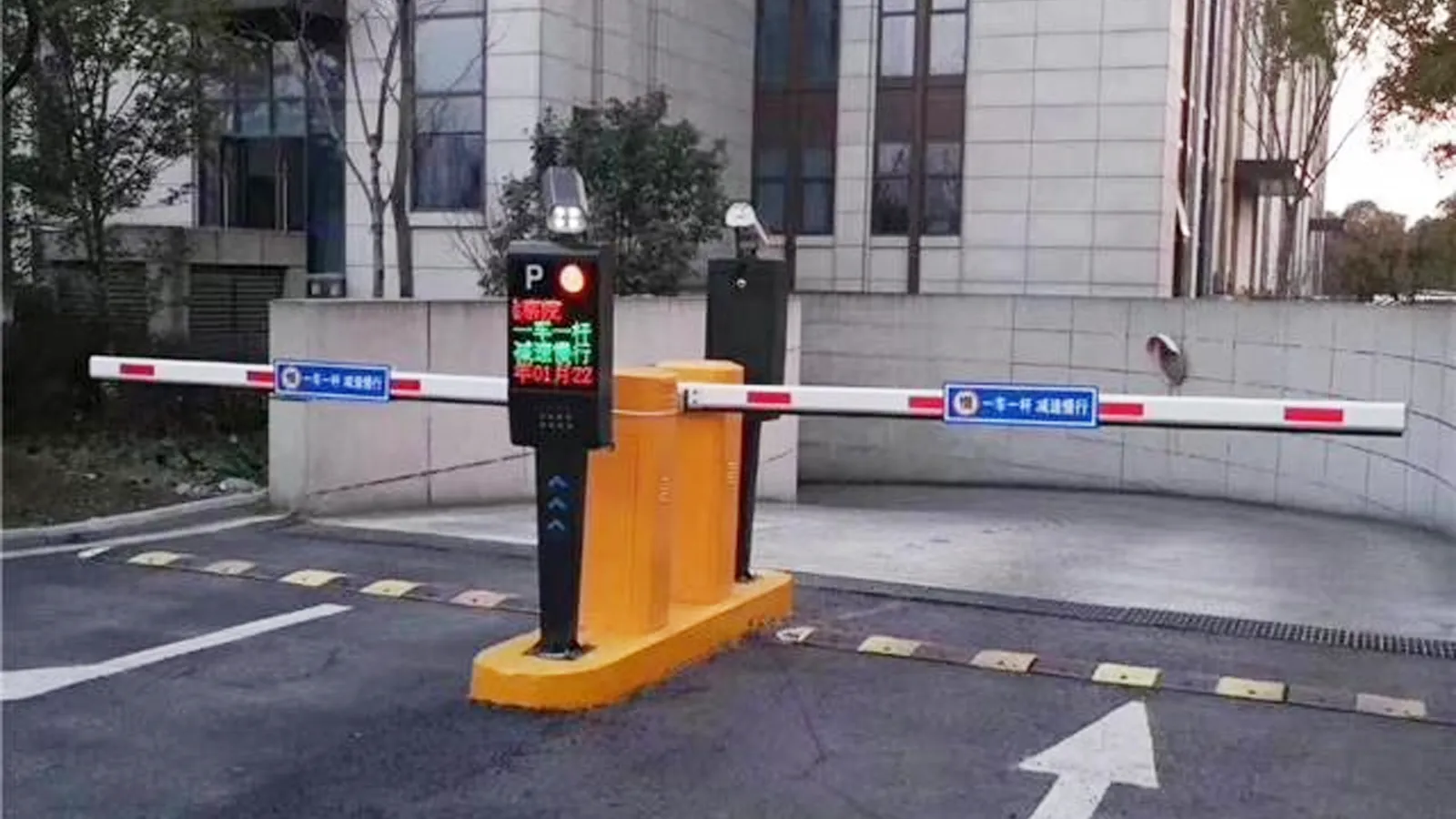
An LPR parking system is a parking access and management solution that uses cameras and recognition software to read a vehicle’s license plate at entry and exit. In practice, the plate becomes the vehicle’s credential, which the system can use for barrier opening, session tracking, payment, permit checking, validation, and audit records. In many markets, LPR, ANPR, and ALPR refer to the same core technology, with the name changing mostly by region.
What Is an LPR Parking System?
At a simple level, an LPR parking system replaces part or all of the traditional ticket, card, or manual gate process with automatic plate recognition. When a vehicle arrives, the system captures the plate, converts it into searchable text, checks the parking rules or database, and then decides what to do next, such as open a barrier, start a parking session, or request payment.
This is why LPR is commonly used in ticketless parking, virtual permits, staff and resident access, visitor parking, and mixed-use sites where operators want faster throughput without losing control. Universities and other managed sites also use license plates as virtual permits instead of decals or hangtags.
What Are the Main Components of an LPR Parking System?
A real parking LPR solution is more than a camera. Most deployments combine image capture, vehicle detection, recognition software, parking logic, and hardware such as gates, kiosks, intercoms, or payment tools. In gated lanes, operators also commonly use loop detectors or similar vehicle-presence devices because plate recognition alone does not tell the barrier whether a vehicle is still physically under the arm.
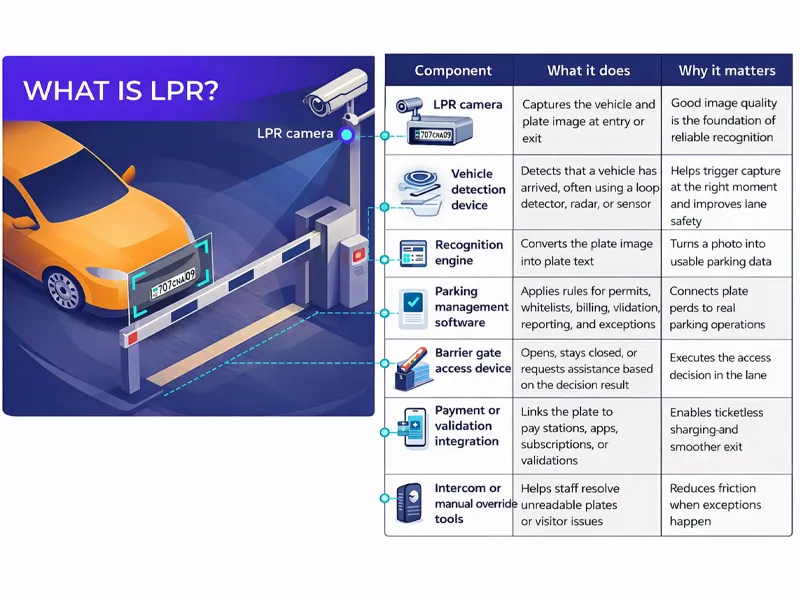
The table below summarizes the core components readers usually need to understand first.
| Component | What it does | Why it matters |
|---|---|---|
| LPR camera | Captures the vehicle and plate image at entry or exit | Good image quality is the foundation of reliable recognition |
| Vehicle detection device | Detects that a vehicle has arrived, often using a loop detector, radar, or sensor | Helps trigger capture at the right moment and improves lane safety |
| Recognition engine | Converts the plate image into plate text | Turns a photo into usable parking data |
| Parking management software | Applies rules for permits, whitelists, billing, validation, reporting, and exceptions | Connects plate reads to real parking operations |
| Barrier gate or access device | Opens, stays closed, or requests assistance based on the decision result | Executes the access decision in the lane |
| Payment or validation integration | Links the plate to pay stations, apps, subscriptions, or validations | Enables ticketless charging and smoother exit |
| Intercom or manual override tools | Helps staff resolve unreadable plates or visitor issues | Reduces friction when exceptions happen |
How Does the Workflow Work from Entry to Exit?
The workflow is usually straightforward: detect the vehicle, capture the plate, read the characters, check the rule or payment status, and then allow or deny exit or entry. In ticketless systems, the plate is used as the lookup key throughout the stay.
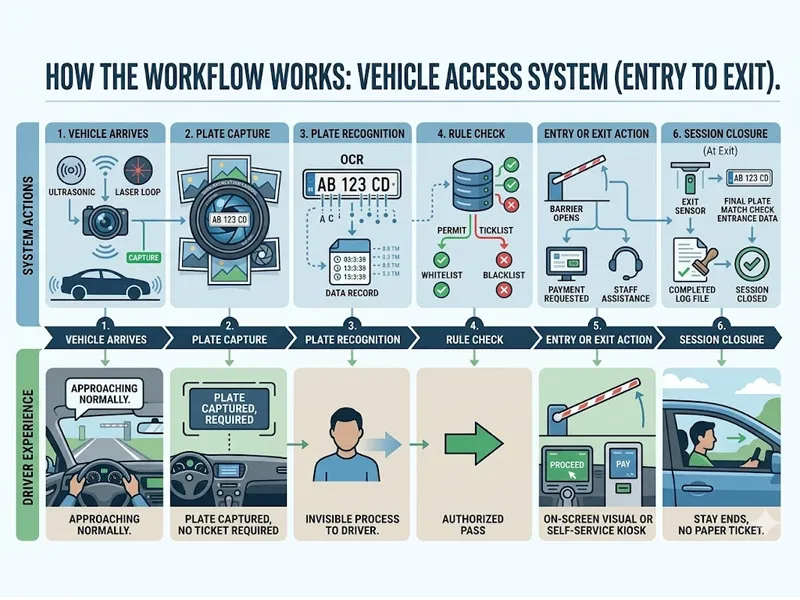
The driver experience and the system workflow often look like this:
| Workflow stage | What the system does | What the driver experiences |
|---|---|---|
| 1. Vehicle arrives | Sensor or loop detects the vehicle and triggers image capture | The driver approaches the lane normally |
| 2. Plate capture | Camera records one or more images of the plate and vehicle | Usually no ticket pull is needed |
| 3. Plate recognition | Software reads the plate characters and creates an event record with time and lane data | The process is mostly invisible to the driver |
| 4. Rule check | The system checks permits, whitelist/blacklist rules, booking status, validation, or payment logic | Authorized users may pass automatically |
| 5. Entry or exit action | Barrier opens, payment is requested, or staff assistance is triggered | The driver either proceeds or follows on-screen instructions |
| 6. Session closure | At exit, the system matches the plate, confirms payment or permission, logs the event, and closes the stay | The stay ends without a paper ticket in a ticketless setup |
What happens in a typical lane?
At the entrance, the camera reads the plate and the system creates an entry record. If the vehicle is approved, the barrier can open automatically; if not, the lane may fall back to an intercom, ticket, or manual approval step. At the exit, the system reads the plate again, matches it to the visit record, checks whether the session is paid or authorized, and then releases the vehicle if the conditions are met.
Why exception handling matters
A good LPR parking system is not judged only by how it handles easy reads. It also needs a plan for unreadable plates, dirty or damaged plates, tailgating, temporary plates, visitors without preregistration, and mixed vehicle types. Poor exception handling is one of the fastest ways to create disputes and “mystery sessions” in ticketless parking.
What Are the Key Benefits of an LPR Parking System?
The main benefit is speed. Because the system can identify the vehicle automatically, it reduces the need for drivers to stop for tickets, cards, or manual checks. That improves entry and exit flow and often reduces queues at busy times.
LPR also improves convenience. Drivers do not need to keep track of paper tickets in a fully ticketless setup, and operators can manage monthly users, staff, residents, and visitors with the plate as the identifier. This model is also widely used for virtual permits.
For operators, the benefits are operational as well as customer-facing. LPR systems can reduce consumables, automate routine access decisions, create clearer entry/exit records, and generate usage data that supports reporting and planning. They can also be deployed in hybrid mode, where operators keep existing ticket workflows for some users while adding plate-based access for others.
What Are the Common Challenges?
The biggest challenge is real-world read performance. Parking LPR depends heavily on image quality, not just software claims. Camera angle, mounting position, distance, lighting, glare, headlight flare, weather, lane design, and plate occlusion can all affect results. If the captured image is blurred, overexposed, too small, or blocked, even a strong recognition engine cannot fully recover the characters.
The second challenge is integration. Buyers often underestimate how much the final result depends on smooth integration with barriers, payment systems, software, databases, networks, and operating procedures. This is why vendor experience, reference projects, planning quality, and support matter as much as the camera specification sheet.
The third challenge is data governance. In many parking and surveillance contexts, a vehicle registration mark may be treated as personal data, especially when it is processed to identify an individual or take action. Operators should therefore define a clear purpose for collection, limit access, set sensible retention rules, and align the deployment with local privacy requirements.
Where Are LPR Parking Systems Commonly Used?
LPR parking is widely used in residential communities, office parks, shopping centers, hospitals, hotels, factories, campuses, airports, and public parking facilities. What changes from one site to another is not the basic technology, but the rule set behind it: resident access, employee permissions, visitor validation, revenue control, enforcement, or mixed-use traffic management.
For example, a residential or office site may focus on whitelist access and tenant convenience, while a commercial car park may focus more on ticketless payment, turnover, validation, and revenue protection. Universities often use the plate as a virtual permit, while larger public sites may combine LPR with traditional tickets, apps, or other identifiers for flexibility.
How to Choose the Right LPR Parking System
When comparing options, start with the questions that affect daily performance rather than brochure claims. Ask whether the system supports your local plate formats, whether the vendor can show real parking references similar to your site, and whether the lane design has been considered as part of the solution.
Next, check the integration path. A practical system should work cleanly with your barriers, software, payment flow, and exception process. Hybrid operation can also be valuable, especially if you want to upgrade gradually instead of replacing everything at once.
Finally, compare total cost of ownership, not just the initial quote. Planning, installation, networking, storage, software licensing, maintenance, support response, and future upgrades all affect long-term value. Buyers should also ask how the system performs in rain, glare, nighttime conditions, and unreadable-plate scenarios, because field performance matters more than lab demos.
FAQs
Is LPR the same as ANPR?
Usually yes. LPR, ANPR, and ALPR typically describe the same basic process of reading a vehicle plate with cameras and recognition software, with the label varying by market or region.
Can an LPR parking system work without tickets?
Yes. Many deployments use ticketless operation where the plate becomes the parking credential, although some sites choose hybrid setups that combine LPR with tickets or other identifiers.
Does an LPR system always need a barrier gate?
No. Some sites use LPR in barrier-controlled lanes, while others use it in semi-gated or barrierless workflows for access, validation, payment, or enforcement. The right model depends on the site’s security and revenue-control needs.
How accurate is LPR in rain or at night?
Accuracy depends heavily on installation quality and operating conditions. Lighting, plate visibility, camera angle, shutter settings, glare, weather, and occlusion all affect results, so buyers should ask for real-world evidence rather than relying only on a headline accuracy number.
What happens if the system cannot read a plate?
A well-designed parking system should have exception handling, such as intercom support, manual review, fallback credentials, or staff override. This is important because unreadable plates and edge cases are normal in real operations.
Is license plate data personal data?
In many contexts, yes. Regulators note that a vehicle registration mark may be personal data when it is collected and used as part of a surveillance process to identify an individual or take action. Operators should assess the local legal context and set appropriate controls.
Conclusion
An LPR parking system is best understood as a complete workflow, not just a camera. The camera captures the plate, the software interprets it, the parking platform applies the rules, and the lane hardware or payment system carries out the decision. When those pieces are designed well together, LPR can deliver faster access, less friction, better records, and more flexible parking control.
For parking operators evaluating a new project, the most important question is not “Does the camera read plates?” but “Will the whole system still work reliably in my real lane, with my users, my payment flow, and my exceptions?” That is usually the difference between a smooth deployment and a frustrating one.