
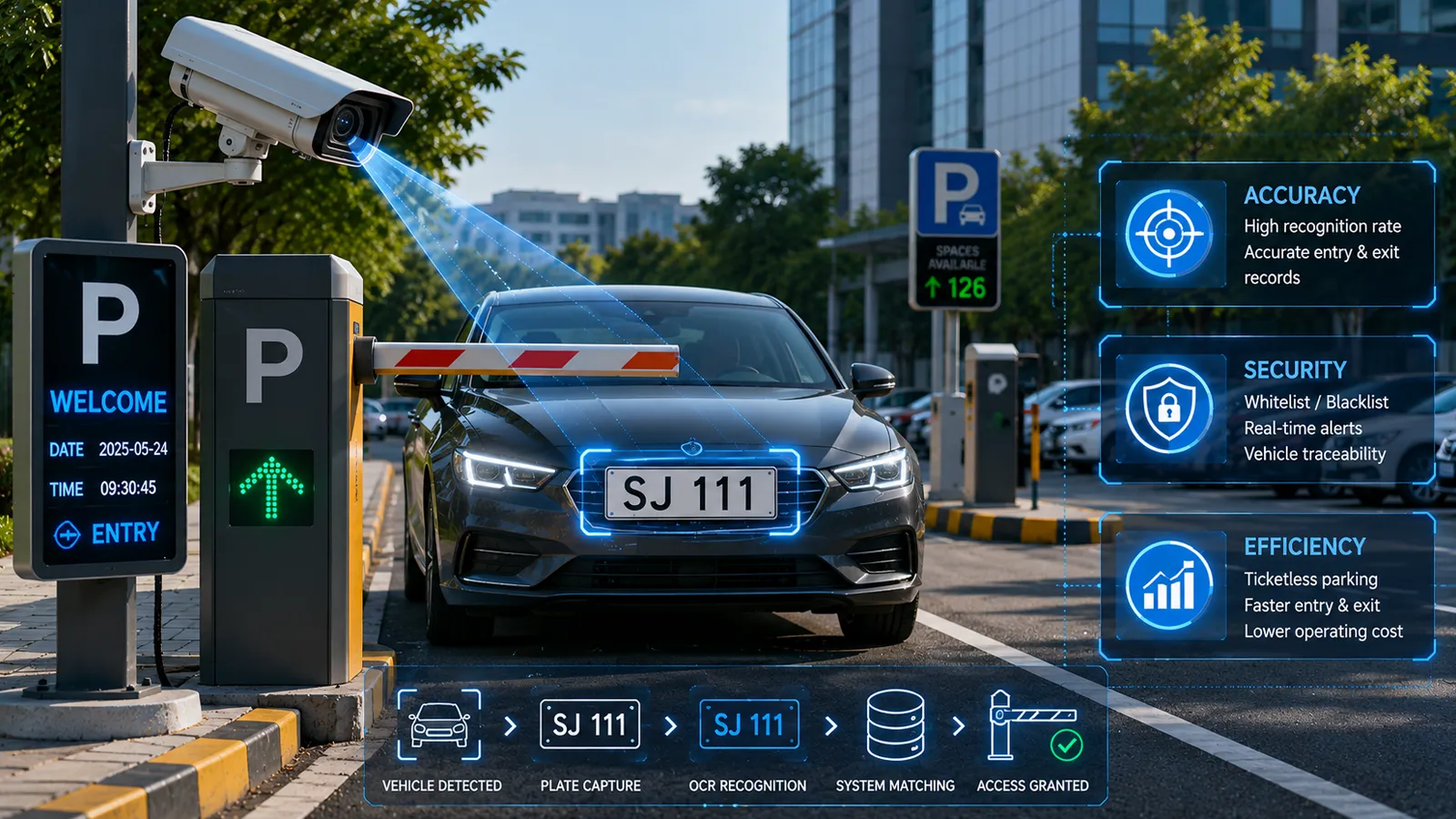
License Plate Recognition, or LPR, cameras help modern parking facilities identify vehicles automatically by reading license plates at entry, exit, and key monitoring points. Instead of relying only on paper tickets, RFID cards, or manual guards, an LPR parking system turns the vehicle’s plate number into a digital credential for access control, parking duration calculation, payment verification, security records, and enforcement. Shunjie describes LPR/ANPR as technology that uses image processing and optical character recognition to read vehicle registration plates in real time, while Axis also notes that LPR is commonly used for access control, parking management, payment automation, alerts, and traffic monitoring.
For parking operators, property managers, and system integrators, the value is practical: better recognition accuracy, fewer manual mistakes, stronger vehicle traceability, faster entry and exit, and lower daily management workload. When the camera, barrier gate, payment system, and parking software are correctly integrated, LPR becomes the foundation of a smarter, safer, and more efficient parking solution.
What Is an LPR Camera in a Parking System?
An LPR camera is a specialized camera designed to capture a vehicle’s license plate and convert the plate image into readable text. In parking applications, this text can be used to open a barrier gate, start or end a parking session, verify a monthly permit, calculate parking fees, trigger a blacklist alert, or create a searchable vehicle record.
LPR is also called ANPR in many regions, meaning Automatic Number Plate Recognition. The core workflow is similar: the camera captures the plate, recognition software reads the characters, and the parking system decides what to do next. Shunjie’s own LPR parking system guide explains this workflow as vehicle detection, plate capture, software recognition, barrier control, and parking platform record storage.
A normal CCTV camera mainly records video for later review. An LPR camera is different because it is optimized for license plate capture. It usually needs the right lens, lighting, shutter settings, recognition algorithm, and installation angle to produce a plate image that software can read reliably.
How Do LPR Cameras Work in Parking Lots?
In a typical parking entrance or exit lane, the process happens in seconds:
- A vehicle approaches the recognition area.
- A loop detector, radar, video trigger, or virtual line detects the vehicle.
- The LPR camera captures the license plate image.
- The software locates the plate and improves image readability.
- OCR converts the plate characters into text.
- The parking system checks the plate against rules, such as whitelist, blacklist, payment status, visitor record, or permit database.
- The system opens the barrier, denies access, sends an alert, or records the parking session.
This workflow makes the license plate the “ID card” of the vehicle. Axis describes a similar process: the analytics capture the plate in real time, compare or add it to a list, and then trigger an action such as opening a gate, adding a cost, or generating an alert.
How LPR Cameras Improve Parking Accuracy
Parking accuracy is not only about reading the plate correctly. It also includes accurate entry time, exit time, parking duration, payment status, vehicle identity, and enforcement records.
More accurate entry and exit records
In a traditional ticket-based car park, disputes often happen when a ticket is lost, damaged, exchanged, or manually entered incorrectly. With LPR, the vehicle plate is recorded automatically when the vehicle enters and exits. This creates a clearer parking timeline and reduces arguments over arrival time, departure time, and fee calculation.
For paid parking, this is especially important. A plate-based parking record allows the system to calculate parking duration automatically and match the record with QR code payment, app payment, card payment, or on-site payment station data. Shunjie’s website states that ticketless or cardless parking links ANPR with payment systems so that parking time and parking fees can be calculated automatically.
Fewer manual input errors
Manual parking management depends heavily on people: guards write plate numbers, drivers keep tickets, cashiers calculate fees, and enforcement staff check vehicles by hand. Each step can create mistakes.
LPR reduces these errors by automating plate capture and record generation. The system does not need a guard to type a plate number for every vehicle. It also reduces problems caused by lost tickets, unreadable handwriting, manual fee calculation, or unauthorized card sharing.
Better permit and payment verification
For monthly parking users, residents, employees, VIP users, delivery vehicles, and registered visitors, LPR makes verification faster. Once the plate is stored in the system, the vehicle can be recognized automatically. The parking software can decide whether the vehicle is allowed to enter, whether the permit is still valid, whether a visitor has been approved, or whether payment has been completed.
This is useful for residential communities, office buildings, logistics parks, hospitals, hotels, shopping malls, and mixed-use commercial sites. It is also valuable in locations where different user groups need different rules, such as residents, tenants, staff, temporary visitors, suppliers, and blacklisted vehicles.
What affects LPR recognition accuracy?
LPR accuracy depends on both technology and site design. A strong camera cannot perform well if the plate is too small in the image, blocked by another vehicle, overexposed by headlights, blurred by speed, or captured from an extreme angle. TP-Link’s LPR camera configuration guide notes that recognition performance can be affected by environment, distance, vehicle speed, angle, license plate condition, and lighting.
Important factors include:
| Accuracy Factor | Why It Matters | Practical Recommendation |
|---|---|---|
| Camera angle | Extreme horizontal or vertical angles distort plate characters | Install the camera where the plate is clearly visible and test with real vehicles |
| Lighting | Strong backlight, headlights, darkness, rain, or glare can reduce readability | Use IR light, fill light, WDR/BLC settings, and site lighting where needed |
| Vehicle speed | Fast movement can create motion blur | Use lane design, speed bumps, or trigger zones to slow vehicles |
| Plate condition | Dirty, damaged, reflective, or non-standard plates are harder to read | Keep a manual review process for unusual cases |
| Recognition area | If the area is too wide, the camera may capture the wrong vehicle or background plates | Configure the recognition zone and trigger line carefully |
| System integration | A correct read still needs correct software action | Test whitelist, blacklist, payment, and barrier logic before launch |
How LPR Cameras Strengthen Parking Security
Parking security is not only about stopping theft. It also includes knowing which vehicles entered, when they entered, where they exited, and whether they were authorized.
Real-time vehicle identification
An LPR parking system can record each vehicle’s license plate, image, time, lane, and access result. This creates a searchable log for operators. If an incident happens, staff can search by plate number or time range instead of manually watching hours of CCTV footage.
This is useful for investigating vehicle damage, tailgating, gate collisions, theft, vandalism, unauthorized access, and disputes between users. In access-control environments, Axis notes that LPR can open gates for authorized vehicles and register visiting vehicles automatically.
Unauthorized vehicle alerts
LPR systems can support whitelist and blacklist management. A whitelist allows registered vehicles to enter automatically. A blacklist can trigger alerts when restricted, unpaid, banned, or suspicious vehicles appear.
For example:
- A residential community can allow resident vehicles while flagging unknown overnight vehicles.
- A corporate campus can restrict private parking areas to staff and approved visitors.
- A logistics park can monitor truck access and loading-zone activity.
- A paid parking lot can identify vehicles with unpaid fees or repeated violations.
This reduces the need for guards to remember every vehicle and helps operators apply rules consistently.
Better incident investigation
Because LPR records are tied to plate numbers, the system can provide stronger evidence than general video alone. When combined with entry cameras, exit cameras, overview cameras, barrier records, and payment records, operators can reconstruct what happened more quickly.
For example, if a driver claims they paid but the barrier did not open, the operator can check the plate recognition record, payment record, and exit-lane event. If a gate arm is damaged, the operator can search for the vehicle that passed through the lane at that time.
Safer access control
In gated parking, LPR improves both convenience and security. Authorized vehicles can enter without stopping to scan a card, while unauthorized vehicles can be denied automatically. This is especially helpful at residential communities, offices, industrial parks, warehouses, toll-style entrances, and parking facilities with high traffic.
For higher-security projects, LPR should not be the only control layer. Operators can combine it with guard confirmation, visitor QR codes, intercoms, RFID, facial access for pedestrians, or manual override rules.
How LPR Cameras Improve Parking Efficiency
Efficiency is where LPR often delivers the most visible improvement. Drivers notice shorter queues. Operators notice fewer manual tasks. Owners notice better revenue control and smoother traffic flow.
Faster vehicle entry and exit
Traditional parking systems often require drivers to stop, press a button, take a ticket, scan a card, pay at a booth, insert a ticket, or wait for manual verification. LPR removes many of these steps.
In ticketless parking, the plate itself becomes the parking credential. The vehicle enters, the system records the plate, and the parking session starts. At exit, the system reads the plate again and checks whether payment is complete or whether the vehicle is within a free parking period.
Arivo notes that ticketless LPR parking recognizes the plate at entry and exit and calculates parking duration accordingly, removing the need for paper tickets.
Reduced labor and operating workload
LPR can reduce the need for full-time guards at every entrance and exit. It can also reduce manual patrols, paper ticket handling, cashier reconciliation, and manual permit checking.
This does not mean every parking lot should remove staff completely. Large or high-risk sites may still need attendants, maintenance personnel, or security staff. But LPR allows those people to focus on exceptions instead of repetitive plate checking.
Better space turnover and revenue control
Parking revenue can be lost through free riding, lost tickets, overstays, unauthorized parking, shared cards, or inaccurate fee calculation. LPR helps close these gaps by connecting vehicle identity with time, fee, and access rules.
For shopping malls, this can support free parking periods and paid overtime. For office buildings, it can manage staff permits and visitor billing. For hospitals and airports, it can improve traffic flow at busy entrances. For logistics parks, it can track truck arrival and departure times.
Easier digital parking management
Once vehicle records are digital, operators can generate reports about traffic volume, peak hours, repeat users, entry/exit patterns, overstays, and unusual events. These reports help managers adjust staffing, pricing, lane design, user rules, and maintenance planning.
| Parking Goal | Traditional Challenge | How LPR Helps |
|---|---|---|
| Accurate billing | Lost tickets and manual fee disputes | Records entry/exit by plate and calculates duration |
| Access control | Cards can be shared, lost, or forgotten | Uses the vehicle plate as a digital credential |
| Security | Hard to search CCTV manually | Creates searchable plate-based event records |
| Enforcement | Manual patrols are slow and inconsistent | Flags overstays, unauthorized vehicles, or blacklist matches |
| User experience | Queues form at ticket machines and booths | Enables ticketless, faster vehicle flow |
| Management reporting | Data is scattered or incomplete | Provides structured records for analysis |
Common LPR Parking Application Scenarios
Residential communities
In residential parking, LPR improves resident convenience and strengthens gate security. Registered residents can enter automatically, while visitor vehicles can be managed through temporary authorization, manual approval, QR code registration, or intercom confirmation.
Shopping malls and commercial parking lots
Retail parking often needs fast vehicle flow, free parking periods, membership recognition, payment integration, and high turnover. LPR supports ticketless entry and exit, reduces ticket machine problems, and helps users pay by plate number.
Office buildings and corporate campuses
Office parking needs clear rules for employees, tenants, visitors, contractors, and VIP vehicles. LPR helps automate permit verification and reduces the workload at security booths.
Hospitals and airports
Hospitals and airports usually have high traffic and time-sensitive users. LPR can speed up entry and exit, support paid parking, reduce lost-ticket issues, and help operators review traffic records when disputes happen.
Logistics parks and industrial zones
For logistics facilities, LPR supports truck tracking, loading area management, restricted access, and vehicle traceability. It can help record when trucks enter, where they are allowed to go, and when they leave.
Outdoor and on-street parking
Outdoor lots and on-street parking environments need strong lighting control, weather resistance, and flexible deployment. LPR can support enforcement, EV charging space management, low-emission zone control, and remote monitoring where manual inspection is expensive.
LPR Cameras vs. Traditional Parking Methods
LPR does not replace every parking method in every situation. The best system depends on project size, budget, user type, payment model, and security requirements. However, LPR is often the best choice when operators want ticketless access, automated records, and stronger vehicle traceability.
| Parking Method | Main Credential | Key Advantage | Main Limitation |
|---|---|---|---|
| Paper ticket | Printed ticket | Familiar and simple for users | Tickets can be lost, damaged, exchanged, or jammed |
| RFID card | Card or tag | Convenient for registered users | Cards can be lost, shared, copied, or forgotten |
| Manual guard | Human verification | Flexible for special cases | Labor-intensive and inconsistent |
| QR code access | Mobile or printed QR code | Useful for temporary visitors | Requires user action and phone/screen readability |
| LPR camera | License plate | Ticketless, automated, searchable, and fast | Requires proper camera setup, lighting, software, and privacy controls |
What Should You Consider Before Installing LPR Cameras?
Camera position and lane design
LPR performance begins with placement. The camera should capture the plate where the vehicle is slow, visible, and aligned. A good installation plan should define the recognition point, capture distance, camera height, horizontal angle, vertical angle, lighting direction, vehicle speed, and barrier location.
TP-Link recommends confirming mounting height, angle, position, field of view, recognition area, and trigger line during setup, and testing the capture result with real vehicles.
Lighting conditions
Lighting is one of the most common causes of poor plate recognition. Parking entrances can have direct sunlight, shadows, reflections, headlights, rain, fog, and low-light conditions. At night, the camera may need IR or white-light supplement. In backlight scenes, WDR or BLC settings may help, but they should be tested because every site is different.
Plate types and country compatibility
License plate formats vary by country and region. A system that works well in one market may need training or configuration for another market. This matters for distributors, cross-border projects, logistics parks, ports, airports, and countries with mixed plate styles.
Shunjie states that its LPR systems support plate recognition in more than 150 countries and regions and achieve up to 99% accuracy under suitable conditions.
Integration with parking software and barrier gates
An LPR camera alone is not a full parking solution. The camera must connect with barrier gates, loop detectors, payment stations, LED displays, parking management software, access-control rules, and reporting tools.
Shunjie’s product page lists ANPR cameras, ALPR display terminals, rapid gate arm barriers, and multi-channel payment stations as part of its parking equipment portfolio, including support for integration with barriers, displays, and payment terminals.
Data security and privacy
License plate data can be sensitive because it connects vehicles with time and location. Parking operators should define who can access LPR records, how long data is kept, when it is deleted, whether records are shared, and how the system is secured.
UC Berkeley’s ALPR policy treats ALPR information as protected personal information and requires controls for collection, storage, disposal, access logs, sharing, and retention. USC’s ALPR policy also states that ALPR data should not be sold, published, exchanged for commercial reasons, or shared with unauthorized persons.
For private parking operators, the exact legal requirements depend on country, region, and project type. The safest approach is to publish clear signage, use secure storage, limit user permissions, keep audit logs, define a retention period, and follow local privacy regulations.
How to Choose the Right LPR Camera for Your Parking Project
Different parking projects need different LPR priorities. A residential entrance does not have the same requirements as an airport car park, logistics hub, or outdoor paid parking lot.
| Project Type | Recommended LPR Focus | Why It Matters |
|---|---|---|
| Gated community | Whitelist access, visitor rules, blacklist alerts | Improves resident convenience and security |
| Shopping mall | Fast recognition, payment integration, free-period logic | Reduces queues and improves customer experience |
| Office building | Employee permits, visitor records, barrier integration | Simplifies daily access control |
| Hospital or airport | High-traffic performance, reliable billing, fast exit | Reduces congestion in busy environments |
| Outdoor parking lot | Weather resistance, night capture, strong lighting control | Maintains recognition quality in changing conditions |
| Logistics park | Truck recognition, event records, restricted access | Supports traceability and operational control |
| On-street parking | Flexible deployment and enforcement records | Helps manage distributed parking spaces |
Before buying, operators should test the system in real site conditions, not only in a showroom. The test should include day and night capture, different vehicle types, local plate formats, rainy or low-light conditions if possible, barrier response time, payment matching, and abnormal cases such as unreadable plates or tailgating.
Why Shunjie LPR Parking Solutions Fit Modern Parking Projects
Huizhou Shunjie Technology Co., Ltd. was established in 2008 and focuses on LPR parking solutions. The company states that it has 17 years of experience, supports recognition in more than 150 countries and regions, reaches up to 99% recognition accuracy under suitable conditions, and serves agents and clients across 123+ countries.
For parking operators and project partners, Shunjie’s value is not only the camera. A complete LPR parking project often needs cameras, barrier gates, LED display terminals, loop detectors, payment devices, management software, customization, and technical support. Shunjie’s product portfolio includes ANPR cameras, ALPR display terminals, rapid gate arm barriers, and multi-channel payment stations, which makes it suitable for integrated parking access-control projects.
Shunjie is especially suitable for:
- Residential communities that need automatic resident access.
- Commercial parking lots that need ticketless entry and payment.
- Office buildings that need staff and visitor vehicle management.
- Logistics parks that need truck access records.
- Distributors and integrators that need OEM/ODM customization.
- Projects that require cost-effective, factory-direct parking equipment.
Conclusion: LPR Makes Parking More Accurate, Secure, and Efficient
LPR cameras are essential for modern parking because they solve three problems at the same time: accuracy, security, and efficiency.
They improve accuracy by recording vehicle identity, entry time, exit time, and parking duration automatically. They improve security by creating searchable vehicle records, supporting whitelist and blacklist control, and helping operators investigate incidents. They improve efficiency by reducing manual ticketing, speeding up entry and exit, supporting ticketless payment, and giving parking managers better operational data.
For the best results, an LPR parking system should not be treated as just a camera purchase. It should be planned as a complete parking workflow: vehicle detection, plate capture, recognition, barrier control, payment matching, data storage, privacy control, and maintenance. With the right design and supplier, LPR can turn a traditional parking lot into a smarter, safer, and easier-to-manage parking facility.
Frequently Asked Questions
What is an LPR camera used for in parking?
An LPR camera is used to automatically read vehicle license plates at parking entrances, exits, or monitoring points. The system can use the plate number for access control, parking duration calculation, payment verification, permit management, blacklist alerts, and security records.
How accurate are LPR parking cameras?
Accuracy depends on camera quality, plate format, installation angle, lighting, vehicle speed, software, and site conditions. Shunjie states that its LPR systems can achieve up to 99% accuracy under suitable conditions.
Can LPR cameras work at night?
Yes, professional LPR cameras can work at night when they are supported by proper IR light, white fill light, exposure settings, and installation design. Night performance should always be tested at the actual site because headlights, reflections, rain, and shadows can affect plate readability.
Can LPR cameras open barrier gates automatically?
Yes. In a parking access-control system, the LPR camera reads the plate, the software checks whether the vehicle is authorized or paid, and the barrier gate opens if the rule is satisfied. This is commonly used for residential communities, offices, commercial lots, and logistics parks.
Can LPR parking systems support ticketless payment?
Yes. Ticketless parking uses the license plate as the parking credential. The system records the plate at entry and exit, calculates parking duration, and connects the record with payment methods such as QR code payment, app payment, payment stations, bank cards, or account-based billing.
Where should LPR cameras be installed?
LPR cameras should be installed where the plate is clearly visible, vehicles are moving slowly, lighting can be controlled, and the camera has a stable view of the recognition zone. Common positions include entry lanes, exit lanes, payment verification lanes, loading zones, and restricted access points.
What causes license plate recognition errors?
Common causes include poor lighting, glare, dirty plates, damaged plates, extreme camera angle, incorrect focal length, motion blur, wrong trigger zone, heavy rain, snow, occlusion by another vehicle, or unsupported plate formats.
Is LPR better than RFID for parking access control?
LPR is often better when the operator wants ticketless access, searchable vehicle records, and lower dependence on cards or tags. RFID may still be useful for some closed communities or employee parking projects. Many sites combine both methods for backup or higher reliability.
Can LPR cameras integrate with existing parking management software?
Yes, many LPR systems support integration with parking software, barrier gates, payment stations, access-control platforms, LED displays, and cloud or local management systems. Before purchasing, confirm the required protocol, API, relay output, database connection, and payment workflow.