
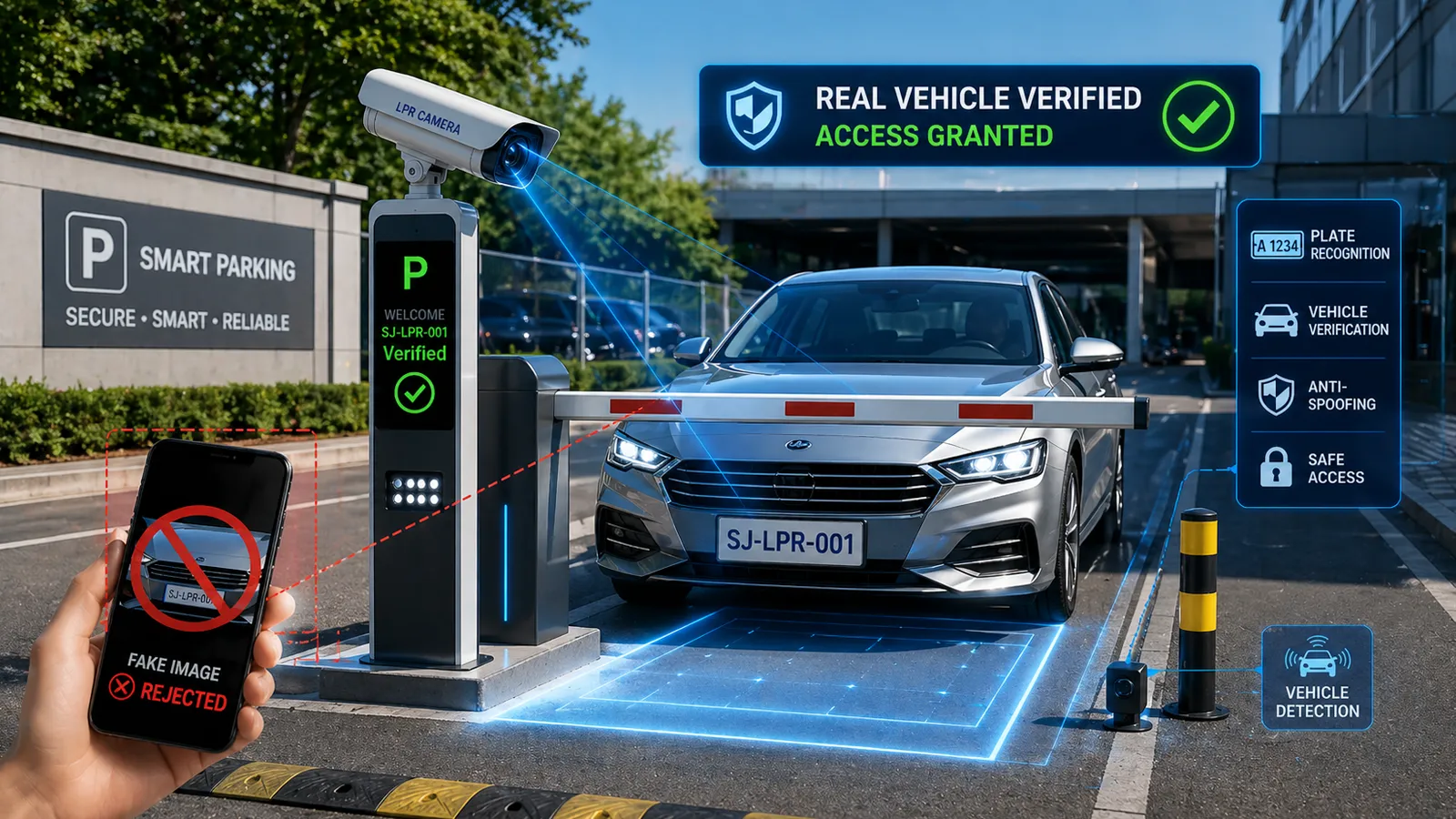
Yes, a photo can fool some low-end or older license plate recognition barrier systems, especially when the system only checks whether the camera can read a plate number. If the system does not verify whether a real vehicle is present, whether the vehicle is in the correct lane position, or whether the plate matches the vehicle body, a mobile phone image, printed plate, or other static image may cause false barrier opening.
A secure LPR parking system should not rely on plate text alone. It should combine anti-counterfeiting algorithms, vehicle feature recognition, ground loop or radar detection, barrier control logic, and access records to confirm that one real vehicle is passing with one valid authorization.
Can a Photo Really Fool a License Plate Recognition Barrier?
In some older or low-end systems, yes.
A basic LPR barrier system works by capturing an image of the license plate, recognizing the plate number, and comparing it with the parking database. If the plate is registered as a monthly rental vehicle, VIP vehicle, internal vehicle, or prepaid vehicle, the barrier may open automatically.
The problem appears when the system only answers one question:
“Can I read a valid license plate number?”
A safer system should answer several questions:
“Is this plate attached to a real vehicle?”
“Is the vehicle in the correct recognition zone?”
“Does the plate match the vehicle’s color or type?”
“Is only one vehicle passing through the barrier?”
“Is this access event normal compared with previous records?”
Modern ANPR/LPR systems increasingly recognize more than the plate number. For example, some ANPR cameras can identify vehicle color, type, manufacturer, and travel direction together with the plate number. These extra data points help parking operators detect mismatches and suspicious access events.
Why Photo-Based Barrier Opening Happens
Photo-based barrier opening usually happens because the system treats a plate image as equal to a real vehicle. This is common in systems with weak anti-counterfeiting design.
The risk is highest in parking lots where monthly rental vehicles can enter automatically. If someone obtains a photo of a valid monthly rental plate, a weak system may mistakenly treat that image as the real vehicle. This can lead to unauthorized entry, stolen monthly parking privileges, or temporary vehicles avoiding payment.
This is not only a “recognition accuracy” problem. A system may recognize plate characters accurately but still make the wrong access-control decision. In parking security, recognition accuracy and anti-counterfeiting ability are different capabilities.
Common Vulnerabilities in Low-End or Older LPR Barrier Systems
| Vulnerability | What Happens | Main Risk | Recommended Prevention |
|---|---|---|---|
| Photo-based barrier opening | A phone image, printed plate, or paper plate is recognized as a valid plate | Unauthorized entry or monthly parking misuse | Anti-spoofing algorithm + vehicle presence detection |
| Forged or cloned plate | A fake plate copies an authorized vehicle’s number | Fake monthly rental or internal vehicle entry | Plate + vehicle color/type verification |
| Tailgating | A second vehicle follows a valid vehicle through the barrier | Toll evasion or unauthorized access | One-car-one-pass logic + vehicle sensors |
| No ground loop or radar | The camera recognizes a plate before a vehicle reaches the correct position | False opening from the wrong distance | Ground loop, ground radar, or vehicle detection sensor |
| Poor damaged-plate recognition | Dirty, bent, covered, or damaged plates cause recognition errors | Wrong billing, failed entry, or manual disputes | Better camera setup + algorithm upgrade + review process |
1. Photo-Based Barrier Opening
Photo-based barrier opening is the most typical vulnerability. It happens when the LPR camera sees a valid plate number but the system does not confirm that the plate belongs to a real vehicle.
A low-end system may fail to distinguish between:
- a real metal license plate on a vehicle,
- a license plate displayed on a phone screen,
- a printed license plate photo,
- a hand-drawn or paper plate,
- a copied monthly rental plate image.
This type of attack is especially damaging in residential parking, office parks, logistics parks, and commercial parking lots where monthly rental vehicles are allowed to enter without manual checks.
The solution is not simply to buy a higher-resolution camera. The system needs stronger decision logic: anti-counterfeiting recognition, vehicle body verification, vehicle presence detection, and access record comparison.
2. License Plate Cloning and Forgery
Another common risk is license plate cloning. In this case, the plate number may be real, but it is not attached to the correct vehicle.
For example, a fake plate may copy the number of a monthly rental vehicle. If the parking system only checks the plate number, it may open the barrier even though the vehicle is not authorized.
This is why plate-only recognition is not enough for high-security parking areas. A better system should compare the plate number with additional vehicle attributes such as vehicle color, vehicle type, or vehicle model. Make and Model Recognition technology can detect attributes such as brand, model, category, and color, adding another verification layer to ANPR results and helping flag plate-vehicle mismatches.
3. Vehicle Tailgating After a Valid Entry
Tailgating means one vehicle follows another vehicle through the barrier before the barrier closes. In this situation, the first vehicle may be correctly recognized, but the second vehicle enters without valid recognition or payment.
This problem is not caused by the license plate camera alone. It is usually caused by weak lane control logic, slow barrier closing, poor sensor placement, or missing one-vehicle-one-pass verification.
Vehicle gate systems are vulnerable during the open-close interval, and tailgating detection solutions are designed to detect and record unauthorized vehicles following through a controlled gate.
To reduce this risk, parking operators should use:
- one-car-one-recognition logic,
- ground loop or radar detection,
- barrier arm timing control,
- lane cameras for event recording,
- alarms for abnormal two-vehicle passage,
- speed bumps and lane markings before the barrier.
4. “No Ground Sensor” Vulnerability
A parking barrier system without a ground loop, radar, or vehicle presence sensor may rely too much on camera recognition. This can allow recognition to happen before a real vehicle reaches the correct lane position.
A ground loop or vehicle detection sensor helps confirm that a vehicle is physically present in the recognition zone. In gate systems, loop detectors and equivalent devices are commonly used to prevent unsafe or incorrect gate operation around vehicles.
For LPR parking access, vehicle presence detection has two important benefits:
First, it prevents the system from opening too early. The camera should only trigger recognition when a vehicle reaches the correct position.
Second, it helps the system connect one recognized plate with one actual vehicle. This is important for anti-tailgating, billing accuracy, and access records.
5. Low Recognition Rate for Damaged or Dirty Plates
Damaged, dirty, bent, reflective, covered, or poorly installed plates can reduce recognition performance. Bad lighting, rain, fog, camera noise, strong backlight, and poor installation angle can also affect results.
Research on ALPR performance shows that distortions such as weather effects and camera read noise can affect system robustness, which is why resilient models, image enhancement, and proper system design matter.
For parking operators, the practical solution is to improve both software and installation quality:
- use an LPR camera with suitable resolution and infrared/LED lighting,
- adjust the camera angle and recognition distance,
- avoid strong backlight and glare,
- keep the recognition area well marked,
- upgrade the recognition algorithm,
- keep manual review records for abnormal events.
How Modern LPR Barrier Systems Prevent Photo Spoofing
A secure LPR barrier system should verify more than the license plate number. The goal is to confirm the identity of the vehicle, not just read text from an image.
1. Upgrade the Recognition Algorithm
An upgraded algorithm should identify suspicious static images, screen display patterns, abnormal reflections, missing vehicle body features, and other signs that the plate may not be attached to a real vehicle.
For Shunjie LPR parking solutions, the anti-counterfeiting algorithm has been upgraded to reduce the risk of photo-based false opening. This helps the system make a more complete judgment instead of relying only on plate text.
2. Match License Plate + Vehicle Color + Vehicle Type
Plate number recognition answers “what is the plate number?” Vehicle feature recognition adds “what vehicle is this plate attached to?”
For example, if a monthly rental record belongs to a white SUV but the system sees the same plate number associated with a black sedan, the event should be flagged or rejected according to the operator’s rules.
This combination makes it much harder for a simple photo or copied plate to pass verification.
3. Add Ground Loop, Ground Radar, or Vehicle Detection Sensor
Hardware detection is important because software alone cannot always confirm physical vehicle position.
A recommended access sequence is:
- The vehicle enters the detection area.
- The ground loop or radar confirms vehicle presence.
- The LPR camera captures the plate and vehicle image.
- The system checks plate permission and vehicle features.
- The barrier opens only when the verification result is valid.
- The system records the access event.
- The barrier closes after one vehicle passes.
This creates a safer “real vehicle + real plate + correct position” workflow.
4. Use One-Car-One-Pass Logic
The barrier should not stay open long enough for multiple vehicles to pass on one recognition event. One-car-one-pass logic connects each valid recognition result with one vehicle movement.
For higher-security projects, the system can also add:
- front and rear vehicle detection,
- dual-camera verification,
- anti-tailgating alerts,
- barrier status monitoring,
- event snapshots and video records.
5. Store Complete Access Records
A secure LPR parking system should store more than the plate number. Useful records include:
- plate close-up image,
- full vehicle image,
- vehicle color or type,
- entry/exit time,
- lane number,
- barrier opening result,
- payment or monthly rental status,
- abnormal event notes.
These records help operators investigate disputes, identify repeated abuse, and improve parking lot security.
Algorithm Upgrade vs Hardware Upgrade: Which One Do You Need?
| Situation | Algorithm Upgrade | Hardware Upgrade | Best Recommendation |
|---|---|---|---|
| System can be opened by plate photos | Required | Recommended | Upgrade anti-spoofing algorithm and add vehicle presence detection |
| No ground loop or radar installed | Not enough alone | Required | Add ground loop, radar, or vehicle sensor |
| Frequent tailgating | Helpful | Required | Add one-car-one-pass logic and lane sensors |
| Wrong recognition in rain, glare, or low light | Required | Sometimes required | Improve camera, lighting, angle, and algorithm |
| Cloned monthly rental plates | Required | Recommended | Use plate + vehicle color/type matching |
| Damaged or dirty plates | Required | Sometimes required | Upgrade camera setup and keep manual review process |
In most real projects, the best result comes from combining algorithm and hardware upgrades. Software improves recognition judgment. Hardware confirms that a real vehicle is in the correct place. Barrier logic ensures only one vehicle passes per authorization.
How to Check Whether Your Current LPR Barrier System Is Vulnerable
Parking operators can review the system using the checklist below.
Check 1: Does the system open based only on plate text?
If the answer is yes, the system may be vulnerable. A safer system should verify vehicle presence and vehicle features.
Check 2: Does recognition require a vehicle to reach a fixed position?
The camera should not trigger valid access from far away or from the wrong angle. A ground loop, radar, or vehicle sensor should confirm the correct recognition zone.
Check 3: Does the system store full vehicle images?
Plate close-ups are useful, but they are not enough. Full vehicle images help identify cloned plates, mismatched vehicles, and abnormal access behavior.
Check 4: Can the system detect repeated abnormal monthly card use?
Repeated access by the same plate at unusual times, or entry records without matching exit records, may indicate misuse.
Check 5: Does the system support anti-tailgating logic?
If two vehicles can pass after one recognition event, the barrier control strategy needs improvement.
Check 6: Can the system compare plate number with vehicle color or type?
This is one of the most practical ways to reduce cloned plate and photo spoofing risks.
What Should Buyers Look for in a Secure LPR Barrier System?
When purchasing or upgrading an LPR parking barrier system, buyers should not only ask, “What is the recognition accuracy?” They should also ask, “How does the system prevent false opening?”
A secure system should include:
- anti-photo spoofing capability,
- vehicle presence detection,
- license plate + vehicle feature matching,
- fast and stable barrier control,
- one-car-one-pass logic,
- clear access records,
- strong low-light performance,
- support for local plate formats,
- payment and monthly rental management,
- remote management and maintenance options.
Shunjie’s website states that Huizhou Shunjie Technology Co., Ltd. was established in 2008, has 17 years of experience in LPR parking solutions, supports plate recognition in more than 150 countries and regions, and serves agents and customers across 123+ countries and regions. Shunjie also offers ANPR cameras, ALPR display terminals, and rapid barrier gate products for car parks, toll stations, logistics zones, residential areas, and gated access control.
Recommended Secure LPR Barrier Configuration
For most commercial, residential, and logistics parking projects, the recommended configuration is:
- LPR camera with updated anti-counterfeiting algorithm
Recognizes the plate and checks suspicious image patterns. - Vehicle color/type recognition
Adds another verification layer to reduce cloned plate risk. - Ground loop or ground radar
Confirms that a real vehicle has reached the correct position. - Fast barrier gate with stable controller
Supports one-car-one-pass operation. - Management software
Handles monthly rental vehicles, temporary vehicles, payment records, blacklists, whitelists, and abnormal event logs. - Event image storage
Saves plate image, full vehicle image, time, lane, and barrier result. - Optional anti-tailgating detection
Useful for residential communities, office parks, industrial parks, and high-security entrances.
Why Choose Shunjie LPR Parking Barrier Solutions?
Shunjie focuses on complete LPR parking solutions, not only single devices. A complete system can include the LPR camera, barrier gate, LED display, controller, ground loop or radar, parking management software, and OEM customization.
Key advantages include:
- updated anti-counterfeiting algorithm,
- support for license plate recognition in over 150 countries and regions,
- up to 99% recognition accuracy under suitable conditions,
- LPR camera and barrier gate integration,
- support for monthly rental and temporary vehicle management,
- OEM customization for agents and distributors,
- factory-direct production and technical support.
For parking operators, this means the system can be designed around real site conditions instead of relying on one camera alone.
Conclusion: A Secure LPR Barrier Must Verify the Vehicle, Not Just the Plate
A photo can fool some older or low-end license plate recognition barrier systems because they only recognize static plate text. This creates risks such as photo-based barrier opening, cloned monthly rental plates, tailgating, and payment evasion.
The solution is to upgrade from simple plate recognition to complete vehicle access verification. A secure LPR barrier system should combine anti-spoofing algorithms, vehicle color/type recognition, ground loop or radar detection, one-car-one-pass logic, and complete access records.
For parking lots that still rely on older LPR equipment, the most practical upgrade path is clear: improve the algorithm, add vehicle presence detection, and make sure the barrier only opens for one real, authorized vehicle at a time.
FAQ
Can a mobile phone photo open an LPR parking barrier?
It may happen on older or low-end systems that only recognize plate text and do not verify vehicle presence, vehicle body features, or anti-spoofing signals. Modern systems reduce this risk by using upgraded algorithms and sensor-based vehicle detection.
Why are older LPR systems easier to fool?
Many older systems were designed mainly for plate reading, not anti-counterfeiting. They may lack vehicle feature recognition, ground loop detection, tailgating logic, and abnormal event analysis.
Is license plate recognition accuracy the same as security?
No. Recognition accuracy means the system can read plate characters correctly. Security means the system can decide whether the access event is real, authorized, and safe. A system can read a plate correctly but still open for the wrong vehicle.
Can a ground loop prevent photo-based barrier opening?
A ground loop helps because it confirms that a vehicle is physically present in the recognition area. However, the best protection combines ground loop or radar detection with anti-spoofing software and vehicle feature matching.
What is better: ground loop or ground radar?
Ground loops are stable and widely used, but they require cutting the road surface. Ground radar is easier for some retrofit projects because it can reduce civil work. The best choice depends on the site layout, road surface, budget, and installation conditions.
How can parking lots prevent tailgating?
Use one-car-one-pass logic, ground sensors, fast barrier control, lane cameras, anti-tailgating alerts, and clear lane design. The system should record abnormal events when more than one vehicle passes after one authorization.
Can LPR systems recognize damaged license plates?
Good systems can handle some dirty, tilted, or slightly damaged plates, but severely damaged or blocked plates may still require manual review. Camera quality, lighting, angle, and algorithm strength all affect the result.
What should I check before upgrading an old LPR parking system?
Check whether the system supports anti-photo spoofing, vehicle presence detection, vehicle color/type recognition, access image storage, one-car-one-pass logic, and monthly rental vehicle audit records.
Does Shunjie support OEM LPR parking barrier solutions?
Yes. Shunjie supports OEM customization for agents, distributors, and parking project installers, including LPR cameras, barrier gates, display terminals, software integration, and complete parking access solutions.