
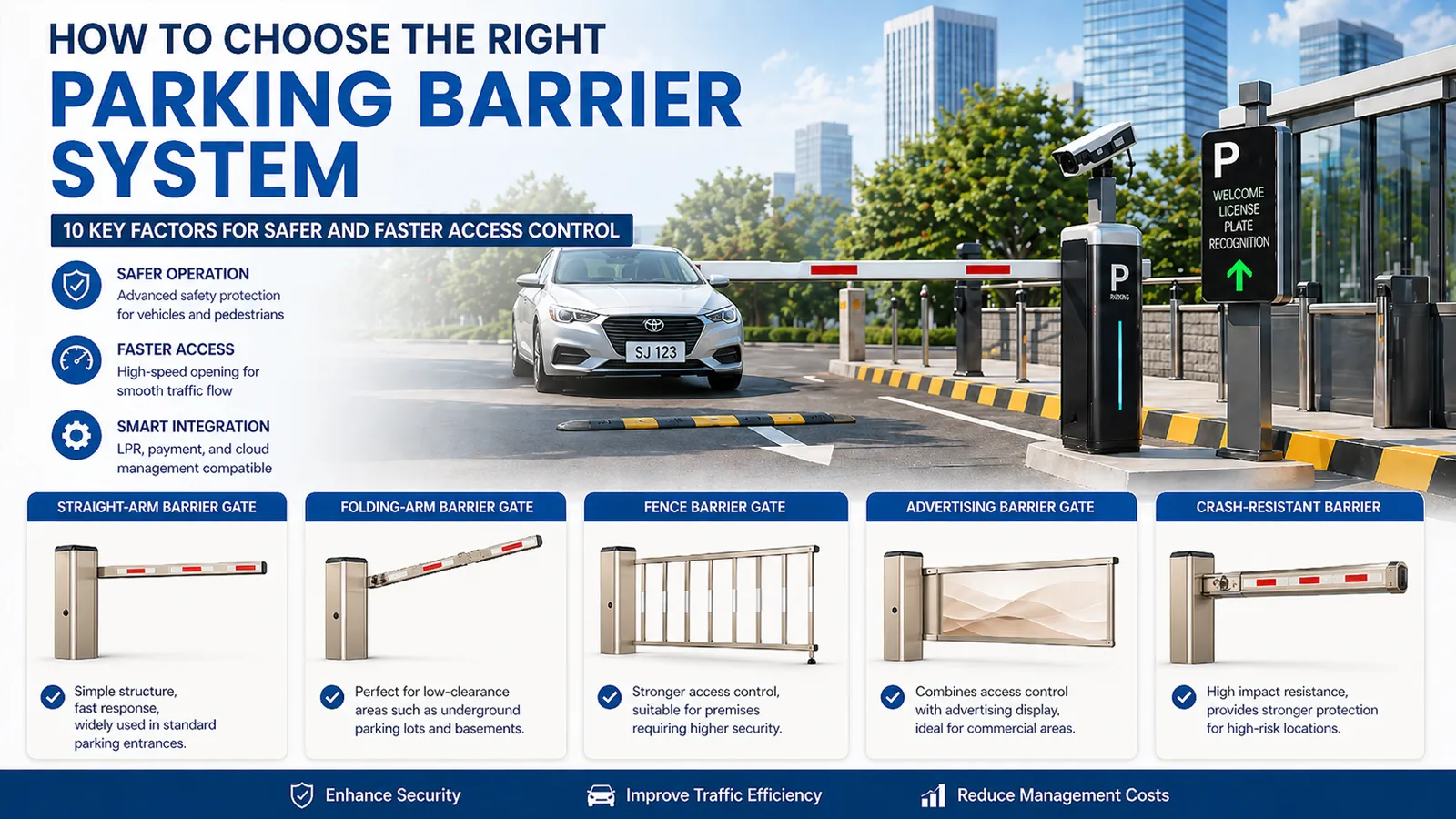
A good parking barrier system should do more than simply raise and lower a boom arm. It should control vehicle access, improve traffic flow, reduce manual management work, and protect vehicles, pedestrians, and property.
To choose the right parking barrier system, first confirm your application scenario, lane width, traffic volume, required opening speed, safety protection, access control method, installation environment, maintenance plan, and future expansion needs. For smart parking projects, compatibility with License Plate Recognition, RFID, QR code access, payment systems, and parking management software is especially important. Site assessment factors such as lane width, traffic volume, power availability, foundation, safety clearances, and environmental conditions are commonly recommended before ordering a barrier gate system.
1. Define the Application Scenario First
Different locations have different access control requirements. A residential community, shopping mall, office building, logistics park, and highway entrance should not use the same selection standard.
For residential communities, the barrier system should be safe, quiet, stable, and easy for residents to use every day. Common access methods include RFID cards, remote control, mobile app access, and License Plate Recognition.
For commercial parking lots, traffic efficiency is usually the priority. During peak hours, a slow or unstable barrier can quickly cause queues at the entrance or exit. In this case, fast opening speed, reliable vehicle detection, and payment system integration are important.
For office buildings and business parks, the system should support employee access, visitor management, whitelist and blacklist control, and entry/exit records.
For logistics parks, factories, and high-frequency entrances, the key concern is durability. The motor, control board, boom arm, spring balance system, and cabinet structure must be suitable for frequent operation.
Before selecting a model, ask these questions:
| Question | Why It Matters |
|---|---|
| How many vehicles pass per day? | Determines motor durability and opening speed |
| Is the entrance indoor or outdoor? | Affects waterproofing, anti-corrosion, and wind resistance |
| Is there a height limit? | Determines whether a straight arm or folding arm is needed |
| Is the site managed manually or automatically? | Determines access control and software requirements |
| Is future LPR integration required? | Affects camera, software, and control board compatibility |
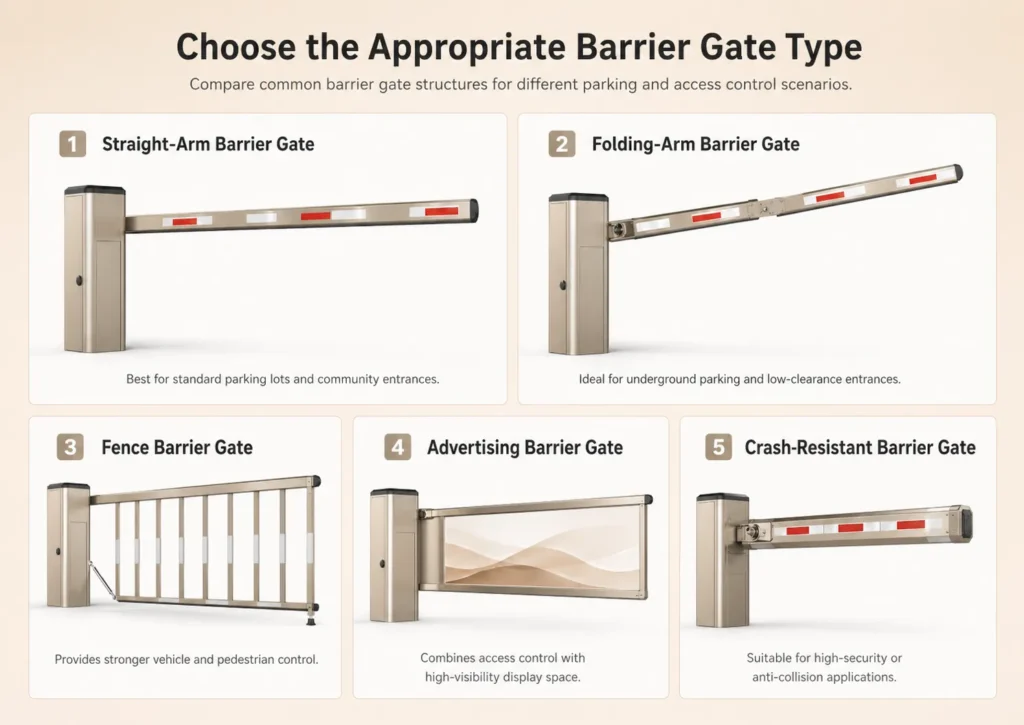
2. Choose the Appropriate Barrier Gate Type
Barrier gates are available in several types. Choosing the correct structure can reduce installation problems and improve long-term performance.
Straight-Arm Barrier Gate
A straight-arm barrier gate is the most common option for standard parking lots, residential communities, office buildings, and commercial entrances. It has a simple structure, fast response, and good cost performance.
It is suitable when the entrance has enough horizontal space and no ceiling height restriction.
Folding-Arm Barrier Gate
A folding-arm barrier gate, also called an articulated-arm barrier, is designed for underground parking lots, basement entrances, and indoor parking areas with limited ceiling height.
When the arm opens, it folds upward instead of requiring full vertical clearance. This makes it a practical choice for low-clearance areas.
Fence Barrier Gate
A fence barrier gate provides stronger physical separation than a standard boom arm. It is suitable for locations that require stricter vehicle and pedestrian control, such as industrial areas, schools, government facilities, and managed communities.
However, fence arms are usually heavier, so opening speed and motor configuration should be carefully matched.
Advertising Barrier Gate
An advertising barrier gate combines vehicle access control with display space. It is often used in commercial plazas, shopping malls, and public parking lots where the entrance has high visibility.
Crash-Resistant or Anti-Collision Barrier
For sites with higher security risks or frequent vehicle impact risks, a stronger anti-collision solution may be required. These systems are more expensive but can provide better property protection.
| Barrier Type | Best For | Main Advantage | Key Limitation |
|---|---|---|---|
| Straight-arm barrier | Standard parking lots, communities | Simple, fast, cost-effective | Requires enough vertical space |
| Folding-arm barrier | Underground parking, basements | Works in low-clearance areas | More complex structure |
| Fence barrier | Controlled access areas | Better physical restriction | Heavier and usually slower |
| Advertising barrier | Commercial parking lots | Adds advertising value | Needs suitable display space |
| Anti-collision barrier | High-risk entrances | Stronger impact protection | Higher cost |
3. Match the Boom Arm Length to the Lane Width
The boom arm should match the actual entrance width. If the arm is too short, vehicles may bypass the barrier. If it is too long, the motor may work under excessive load, causing unstable operation or faster wear.
Before buying, measure the clear vehicle lane width instead of simply estimating the road width. Also consider pedestrian paths, curb positions, safety islands, ticket machines, LPR camera positions, and payment terminals.
For very wide entrances, two shorter barriers may be better than one extra-long arm. A dual-barrier design can improve opening speed, reduce mechanical stress, and make maintenance easier.
4. Select the Right Opening and Closing Speed
Barrier gate speed directly affects traffic efficiency. High-traffic locations usually need faster opening and closing, while low-traffic or high-security locations may accept slower operation.
Fast barriers are useful for:
- Shopping malls
- Commercial parking lots
- Office buildings
- Public parking entrances
- Smart LPR parking systems
- Peak-hour residential entrances
However, faster is not always better. A high-speed barrier must be combined with reliable safety detection. If the barrier closes quickly but vehicle detection is poor, the risk of hitting a vehicle increases.
For busy parking lots, the best solution is not only a fast barrier, but a complete system: barrier gate, vehicle detector, safety sensor, LPR camera, payment system, and parking software working together.
5. Check Motor Performance, Duty Cycle, and Service Life
The motor is one of the most important components of a parking barrier system. It affects opening speed, stability, noise level, energy consumption, and service life.
When comparing barrier systems, do not only ask about price. Ask about:
- Motor type
- Rated operation frequency
- Suitable boom arm length
- Balance spring design
- Noise level
- Heat dissipation
- Control board protection
- Service life testing
- Spare parts availability
A low-cost barrier may look attractive at first, but if it frequently stops working, causes traffic jams, or requires constant repair, the total cost will be higher.
For high-frequency entrances, choose a barrier system designed for continuous operation. The duty cycle, motor quality, and mechanical balance are especially important.
6. Prioritize Safety Protection
Safety is one of the most important factors when choosing a parking barrier system. The barrier arm moves near vehicles and people, so anti-smashing and emergency protection should never be ignored.
Common safety protection methods include loop detectors, infrared photocells, radar sensors, pressure wave sensors, safety edges, and software-based vehicle detection. Automatic vehicular gate safety standards such as UL 325 and ASTM F2200 are often referenced in North America for reducing entrapment and operation risks, but buyers should always confirm the local safety requirements in their own market.
| Safety Method | Main Function | Suitable Scenario | Notes |
|---|---|---|---|
| Loop detector | Detects vehicle presence | Standard parking lanes | Requires ground cutting |
| Infrared photocell | Detects obstacles | Entrances and exits | Needs correct alignment |
| Radar sensor | Detects vehicles without cutting ground | Smart parking upgrades | Easier installation |
| Safety edge | Stops or reverses on contact | Higher safety applications | Adds contact protection |
| Manual release | Allows operation during power failure | All sites | Important for emergencies |
| Warning light / LED arm | Improves visibility | Outdoor and night use | Helps drivers notice the barrier |
A good barrier system should also support manual operation during power failure. This prevents the entrance from being blocked when there is a fault or outage.
7. Choose the Right Access Control Method
The barrier gate is only one part of the parking access system. The access control method determines how users enter and exit.
Common access methods include remote control, RFID card, QR code, ticket system, mobile payment, intercom, and License Plate Recognition.
Remote Control
Remote control is suitable for small sites with simple management needs. It is easy to use but not ideal for large parking lots because it depends on manual operation.
RFID Card or Tag
RFID is suitable for residents, employees, and monthly parking users. It is stable and easy to manage, but users must carry a card or tag.
QR Code or Ticket Access
QR code and ticket systems are suitable for visitor parking, temporary parking, commercial parking, and paid parking lots.
License Plate Recognition
License Plate Recognition allows vehicles to enter and exit automatically after the system identifies the plate number. It is especially useful for smart parking lots, residential communities, office buildings, hospitals, schools, and unmanned parking projects. LPR-based parking access can support ticketless parking and improve convenience for both short-term and long-term users.
For many modern projects, LPR is the most efficient option because drivers do not need to stop, scan, or take a card when the system is properly configured.
8. Confirm System Compatibility and Expansion Ability
A parking barrier system should not only solve today’s access problem. It should also support future upgrades.
Before buying, confirm whether the barrier system can connect with:
- LPR cameras
- RFID readers
- QR code scanners
- Parking payment systems
- LED displays
- Intercom systems
- Cloud management platforms
- Mobile apps
- Visitor management systems
- Third-party parking software
This is especially important for commercial parking lots and multi-site operators. A barrier gate that cannot integrate with software may limit future automation.
For smart parking projects, the system should support entry and exit records, whitelist and blacklist management, fee calculation, image capture, data reports, and remote monitoring.
9. Evaluate Installation Conditions
Even a high-quality barrier system can perform poorly if installation conditions are not suitable. Before purchasing, check the installation environment carefully.
Important installation factors include:
- Ground flatness
- Concrete foundation strength
- Cabinet installation space
- Boom arm movement space
- Power supply position
- Network cable layout
- Signal cable layout
- Drainage and waterproofing
- Camera installation angle
- Vehicle stopping position
- Pedestrian safety distance
For outdoor sites, the cabinet should have suitable protection against rain, dust, sunlight, temperature changes, and corrosion. For coastal or high-humidity areas, anti-rust treatment is also important.
For LPR systems, camera angle and lighting conditions are critical. Poor camera positioning may reduce recognition accuracy even if the camera itself is good.
10. Consider Maintenance, Spare Parts, and After-Sales Service
A parking barrier system is used every day, so maintenance support is just as important as product quality.
Regular maintenance should include:
- Checking motor operation
- Testing opening and closing speed
- Inspecting the boom arm
- Adjusting balance springs if needed
- Testing loop detectors, radar, or photocells
- Checking wiring and control board connections
- Cleaning the cabinet and sensor area
- Testing manual release function
- Updating software when required
Before choosing a supplier, ask these questions:
| Supplier Question | Why It Matters |
|---|---|
| Do you provide installation guidance? | Reduces installation mistakes |
| Are spare parts available? | Shortens downtime |
| What is the warranty period? | Protects the buyer after purchase |
| Can the system support OEM customization? | Useful for distributors and project brands |
| Do you provide software support? | Important for LPR and smart parking |
| Can the system adapt to local plate formats? | Important for international projects |
A reliable supplier should provide clear documentation, technical support, spare parts, and upgrade options.
11. Compare Budget and Total Cost of Ownership
The cheapest barrier gate is not always the most economical choice. Buyers should compare the total cost of ownership, not only the purchase price.
The total cost may include:
- Barrier gate price
- Boom arm type and length
- Safety sensors
- LPR camera
- RFID or QR code devices
- Parking software
- Payment system
- Installation labor
- Civil work and wiring
- Maintenance cost
- Spare parts
- Downtime cost
- Future upgrade cost
For a small private parking lot, a basic barrier may be enough. For a commercial parking lot, residential community, or unmanned parking project, investing in a more complete system can reduce labor costs and improve long-term efficiency.
The best choice is the system that balances safety, speed, durability, compatibility, service, and budget.
12. Check Local Laws, Regulations, and Safety Standards
Different countries and regions may have different requirements for electrical safety, automatic gate safety, emergency access, pedestrian protection, fire lanes, and environmental protection.
Before installation, confirm whether your project needs:
- Electrical compliance documents
- Product certificates
- Safety test reports
- Installation drawings
- Grounding protection
- Emergency manual operation
- Anti-smashing protection
- Warning signs
- Fire access approval
- Maintenance records
Do not assume that one product automatically meets every local requirement. Always check with the local project owner, installer, consultant, or relevant authority.
13. When Should You Choose a Smart LPR Parking Barrier System?
A smart LPR parking barrier system is ideal when the project needs faster entry, lower manual management cost, and better vehicle records.
It is especially suitable for:
- Residential communities
- Commercial parking lots
- Office buildings
- Hospitals
- Schools
- Industrial parks
- Logistics parks
- Hotels
- Public parking lots
- Unmanned parking projects
Compared with traditional card or ticket access, an LPR system can automatically identify vehicles, open the barrier for authorized plates, record entry and exit times, support fee calculation, and improve overall parking management efficiency. Parking control systems commonly combine barrier gates, ticketing or payment devices, access readers, LPR cameras, and management software to create a complete parking operation.
When choosing an LPR barrier system, check:
- Recognition accuracy
- Supported countries and regions
- Plate format adaptability
- Night recognition performance
- Camera resolution
- Fill light quality
- Software compatibility
- Whitelist and blacklist functions
- Offline operation ability
- Cloud or local deployment options
Huizhou Shunjie Technology Co., Ltd. has focused on intelligent parking solutions since 2008. Shunjie’s LPR parking system supports license plate recognition in more than 150 countries and regions, with recognition accuracy of up to 99%, and has earned the trust of agents and customers in 123 countries and regions. For distributors, contractors, and parking project operators, Shunjie also supports OEM customization and provides solutions for a wide range of parking scenarios.
Parking Barrier System Buying Checklist
Before contacting a supplier, use this checklist to clarify your project needs:
| Item | What to Confirm |
|---|---|
| Application scenario | Community, mall, office, factory, logistics park, public parking |
| Daily traffic volume | Low, medium, high, or continuous operation |
| Lane width | Required boom arm length |
| Height restriction | Straight arm or folding arm |
| Opening speed | Standard speed or high-speed barrier |
| Safety protection | Loop detector, radar, photocell, safety edge |
| Access method | Remote, RFID, QR code, ticket, LPR |
| Software integration | Parking management, payment, cloud platform |
| Installation environment | Indoor, outdoor, basement, coastal, dusty area |
| Power and wiring | Power supply, signal cable, network cable |
| Maintenance | Spare parts, service plan, technical support |
| Compliance | Local safety and electrical requirements |
| Budget | Purchase cost plus long-term maintenance cost |
| Future expansion | LPR, payment, visitor system, multiple lanes |
Conclusion: Choose the System That Fits the Site, Not Just the Price
The right parking barrier system should match the real conditions of the site. Before buying, consider the application scenario, barrier type, boom arm length, opening speed, motor performance, safety protection, access control method, installation environment, maintenance needs, budget, and local compliance requirements.
For simple parking entrances, a standard straight-arm barrier may be enough. For height-restricted areas, a folding-arm barrier is more suitable. For smart parking lots, residential communities, and commercial projects, an LPR-integrated parking barrier system can greatly improve traffic efficiency and management convenience.
As a professional manufacturer specializing in LPR parking solutions, Shunjie provides parking barrier systems for residential communities, commercial parking lots, office buildings, industrial parks, and other vehicle access control scenarios. With strong R&D capability, OEM customization support, and practical project experience, Shunjie helps partners build safer, faster, and smarter parking access systems.
FAQ
1. What type of parking barrier gate is best for a standard parking lot?
A straight-arm barrier gate is usually the best choice for a standard parking lot because it is simple, fast, reliable, and cost-effective. If the entrance has a height limit, a folding-arm barrier may be more suitable.
2. How fast should a parking barrier gate open?
It depends on traffic volume. High-traffic parking lots usually need faster opening speeds to reduce queues. Low-traffic or security-focused entrances may use a slower barrier if manual checking is required.
3. What safety features should a parking barrier system have?
A reliable system should include anti-smashing protection, vehicle detection, emergency manual release, warning lights, and clear safety signs. Common detection devices include loop detectors, infrared photocells, radar sensors, and safety edges.
4. Can a parking barrier system work with License Plate Recognition?
Yes. A parking barrier system can be integrated with an LPR camera and parking management software. This allows vehicles to enter and exit automatically after the license plate is recognized.
5. What should I check before installing a barrier gate?
Check lane width, foundation strength, ground flatness, power supply, wiring, boom arm movement space, drainage, waterproofing, and camera installation position if using LPR.
6. Is the cheapest parking barrier gate a good choice?
Not always. A low-price barrier may have weaker motor performance, shorter service life, poor safety protection, or limited software compatibility. It is better to compare total cost of ownership instead of only purchase price.
7. How do I choose a barrier gate for an underground parking lot?
For underground parking lots or basement entrances, choose a folding-arm barrier if ceiling height is limited. Also check lighting, ventilation, vehicle stopping distance, and LPR camera angle.
8. How often should a parking barrier gate be maintained?
Maintenance frequency depends on usage. High-traffic sites should inspect the motor, boom arm, sensors, wiring, balance system, and manual release function regularly.