
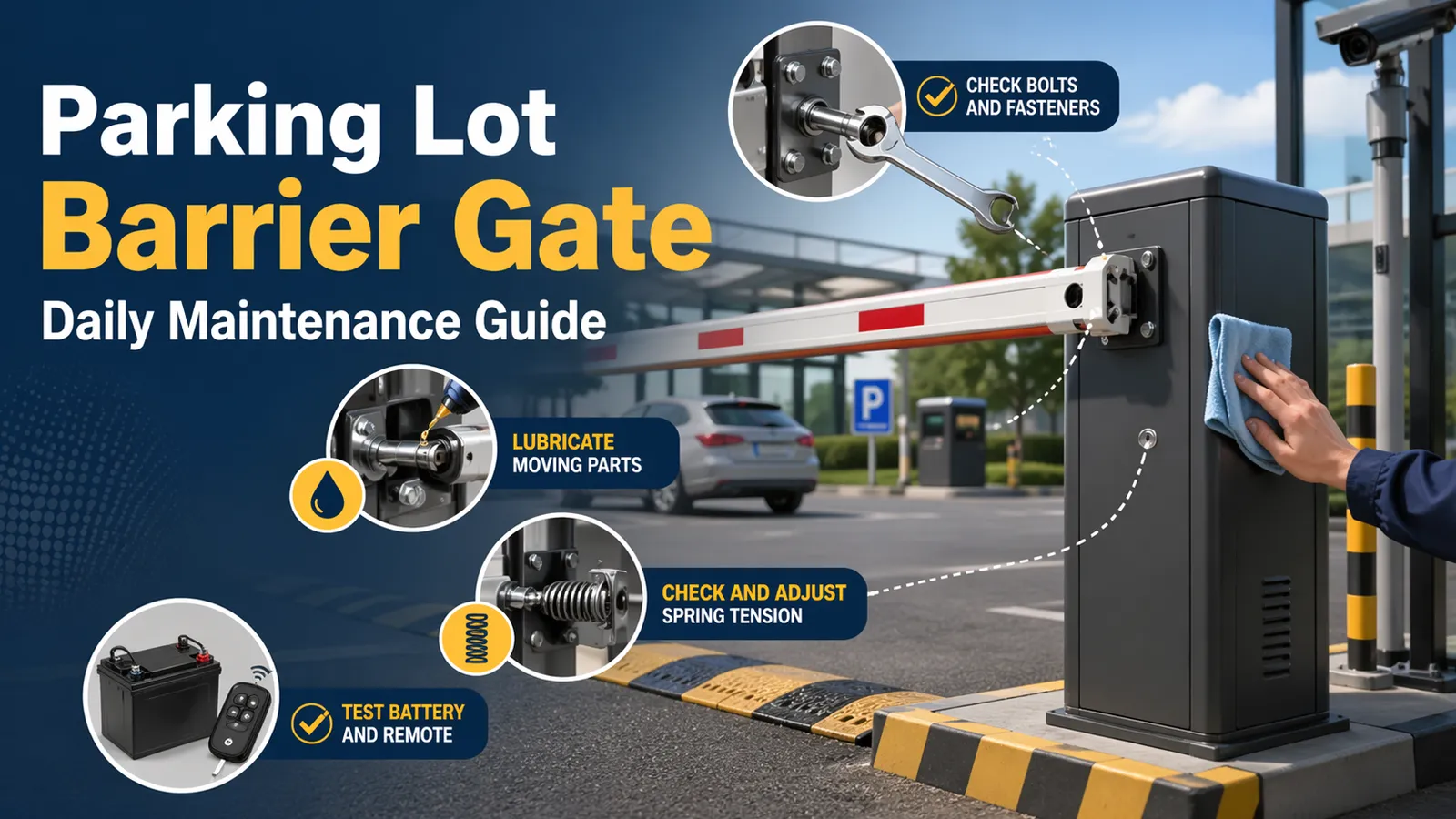
Parking lot barrier gates are essential equipment in modern parking areas. Because they usually work outdoors for long hours, they are exposed to dust, rain, heat, vibration, and frequent opening and closing. Regular maintenance is one of the most effective ways to keep the barrier gate stable, safe, and reliable. Manufacturer manuals commonly recommend routine cleaning, monthly fastener checks, periodic lubrication, spring balance inspection, and scheduled professional servicing.
In simple terms, good maintenance does two things: it reduces unexpected breakdowns and helps the barrier gate keep working smoothly over time. A daily guide does not mean taking the machine apart every day. It means doing a few quick checks regularly and following a clear monthly and quarterly schedule.
Safety note: Before opening the barrier housing or touching internal parts, disconnect the power supply first. Manuals also warn that spring adjustment, internal repairs, and work around moving parts should be handled by qualified technicians because of crushing and injury risks.
Why Daily Maintenance Matters for Parking Lot Barrier Gates
A barrier gate may look simple from the outside, but it depends on the correct coordination of the arm, spring, motor, fasteners, and control system. If one part becomes loose, worn, dirty, or unbalanced, the whole barrier can start working incorrectly. In many cases, small problems appear first as slow movement, unusual noise, inaccurate stopping, or unstable opening and closing. Regular inspection helps catch these problems before they become serious failures.
Inspect Fasteners Every Month
The first key point is to check all fasteners once a month. This includes screws, bolts, anchors, and other fixed connection points on the cabinet, arm bracket, and base. One barrier-gate user manual specifically says to check fasteners monthly for loose or falling-off conditions and tighten them in time. Another manual also warns that insufficient fixing of the housing, arm, or anchors can create safety risks.
Loose fasteners can cause inaccurate barrier arm positioning, extra vibration, and unstable movement. If left untreated, they may also lead to wear on other parts. During inspection, tighten any loose connection immediately. If you see damaged threads, cracked brackets, or a shifting base, stop using the barrier and ask a technician to inspect it.
Keep the Barrier Gate Housing Clean
The second important job is cleaning. The barrier housing should be kept clean so dust, mud, leaves, and water stains do not build up on the surface. Dahua’s user manual recommends using a soft, dry, clean cloth with a small amount of neutral detergent and also states that dust and debris should be removed frequently to keep the casing clean.
A clean cabinet does more than improve appearance. It also makes it easier to notice early rust, paint damage, loose screws, or water entry around the housing. For sites with heavy traffic or outdoor exposure, a quick wipe-down and visual check should be part of the regular routine. At the same time, keep the lane area clear so the barrier arm can move without obstruction.
Lubricate Moving Parts Every Three Months
The third maintenance point is lubrication. The movable connection parts of the barrier gate should be lubricated every three months so the system can stay in good working condition. This is also a recommendation stated directly in manufacturer guidance.
Lubrication helps reduce friction and wear in the moving joints. When these parts run dry, the barrier may become noisy, less smooth, or slower than normal. However, lubrication should be applied to the correct mechanical connection points only. Do not apply oil carelessly to electrical components, control boards, or non-lubricated parts. If you are unsure which points need lubricant, follow the product manual or ask a technician.
Check and Adjust the Balance Spring
The fourth key point is spring balance. The balance spring plays a major role in keeping the barrier arm stable during opening and closing. Manufacturer manuals explain that the barrier arm and spring are matched to a balanced condition, and they also advise users to inspect springs, cables, and supports for wear, damage, or imbalance. One manual recommends checking the balance spring after 30,000 operating cycles and making balance adjustments in time.
If the spring becomes deformed or unbalanced, the barrier arm may rise too slowly, drop too quickly, stop in the wrong position, or place extra stress on the motor. If you notice these signs, do not continue forcing the barrier to run. Switch off the power and arrange professional inspection. Manuals also note that after adjusting force or travel limits, the barrier system should be retested properly.
Check the Main Unit and Remote Control Batteries
The fifth point is power status. If the barrier uses backup batteries or battery-supported controls, check that they are in normal condition and replace them with the same recommended type when needed. Manufacturer guidance also includes battery safety warnings and recommends using the correct model during replacement.
For remote controls, battery power should be checked regularly as well. In Dahua’s troubleshooting guidance, a remote battery running out of power is listed as one possible reason why the remote cannot control the barrier arm even when the controller still works. If the remote becomes weak or stops responding, first check the battery condition before assuming there is a larger system fault.
Arrange Professional Inspection Every Six Months
Daily and monthly checks are important, but they are not enough on their own. A professional inspection every six months is strongly recommended. Dahua’s manual advises consulting professionals every six months to inspect wear parts and replace them in time, while other barrier manuals also state that repairs to barrier hardware should be done by qualified service personnel.
A proper service visit should include inspection of wearing parts, internal connections, manual release functions, and other safety-related items. Preventive maintenance checklists for powered barriers commonly include cleaning and lubrication, checking fixings, testing manual release, verifying warning devices and sensors, and reviewing wiring and electrical connections.
Recommended Barrier Gate Maintenance Schedule
| Maintenance item | Recommended frequency | Purpose |
|---|---|---|
| Observe one full open/close cycle and check for unusual noise or unstable movement | Daily or before peak operation | Find obvious faults early |
| Clean the housing surface and remove dust or debris | Daily to weekly | Keep the unit clean and make defects easier to spot |
| Check screws, bolts, anchors, and other fasteners | Monthly | Prevent inaccurate positioning and vibration |
| Lubricate movable connection parts | Every 3 months | Reduce friction and wear |
| Check spring balance and arm condition | Regularly, and after high cycle use | Keep movement stable and reduce stress on the motor |
| Inspect batteries in remotes and any backup power system | Regularly | Avoid sudden control failure |
| Professional inspection of wear parts and internal systems | Every 6 months | Improve safety and long-term reliability |
The schedule above combines routine operator checks with the maintenance intervals commonly stated in manufacturer manuals, including monthly fastener checks, three-month lubrication, spring inspection, and six-month professional servicing.
Common Maintenance Problems and Quick Solutions
| Problem | Possible cause | Recommended action |
|---|---|---|
| Barrier arm position is inaccurate | Loose fasteners or balance issue | Tighten fasteners and inspect spring balance |
| Barrier moves with unusual noise | Lack of lubrication or worn connection parts | Lubricate correct moving points and inspect for wear |
| Barrier arm opens or closes unevenly | Spring deformation or imbalance | Stop operation and ask a technician to adjust it |
| Remote control does not work | Battery power is low or battery is out of position | Check and replace the remote battery |
| Barrier looks old or rusty | Dust, moisture, and poor cleaning routine | Clean housing regularly and check surface condition |
These examples reflect common issues described in manufacturer troubleshooting and maintenance guidance, especially loose fasteners, remote battery faults, insufficient lubrication, and spring-related problems.
Conclusion
Parking lot barrier gate maintenance is not complicated, but it must be done consistently. Checking fasteners, keeping the housing clean, lubricating moving parts, inspecting the balance spring, and checking battery condition are all basic tasks that help the barrier operate more smoothly. When these routine checks are combined with professional service every six months, the barrier gate is more likely to stay safe, stable, and dependable for long-term use.
FAQ
How often should a parking lot barrier gate be inspected?
A quick visual and operating check can be done daily, while fasteners should be checked monthly and professional servicing should be arranged every six months.
Can users lubricate the barrier gate themselves?
Basic lubrication of the correct movable connection points can usually be done on schedule, but internal repairs and unclear maintenance points should be handled by professionals.
How do I know the balance spring needs adjustment?
Common signs include unstable arm movement, incorrect stopping position, or obvious imbalance during operation. Springs and supports should be inspected regularly for wear or damage.
What should I do before opening the barrier housing?
Disconnect the power supply first. Manuals clearly warn against working inside the housing while power is on.
Why does the remote control suddenly stop working?
A depleted remote battery is one common reason. Check the battery first before investigating ot